Labour MP and challenger for Leader of the Labour party, Andy Burnham, (L) acknowledges the applause after delivering a speech in Manchester, northern England, on June 29, 2026.
'Westminster is broken': Andy Burnham unveils sweeping plan to shift power out of London ahead of expected rise to UK leadership
Devolution drive aims to put regions in control of services and growth
Last updated:
5 MIN READ
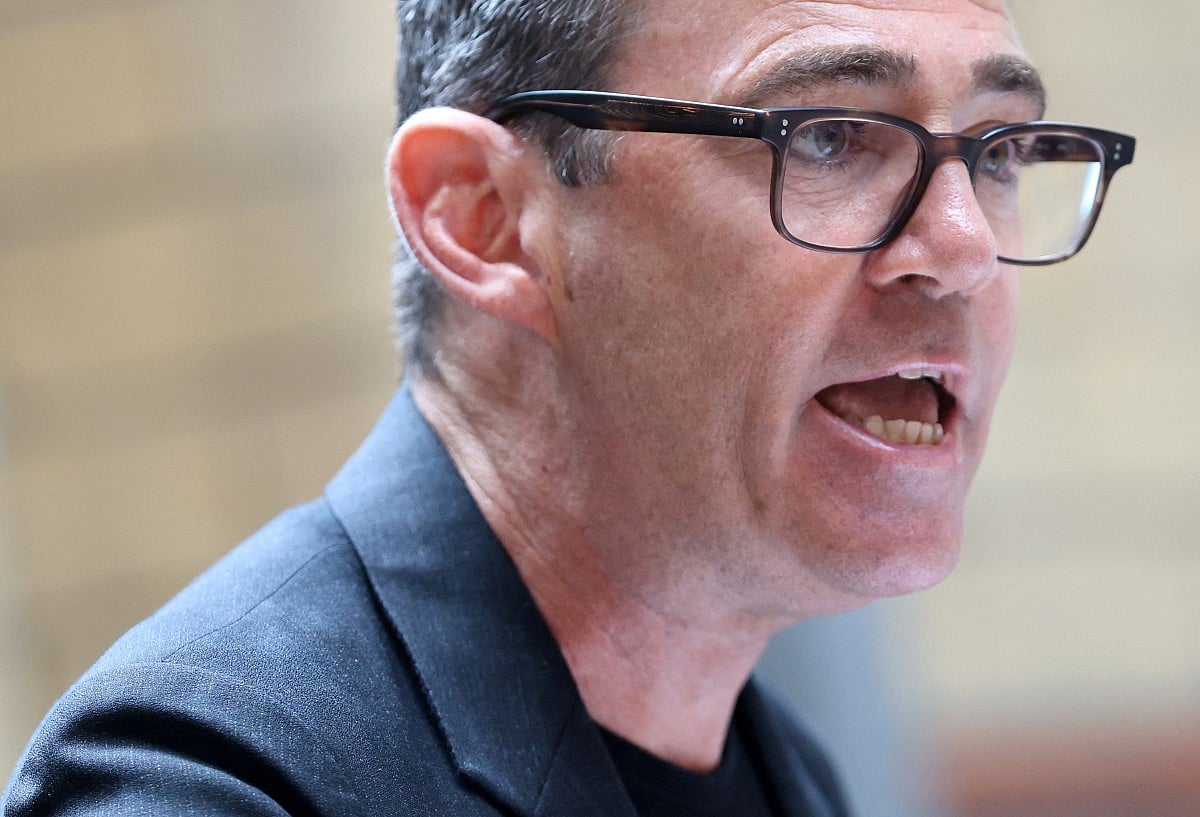
Labour MP and challenger for Leader of the Labour party, Andy Burnham, delivers a speech in Manchester, northern England, on June 29, 2026.
AFP
Manchester, England: Andy Burnham has laid out an ambitious blueprint to decentralise power from London, promising the biggest transfer of authority to England's regions in generations as the Labour heavyweight positioned himself to become Britain's next prime minister.
Speaking Monday in Manchester, where he has served as mayor since 2017, Burnham pledged to reshape the way Britain is governed by moving decision-making closer to local communities, arguing that the country's highly centralised political system has failed to deliver sustained economic growth.
"I am going to give Britain the circuit breaker it needs," Burnham told an invited audience in Manchester, pledging to put power "in the hands of the people and places who can use it best".
Andy Burnham, 56, is currently the only candidate to replace Starmer, who resigned as Labour leader and prime minister earlier this month -- he pledged to devolve greater powers to regional mayors.
"We need a new determination to raise living standards of every single person in this land," he added.
"And we must accept that to do that, to fix the economy and the country, we need to change politics and we need to do it now."
Likely successor to Keir Starmer
His address came days after Prime Minister Keir Starmer announced he would step down as Labour leader after two years in office, opening the door for Burnham, 56, to emerge as the party's frontrunner.
If unopposed, he could formally succeed Starmer as early as July 17.
Burnham used the speech to outline what he called a "new direction" for Britain, drawing on Manchester's economic resurgence — supported in part by major international investment, including from Abu Dhabi — as a model for regional development.
At the centre of his proposals is the creation of a "No. 10 North," a permanent government presence outside London that would serve as the operational hub for a more decentralised state.
"No. 10 North will support the regions on three clear tasks: reform of essential utilities, reindustrialisation and the regeneration of places," Burnham said.
Under the proposal, local and regional authorities would gain broader powers over essential public services, including water, housing, energy and transportation.
"It would mean regions would be able to take greater public control of essential services like water, housing, energy, and transport," he said.
Burnham argued that Britain's economic model has become overly dependent on decisions made in Whitehall, the heart of the U.K. civil service, and called for a bottom-up approach to national development.
"It is time for Whitehall to accept that growth cannot be ordered from the top down. Instead, it can only be nurtured from the bottom up," he said.
Describing the political system as dysfunctional, Burnham said Westminster had become incapable of addressing many of the country's long-standing economic challenges.
"Westminster is broken," he said, arguing that Britain has become "stuck in a rut."
He also pledged to work across party lines if he becomes prime minister, acknowledging the increasingly fragmented nature of British politics.
"I will reach out to other parties," Burnham said, describing Westminster as "fragmented" and "disjointed."
Tackling youth unemployment
His broader economic platform includes tackling youth unemployment, expanding regional investment and launching what he described as the largest council house-building program since the years immediately following World War II.
"I am going to give Britain the circuit-breaker it needs," Burnham said. "The country spends too much time arguing and not enough time doing."
Burnham's speech follows a period of growing political uncertainty for Labour.
Although the party remains in government, recent opinion polls have shown it trailing Nigel Farage's Reform UK, while Burnham's strong performance in the recent Makerfield by-election has strengthened his standing within the party.
Long regarded as one of Labour's most influential regional leaders, Burnham has built his political reputation around expanding devolution and strengthening local government.
Monday's address signaled that, if he becomes prime minister, he intends to make those principles the centerpiece of his national agenda.
Assailed by oppposition
Opposition leaders criticised the speech.
"He doesn't have a plan beyond telling mayors to go and sort it out," said Kemi Badenoch, leader of the main opposition Conservatives.
Robert Jenrick of the hard-right Reform UK party, which has led national opinion polls for more than a year, said the British public wanted "radical change now".
"People can't wait 10 years," he told the GB News television station, after Burnham promised "a 10-year mission to raise living standards across the land".
'Streamlined state'
Delivering his speech from a Manchester museum, Burnham described Britain as "one of the most over-centralised countries in the world".
Starmer, who became prime minister in July 2024 after Labour won an election landslide, announced his resignation last Monday. If no challenger comes forward to replace him, Burnham could be prime minister as early as mid-July.
Burnham would inherit a British economy that ruling centre-left Labour vowed to revitalise when it won power in July 2024 after 14 years in opposition.
After a tough 18 months, growth showed signs of picking up until the Middle East war hindered progress and pushed up inflation.
Burnham used his speech to pledge fiscal discipline and to reduce the country's ballooning welfare bill, having already sought to calm markets by committing to the government's current borrowing limits.
He proposed the creation of a "No. 10 North" to coordinate the devolution -- a play on words on the prime minister's address at 10 Downing Street.
'Manchesterism'
Coining the phrase "Manchesterism", which he defines as business-friendly socialism, Burnham has railed against trickle-down economics and neo-liberalism.
Among his more defined economic beliefs is greater "public control" over services like transport, water and energy, though he was vague Monday on whether this meant full renationalisation of utilities.
Under Starmer, British railway operators were gradually re-entering public hands.
Burnham has positioned himself as a champion for small businesses and proposed cutting business rates for pubs and music venues.
"I will back our scientists, technologists, entrepreneurs, and creatives, as I have done here (in Manchester), and show how Britain will be the innovation nation of the next decade," he said Monday.
Rain Newton-Smith, head of British employers' lobby group, the CBI, said "business leaders will be encouraged by efforts to use the levers of devolution to spread prosperity across the country".
In the days since Starmer resigned, speculation has been rife about who Burnham will appoint as finance minister.
Rachel Reeves has served as chancellor of the exchequer since Labour returned to power almost two years ago but reportedly faces the axe if Burnham takes office.
Sign up for the Daily Briefing
Get the latest news and updates straight to your inbox
Network Links
GN StoreAbout Gulf NewsTerms & ConditionsReach by GNSitemapContact usPrivacy PolicyGN FocusHave your sayWork with usAdvertise with usGulf News epaperPrinting Services
Download our app
© Al Nisr Publishing LLC 2026. All rights reserved.