Scientists discover bizarre microbe that 'gives birth' by bursting itself open
Scientists watched new cells grow inside a mother cell before it ruptured to release them
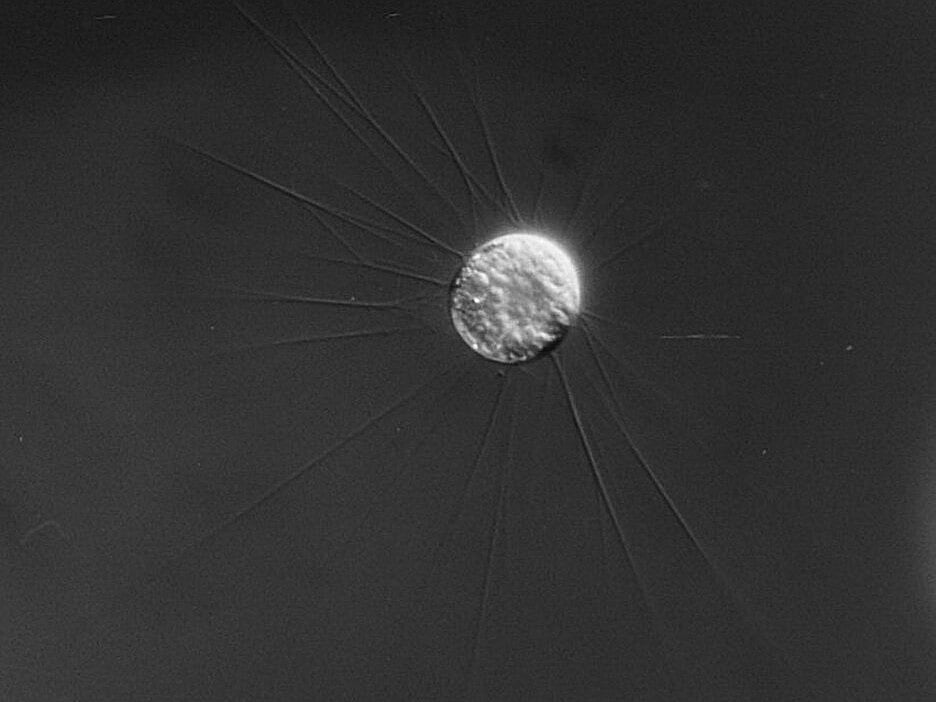
Scientists studying a tiny marine organism found in Scotland expected to see its cells reproduce in familiar ways.
Instead, they watched something that reminded them of a science-fiction film.
Get updated faster and for FREE: Download the Gulf News app now - simply click here.
The microscopic creature grows new cells inside its own body. When those offspring are ready, the outer mother cell ruptures, releasing them.
And there is an even stranger twist: some of the daughter cells can already contain another developing generation.
Researchers jokingly describe them as “pregnant grandmothers.”
The unusual behaviour belongs to a newly described microorganism called Caledochytrium aldermanii, and scientists say they have not previously seen this reproductive strategy in its group. The findings were published in the peer-reviewed journal Protist.
Scientists couldn't believe what they were seeing
Caledochytrium aldermanii belongs to a group of marine microorganisms called Labyrinthulomycetes.
They are tiny but environmentally useful creatures, helping break down dead plant and animal material in seas and other salty environments.
Normally, scientists might expect a cell to reproduce by dividing or producing spores.
But researchers studying C. aldermanii under microscopes observed something very different.
A mature cell develops a large chamber inside itself. One or more completely new daughter cells then form within that chamber.
Eventually, the mother cell breaks open, releasing the offspring.
Professor Peter Morris of Heriot-Watt University said some daughter cells already contain another generation developing inside them before they have even emerged.
The team compared the arrangement with species of greenfly that can be born already carrying the next generation.
The discovery took decades
The finding also demonstrates why simply sequencing an organism's DNA doesn't reveal everything about how it lives.
Dr Jane Polglase has been studying this group of microorganisms for nearly 50 years.
Her team combined modern analysis with the decidedly traditional approach of closely observing the microbes under microscopes.
It was when researchers captured their reproduction using an electron microscope that they realised something unusual was happening.
“If we had not done that, we never would have captured this peculiar reproductive process on camera,” Polglase said.
The scientific paper confirms that daughter cells form inside a vacuole in the mature cell and are released when the mother cell ruptures. It also records cases in which the daughter cell already contains a third-generation cell.
Why is it called Caledochytrium?
The scientists named the organism Caledochytrium aldermanii.
“Caledo” refers to Caledonia, the Latin name associated with Scotland, where researchers found the organism on three occasions.
The second part honours Dr David Alderman, a scientist at the UK's Centre for Environment, Fisheries and Aquaculture Science who helped keep the early cultures alive.
Researchers have found the microorganism in some distinctly Scottish settings.
It has been associated with octopuses and their lairs, with rainbow trout, and, independently, in a salt marsh on Scotland's east coast.
Tiny creatures doing an important job
The bizarre reproduction isn't the only reason scientists are interested in these organisms.
Labyrinthulomycetes act as recyclers in marine ecosystems, breaking down organic material and returning nutrients to the environment.
C. aldermanii also produces a membrane network known as an ectoplasmic net, which it uses for movement, feeding and buoyancy.
When the organism moves, parts of this network can remain behind on surfaces. Marine larvae can then feed on the material, helping move proteins and fats further up the food chain.
Researchers also found that C. aldermanii has several other ways of reproducing and dispersing, including different types of spores — making its life cycle even more complicated than the bursting-cell behaviour alone suggests.
Could the microbe eventually be useful to humans?
There may also be commercial potential.
Scientists are interested in Labyrinthulomycetes because some naturally produce high concentrations of omega-3 fatty acids, including DHA, a nutrient commonly associated with oily fish.
The researchers say C. aldermanii could potentially contribute to the production of omega-3 oils and carotenoids — pigments used in products including food supplements, infant formula and aquaculture.
Its cells are also approximately 50 per cent protein, according to the research team.
Those possibilities remain potential applications rather than products ready for commercial use.
The more immediate finding is biological: even in 2026, researchers can still encounter forms of microscopic life behaving in ways science has not previously documented.
And in this case, scientists only discovered the trick because they kept watching.
Inside one tiny cell, another generation was growing — sometimes with the generation after that already inside it — waiting for the outer cell to burst open.
Network Links
GN StoreDownload our app
© Al Nisr Publishing LLC 2026. All rights reserved.