Scientists create a ‘Little Big Bang’ to study how the early Universe formed
Oxygen and neon crashes show small particles can mimic Big Bang conditions
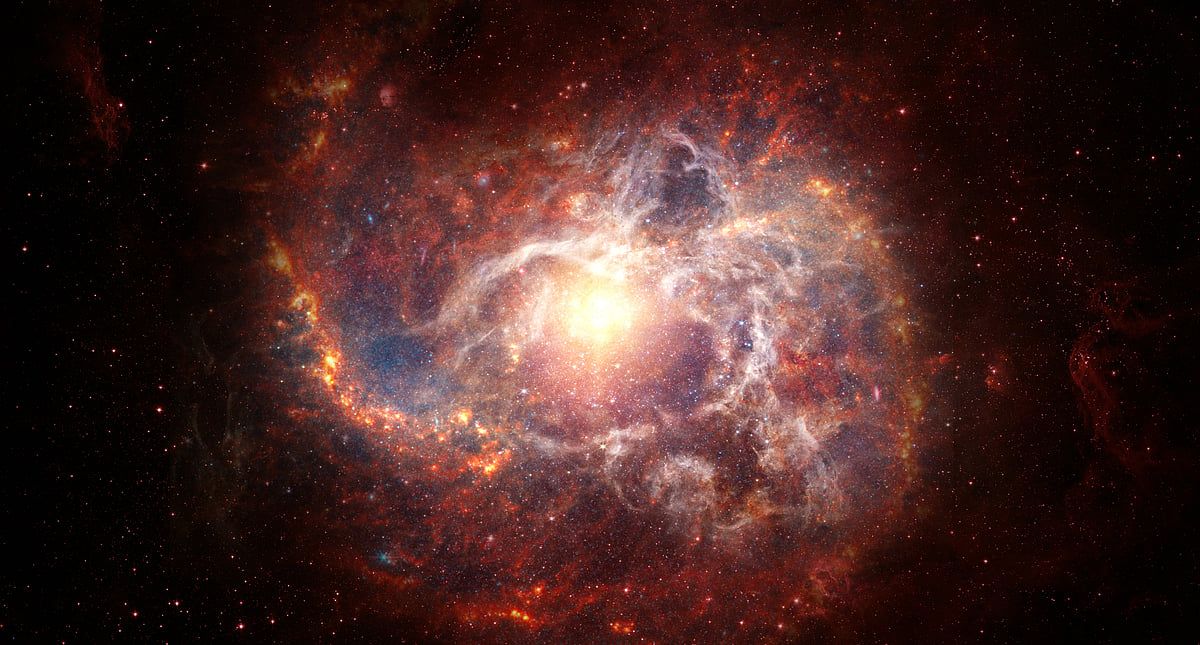
Dubai: Scientists in Europe have successfully created a tiny “Big Bang” by smashing lightweight atomic nuclei together, replicating conditions that existed in the early Universe.
Researchers from the Niels Bohr Institute at the University of Copenhagen and the international ALICE collaboration working at CERN created the miniature "Little Big Bang" together.
The experiment collided oxygen-16 and neon-20 nuclei at near-light speeds. The result created an impact which a microscopic amount of quark-gluon plasma (QGP).
Get updated faster and for FREE: Download the Gulf News app now - simply click here.
Quark-gluon plasma is an extremely hot and dense state of matter that existed during the first millionth of a second after the Big Bang, ScienceDaily, explained. At that time, the Universe was so hot that protons and neutrons had not yet formed. Instead, their building blocks – quarks and gluons – moved freely in a kind of hot “soup”.
The University of Copenhagen Faculty of Science explained that as the Universe expanded and cooled, quarks and gluons gradually became bound together to form, among other things, protons and neutrons. These later became the building blocks of atomic nuclei and, ultimately, the ordinary matter that makes up stars, planets and ourselves.
The breakthrough is significant because past experiments required heavy elements such as lead to create this plasma. The latest test shows that much smaller atomic nuclei can also generate extreme conditions similar to those of the early Universe.
Studying these micro-collisions helps physicists understand how pure energy cooled and transformed into the protons, neutrons and atoms that make up the world today.
Despite the small size of the oxygen and neon nuclei, the scientists found that the collisions produced signals consistent with the behaviour expected from QGP. For an instant, the generated matter appeared to expand collectively like a fluid before cooling and reverting to particles, Wired reported.
The research findings, produced as part of the international ALICE experiment, were published in the journal Physical Review Letters in August.
“We have pushed the boundary for how small the atomic nuclei can be while still recreating this primordial matter – what you could call a Little Big Bang. We now know more about the fundamental conditions required for matter to transition into this extreme state,” said Associate Professor You Zhou, who led the experiment and until recently was employed at the Niels Bohr Institute at the University of Copenhagen, in a press release.
He added: “Hopefully, this will help us better understand how the plasma behaved during the first moments of the Universe – and how it later evolved into the forms of matter that everything around us is made of.”
Network Links
GN StoreDownload our app
© Al Nisr Publishing LLC 2026. All rights reserved.