It is not news to anyone that the United States and the international community have recently experienced some rough weeks in Afghanistan. But if there is a silver lining to the clouds hanging over the American-led war effort here, it is that the terrible recent events — the unintentional burning of Qurans by American forces and ensuing civil unrest, the revenge killings of US and other international forces by "friendly" Afghan soldiers, and the horrific murders of 17 Afghan villagers allegedly committed by a US Army sergeant — have provided a measure of Afghanistan's progress, and of the importance of a continuing international commitment.
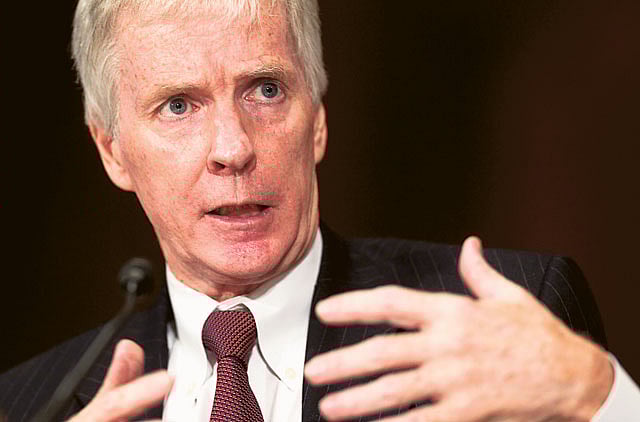
That is the message of the US ambassador in Kabul, Ryan Crocker, who counters reports of doom for the US mission in Afghanistan with evidence of progress — even as he warns of the consequences for America's national security of giving in to war fatigue and pulling out.
"We've had a rough fall, a rough winter — and we are having a rough spring," acknowledges Ambassador Crocker, who then shifts focus to two signs of a stronger, more mature Afghanistan as revealed by the recent trial by fire.
First, the Afghan security forces that Nato and other international partners are training to take over command of the country's security kept control of an explosive domestic climate after the Quran burnings, protecting both Afghans and foreign forces with minimal loss of life. "It was Afghan security forces who stepped up … They protected Afghan lives, and they protected American lives [and] the lives of others from the international community," he says, noting that 30 Afghans were reported to have died in the days of unrest.
Second, Crocker underscores the fact that, despite some turbulence, the US-Afghanistan negotiations towards reaching a Strategic Partnership Agreement — the framework that will determine America's military role in Afghanistan after 2014 — weathered the trying events and are moving forward. "We're making significant headway" in negotiations, he says, "and we're doing it under particularly difficult conditions".
Crocker says such signposts of progress should encourage both the US and the international community to muster the "strategic patience" that will be necessary for sticking with a country that may seem to be progressing slowly — but which to abandon would be to open the way to potential recurrences of the 9/11 tragedy.
The two countries have settled the thorny issue of the conditions for handing over about 3,000 detainees in US custody to Afghan authority, while the question of night raids by foreign forces is still under discussion. The night raids — troops entering sleeping villages to ferret out insurgents and suspected terrorists — are particularly unpopular among Afghans, and they raise the ire of Afghan President Hamid Karzai, who considers them a stab at Afghan sovereignty. But US military commanders consider the tactic an essential tool in the anti-Taliban effort, and the US insists on the ability to rely on the raids in the counterterrorism efforts it wants to continue after the international combat role ends in December 2014.
Some US and international military officials hint that an accord on night raids is likely, perhaps by assuaging Karzai's sovereignty concerns with a provision requiring a warrant from an Afghan judge. Crocker calls the Strategic Partnership Agreement, or SPA, "a powerful signal to the Taliban" that the international community will remain committed to Afghanistan into the future. Others say the SPA will be a reassuring sign to the international community and will help head off the "rush to the exits" that President Obama has warned against.
The strategic partnership negotiations are just one example of what Crocker calls the "really really hard" process of helping a country such as Afghanistan remake itself. He might add "expensive", too, although he notes that whatever financial commitment the US makes to Afghanistan in the years after the formal end of the combat mission will pale in comparison to the $12 billion (Dh44 billion) a year the US now spends.
But if Americans are tempted by the siren of a total pullout from Afghanistan, Crocker says they need to remember the 9/11 attacks and Al Qaida's command centre that brought the US here in the first place. "If we decide we're tired … they'll be back," he says, referring to Al Qaida. "We know what they did once. They haven't gotten any kinder or gentler in the decade."
Crocker — who has the "unique" perspective of having returned to Afghanistan after a first stint as ambassador in 2002 following the fall of the Taliban regime — says the country's progress is impressive but not irreversible, and requires an international commitment to sustain it.
Continuing improvements in the Afghan National Army and national police are one element. The Afghan security forces, which are now the primary providers of security to about half the country, should be able to expand to providing "immediate security" to about 75 per cent of Afghans by midsummer, Crocker says.
Other encouraging factors, he adds, are rising education rates, falling infant and maternal mortality rates in one of the world's poorest countries, development of a professional class of young leaders, and prospects for impressive economic gains from unexploited natural resources.
He also points to expanded women's rights, which he cites as a key priority for the US. Noting that some Afghan women have expressed fears of a rollback of women's advances in the event of a weakened international commitment, Crocker says neither young Afghans nor the US are about to let that happen.
"I know what my boss thinks about this," says Crocker, referring to Secretary of State Hillary Rodham Clinton's outspoken commitment to advancing Afghan women's rights. But he also says the female university students he meets here would never accept a reversion to the past.
Crocker offers a modest definition of the Afghanistan he believes should be the realistic goal of Afghans and the international community: "A basically secure, basically stable, basically democratic country that can look after its own interests."
-The Christian Science Monitor
Sign up for the Daily Briefing
Get the latest news and updates straight to your inbox
Network Links
GN StoreDownload our app
© Al Nisr Publishing LLC 2026. All rights reserved.