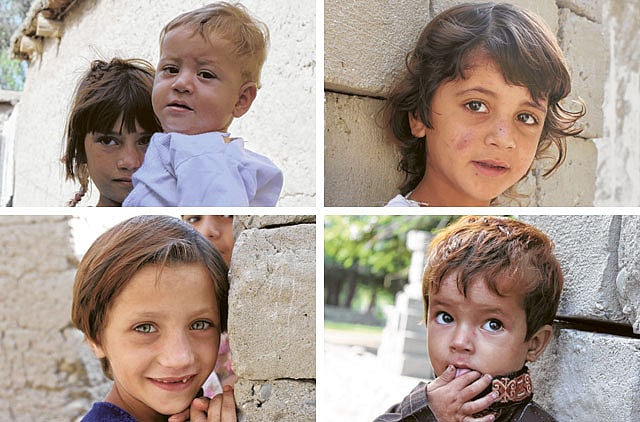
Kabul: Every year, almost 50,000 children in Afghanistan die from diarrhoea caused by drinking dirty water from the country's streams and rivers.
According to 2008 Unicef statistics, 311,000 children die every year in the troubled country. Preventable deaths from diarrhoea total 16 per cent of this.
Interactive on the clean water project in Afghanistan
Danish Committee for Aid to Afghan Refugees (Dacaar) figures show that less than 25 per cent of the rural population has access to safe drinking water.
Dacaar director Dr Arif Qaraeen told Gulf News from its Kabul headquarters: "Diarrhoea could be related to many factors, some of it bacteria, some of it giardia, some... other elements, which means that the water is not safe to drink, that's why the diarrhoea comes.
"In fact, one out of four children die because of diarrhoea every week, and that diarrhoea comes from water that is not suitable for drinking," he said.
Afghanistan's poor rural communities suffer from a lack of education. Families are illiterate and do not know that the conditions causing diarrhoea are coming from the dirty water they are drinking.
A simple solution
In the north-east Nangahar province, this problem is being addressed. After a survey was undertaken by Dacaar's provincial office in Jalalabad, it was found that more than 10,000 families didn't have access to clean water.
Haji Ameen, Provincial Manager, said from his Jalalabad office: "They need biosand filters, because they live near to the river [where] the strata is very hard... you can't dig tubing for a well near to the river". The biosand filter is a simply-constructed concrete column filled with various gradients of gravel and sand to form a biolayer.
This filters dirty river water, turning it into safe, drinkable water. Dirty water is poured into the top and clean water comes out of the bottom.
The filters are made and distributed by Dacaar as part of its water sanitation programme (WSP), which is coupled with a hygiene education programme.
Hygiene teachers visit different areas, giving communities practical demonstrations on how to wash clothes, and on personal hygiene, cooking safety and other topics such as illness.
A variety of techniques are used by the teachers, such as fabric flip charts with pictures suitable for illiterate communities. Each family is also given a hygiene kit containing basic essentials such as soap, shampoo, nail cutters, toothbrush, toothpaste and a small towel.
Sign up for the Daily Briefing
Get the latest news and updates straight to your inbox
Network Links
GN StoreDownload our app
© Al Nisr Publishing LLC 2026. All rights reserved.