US President Donald Trump greets Russian President Vladimir Putin, Aug. 15, 2025, at Joint Base Elmendorf-Richardson, Alaska. Political tensions, disagreements over China’s role, and the breakdown of broader US-Russia relations prevented a new deal.
US-Russia New START treaty expires: Is the world heading toward a dangerous nuclear arms race?
With nuclear limits gone, experts warn of rapid buildups and rising global risks
Last updated:
3 MIN READ
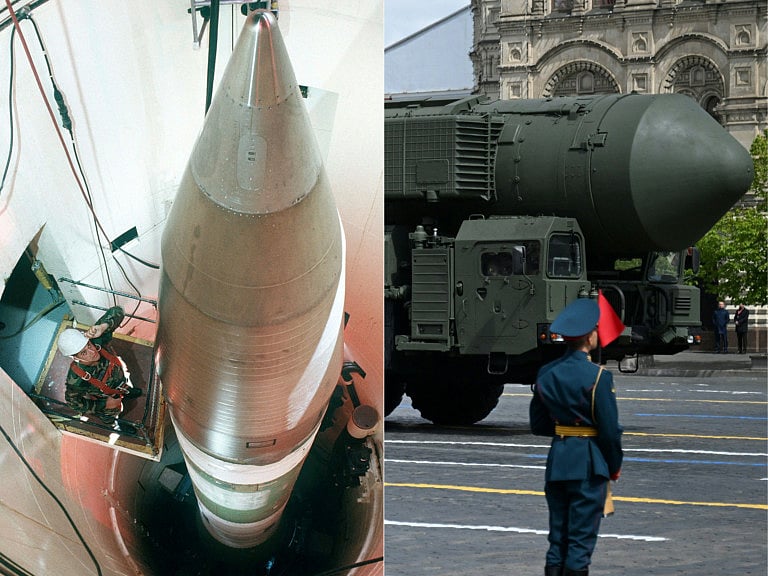
An Air Force technician inspecting an LGM-30G Minuteman III missile inside a silo about 60 miles from Grand Forks Air Force Base, in North Dakota. A RS-24 Yars intercontinental ballistic missile system drives across Red Square during the Victory Day military parade in central Moscow on May 9, 2025.. The last nuclear treaty between Russia and the United States expired on February 5, 2026, abruptly ending decades of restrictions on how many warheads the two top powers can deploy and triggering fears of a global arms race.
AFP file
Dubai: The expiration of the last remaining nuclear arms control treaty between the United States and Russia has triggered fresh fears of a global nuclear arms race, leaving the world’s two largest nuclear powers without formal limits on their arsenals for the first time in decades, CNN reported.
The treaty, known as New START, had capped the number of deployed nuclear warheads and delivery systems on both sides, while allowing inspections that reduced the risk of miscalculation and surprise escalation.
With its lapse, experts warn that Washington and Moscow are now free to rapidly expand their nuclear forces — at a time when China is also building up its arsenal.
US President Donald Trump has downplayed concerns, saying a better agreement could be reached, while insisting any future arms control must include China.
Russia, led by Vladimir Putin, has expressed frustration over Washington’s response to proposals for a temporary extension.
What happens if a new nuclear arms race begins?
Experts warn that the collapse of nuclear limits could trigger rapid competition between the United States, Russia and China, with serious global consequences.
Faster buildup of nuclear weapons: Both Washington and Moscow could quickly add more warheads to existing missiles, while China continues expanding its arsenal — dramatically increasing global nuclear stockpiles.
Loss of transparency: Without inspections and data-sharing, countries would have little visibility into each other’s nuclear forces, raising suspicion and fear.
Higher risk of miscalculation: Increased secrecy and military activity could lead to misunderstandings, accidents or escalation during crises.
Massive costs: Modernising and expanding nuclear arsenals would cost hundreds of billions of dollars over time.
Global ripple effects: Other nations may feel pressured to develop or expand their own nuclear weapons, weakening global non-proliferation efforts.
Meanwhile, US Secretary of State Marco Rubio has made clear that the US does not want to stick to the treaty’s limits unless Beijing joins talks — something China has repeatedly rejected.
With no replacement framework in sight, analysts warn the collapse of New START could mark the beginning of a dangerous new era of nuclear competition.
What was the New START treaty?
New START was a nuclear arms control agreement signed in 2010 and enforced from 2011.
It limited both the US and Russia to:
1,550 deployed nuclear warheads
700 deployed missiles and heavy bombers
800 total launch systems
It also allowed inspections to ensure compliance.
Why has it expired now?
The treaty was originally valid for 10 years and was extended once in 2021 for five more years, expiring in February 2026 with no option for further renewal.
Political tensions, disagreements over China’s role, and the breakdown of broader US-Russia relations prevented a new deal.
Why does the US want China included?
Washington argues that China is rapidly expanding its nuclear arsenal and could reach around 1,500 warheads by 2035.
US officials say arms control no longer makes sense if only the US and Russia are bound by limits.
China says its arsenal is far smaller and refuses trilateral talks.
What is Russia’s position?
Russia proposed maintaining the treaty’s limits temporarily but says the US did not respond properly.
Moscow now says it considers itself free from all obligations under the agreement.
Why are experts worried?
Without New START:
There are no legal limits on US and Russian nuclear forces
No inspections or transparency measures
Higher risk of rapid weapons buildup and miscalculation
Some experts warn Russia could expand faster than the US due to stronger production capacity.
5 THINGS TO KNOW
New START was the last major nuclear arms control treaty between the US and Russia
It capped warheads and missiles and allowed on-site inspections
It expired after a five-year extension with no replacement deal
The US wants China included in future agreements — Beijing refuses
Experts fear a three-way nuclear arms race between the US, Russia and China
TIMELINE: US-RUSSIA NUCLEAR ARMS CONTROL
2010 – New START treaty signed
2011 – Treaty enters into force
2021 – US and Russia extend treaty for five years
2022 – Pentagon warns China’s nuclear arsenal growing fast
2025 – Indirect US-Russia tensions rise over arms control
2026 – New START officially expires

A Senior Associate Editor with more than 30 years in the media, Stephen N.R. curates, edits and publishes impactful stories for Gulf News — both in print and online — focusing on Middle East politics, student issues and explainers on global topics. Stephen has spent most of his career in journalism, working behind the scenes — shaping headlines, editing copy and putting together newspaper pages with precision. For the past many years, he has brought that same dedication to the Gulf News digital team, where he curates stories, crafts explainers and helps keep both the web and print editions sharp and engaging.
Sign up for the Daily Briefing
Get the latest news and updates straight to your inbox
Network Links
GN StoreAbout Gulf NewsTerms & ConditionsReach by GNSitemapContact usPrivacy PolicyGN FocusHave your sayWork with usAdvertise with usGulf News epaperPrinting Services
Download our app
© Al Nisr Publishing LLC 2026. All rights reserved.