Trump warns US will sink any Iran boats that challenge blockade
Any Iranian attack boats that approach the American naval blockade would be 'destroyed'
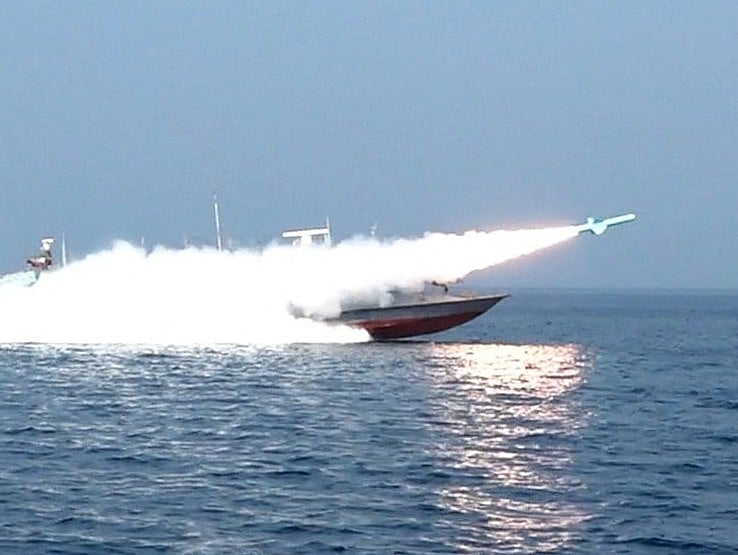
US President Donald Trump warned Monday that any Iranian attack boats that approach the American naval blockade around Iran's ports would be destroyed, despite international calls for a ceasefire to be respected and negotiations to resume.
The US military said the blockade, which took effect at 1400 GMT, applied to all ships leaving or seeking to dock at Iranian harbors.
In a social media post, Trump said the bulk of Iran's navy had already been destroyed during the war, but that if any of what he said were Tehran's few remaining "fast attack ships" approach the blockade "they will be immediately ELIMINATED."
He also said 34 ships had passed through the strait on Sunday, adding it was the most since the war began, though the figure could not be immediately corroborated.
Trump announced the blockade on Sunday after a delegation led by Vice President JD Vance returned from a meeting with Iranian officials in Pakistan without securing a deal to end the war, launched on February 28 with US and Israeli strikes on Tehran.
"I really think the ball is in the Iranian court, because we put a lot on the table. We actually made very clear what our red lines were," Vance told Fox News on Monday.
He said Washington must control Iran's enriched uranium, and that there must be a verification mechanism to ensure Tehran does not develop a nuclear weapon in the future.
2-week truce
Last Wednesday, the US and Iran agreed a two-week truce to allow the negotiations to go ahead, and mediator Pakistan and Gulf state Qatar were still calling on Monday for it to be respected as diplomatic efforts continue.
"The ceasefire is still holding and, as I speak, full efforts are underway to resolve the outstanding issues," Prime Minister Shehbaz Sharif of Pakistan told a cabinet meeting.
Speaking at the White House, Trump said Iranian representatives had called seeking to make a deal since the Islamabad talks failed, without identifying which officials had called.
Meanwhile, Iranian Foreign Minister Abbas Araghchi blamed the United States for the impasse in the talks during a call with his Saudi counterpart Prince Faisal bin Farhan.
"Unfortunately, we witnessed the continued excessive demands of the American side in the negotiations, which led to the failure to achieve a result," his ministry quoted him as saying.
Freedom of navigation
Qatari Foreign Minister and Premier Sheikh Mohammed bin Abdulrahman Al Thani urged both sides to guarantee freedom of navigation and refrain from using maritime routes "as a tool for pressure," encouraging Tehran and Washington to remain in touch with mediators.
Iran had already closed the strait to what it regards as enemy shipping, allowing only vessels serving countries it deems friendly -- such as China -- to cross.
Analysts suggested the US president was trying to starve Iran of funds but also pressure Beijing, the biggest buyer of Iranian oil, to lean on Tehran to reopen Hormuz.
Beijing criticized the blockade, with foreign ministry spokesman Guo Jiakun emphasizing the strait's importance to trade and saying that "maintaining its security, stability, and unimpeded flow is in the common interest of the international community."
UN chief Antonio Guterres also called for freedom of navigation to be respected and pointed to the mariners trapped in the Gulf.
"We need to remember that some 20,000 seafarers have been caught up in this conflict and are currently stranded on ships, facing increasing hardships daily," his spokesman Stephane Dujarric said.
US Central Command said the blockade included "vessels of all nations entering or departing Iranian ports and coastal areas, including all Iranian ports on the Arabian Gulf and Gulf of Oman."
US forces would not impede vessels transiting the strait to and from non-Iranian ports, it added.
Iran's military command issued a statement branding the blockade an act of piracy, and warned that if the security of its harbors "is threatened, no port in the Persian Gulf and the Arabian Sea will be safe".
French President Emmanuel Macron said that France and Britain would host a conference with countries prepared to join a "peaceful multinational mission" to secure the strait, but it would be "strictly defensive" and only operational once circumstances permit.
Russian offer
Iran's parliament speaker Mohammad Bagher Ghalibaf, who led Tehran's delegation in Pakistan, has said Tehran will "not bow to any threats," while navy chief Shahram Irani has called Trump's blockade "ridiculous."
The strait was far from the only friction point impeding efforts to end the war.
The US delegation in Islamabad -- led by Vance, special envoy Steve Witkoff and Trump's son-in-law Jared Kushner -- was frustrated by Iran's refusal to give up what it insists is a civilian nuclear program.
Russia has offered to hold Iran's enriched uranium safely as part of any deal.
"The offer still stands, but has not been acted upon," Kremlin spokesman Dmitry Peskov told reporters.
Sign up for the Daily Briefing
Get the latest news and updates straight to your inbox
Network Links
GN StoreDownload our app
© Al Nisr Publishing LLC 2026. All rights reserved.