UAE skywatchers, look up: Harvest Moon and Saturn to light up weekend skies
September’s full Moon rises over the UAE this weekend with Saturn close by
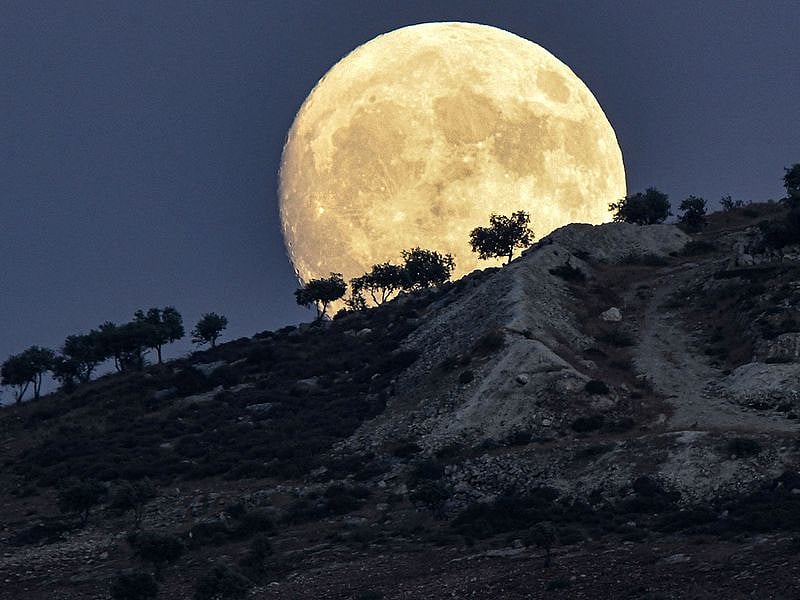
Dubai: UAE residents have a special reason to look up on Saturday night as September’s full Moon rises over the country, bringing the 2026 Harvest Moon together with the ringed planet Saturn.
The full Moon reaches its exact phase at 8.49pm UAE time on Saturday, September 26, but skywatchers will not have to wait that long to enjoy the spectacle. The Moon will rise around sunset, giving residents a chance to watch it climb into the eastern sky as darkness settles.
In Dubai, the Harvest Moon will rise at around 5.54pm on Saturday, shortly before sunset at 6.11pm, according to Timeanddate. The Moon will climb into the eastern sky as daylight fades, while Saturn will appear nearby, creating a striking pairing that can be seen with the naked eye.
UAE skywatchers, look up: Harvest Moon and Saturn to light up Saturday
Strap: September’s full Moon rises over the UAE with Saturn close by
Dubai: UAE residents can look forward to a striking celestial display this weekend as September’s full Moon rises in the evening sky, bringing the 2026 Harvest Moon close to Saturn.
The full Moon will reach its exact phase at 8.49pm UAE time on Saturday, September 26. But there is no need to wait until then to see it.
In Dubai, the Harvest Moon will rise at around 5.54pm on Saturday, shortly before sunset at 6.11pm, according to Timeanddate. As daylight fades, the Moon will climb higher in the eastern sky, with Saturn appearing nearby and visible to the naked eye.
Why is it called the Harvest Moon?
The name comes from the full Moon's position in relation to the autumn equinox, which took place on September 23.
Traditionally, the Harvest Moon was important to farmers because the Moon rose relatively soon after sunset around this time of year. That meant several evenings in a row had extra natural light, giving farmers more time to gather crops after daylight hours.
The Harvest Moon does not always occur in September. It is defined as the full Moon closest to the autumn equinox, so in some years the October full Moon takes the title instead.
This year's September full Moon is also known as the Corn Moon, a traditional name linked to the harvest of corn in parts of North America.
Why the Moon can look huge at moonrise
One of the most eye-catching parts of the spectacle could happen before the Moon has even climbed high into the sky.
When the full Moon is close to the horizon, it can appear dramatically larger than when it is overhead. This is known as the Moon illusion.
The Moon itself has not suddenly grown. Instead, the presence of familiar objects such as buildings, trees and the horizon can influence how large our brains perceive it to be.
That makes moonrise a particularly good time for photographs, especially with the UAE's skyline or desert landscape in the foreground.
Look for an orange or reddish Moon
The Moon may also appear orange, amber or reddish when it first rises.
Its light has to travel through more of Earth's atmosphere when the Moon is low on the horizon. The atmosphere scatters shorter wavelengths of light more strongly, allowing more of the red and orange wavelengths to reach our eyes.
As the Moon rises higher, its colour should become paler and its familiar bright white appearance more noticeable.
Saturn will join the Moon
The Harvest Moon has a planetary companion this weekend.
Saturn will appear close to the Moon on September 26, creating an easy-to-spot pairing in the evening sky.
Look towards the east around sunset and after dark. The Moon will rise first, followed by Saturn, which should appear as a bright point of light nearby.
You do not need a telescope to spot Saturn, although binoculars or a telescope can reveal more detail.
On the following evening, September 27, the Moon and Saturn will still appear close together, although their positions will have shifted.
Is this a supermoon?
Being called a Harvest Moon does not automatically make it a supermoon.
A supermoon occurs when a full Moon coincides with the Moon being relatively close to Earth in its orbit. The Harvest Moon is instead defined by its proximity to the autumn equinox.
Some Harvest Moons can also be supermoons, but the two terms describe different things.
What else can UAE residents see?
September and early October offer several other opportunities for skywatchers.
Mercury and Venus can be spotted low in the western sky after sunset during late September. Venus is particularly bright and can be seen without optical equipment under suitable conditions.
The Moon will also pass close to the Pleiades star cluster on September 28, 29 and 30, while the red star Aldebaran — known as the Eye of the Bull — will appear in the same part of the sky.
On October 1, the Moon will appear near Aldebaran and the bright star Capella.
For early risers, October's morning sky will feature Jupiter and Mars before sunrise.
The Harvest Moon's unusual timing
There is another reason this full Moon has fascinated skywatchers for centuries.
Normally, the Moon rises about 50 minutes later each day on average. Around the autumn equinox in the Northern Hemisphere, however, the difference between successive moonrises becomes much smaller.
That means the Moon can continue appearing in the evening sky at a relatively similar time over several nights.
For ancient farming communities, that extra evening moonlight had a practical purpose. For modern UAE residents, it offers something rather different — a chance to step outside and enjoy a spectacular night-sky display.
How to watch the Harvest Moon in Dubai
Best viewing spot: Find a location with a clear eastern horizon and minimal obstructions.
Moonrise: The Harvest Moon will rise at around 5.54pm in Dubai on Saturday.
Sunset: Sunset is at 6.11pm, shortly after moonrise.
Full Moon: The Moon reaches its fullest phase at 8.49pm UAE time.
For photographers: Moonrise may offer the most striking views, as the low Moon can appear larger and take on orange or reddish tones.
Look for Saturn: As the sky darkens, Saturn will appear close to the Moon.
What to do: Look towards the east on Saturday evening for the Harvest Moon and Saturn.
With inputs from Agencies, NASA
Network Links
GN StoreDownload our app
© Al Nisr Publishing LLC 2026. All rights reserved.