Up to 100 meteors an hour in UAE: Why Perseids 2026 meteor shower is unlike any other
How to watch and capture this year's peak under a new moon, amid darkest skies since 2018
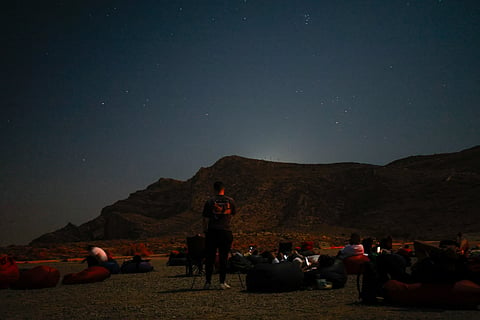
Dubai: UAE skywatchers are in for a treat this month, as the Perseid meteor shower reaches its peak on the night of August 12-13, bringing up to 100 meteors an hour blazing across the desert sky, according to the Dubai Astronomy Group.
This year's display arrives with a bonus: it also falls on a new moon, stripping away the moonlight that usually washes out the fainter streaks.
The Perseids occur every year when Earth ploughs through a trail of dust and ice left behind by Comet Swift-Tuttle, named after the constellation Perseus, from which the meteors appear to radiate.
As the debris burns up in the atmosphere at roughly 59 kilometres a second, it creates the bright, fast streaks, and occasional fireballs, that make the Perseids one of the most reliable shows of the year.
Peak night
The shower is active from mid-July to late August, but the real action unfolds on the night of Wednesday, August 12, running into the early hours of Thursday, August 13.
The best window is after midnight until dawn, once the shower's radiant climbs higher in the sky.
Why the new moon matters
This year's peak coincides almost exactly with a new moon on August 12, meaning there will be little to no moonlight competing with the meteors.
That darkness allows observers to catch even the faintest streaks that would otherwise be lost in the glow. Sky-tracking sites report it is the best moon condition for the Perseids since 2018, with the next comparably dark peak not expected again until later this decade.
The comet behind the scene
Behind the spectacle is Comet Swift-Tuttle, a periodic comet with a nucleus roughly 26 kilometres across, about twice the size of the object believed to have wiped out the dinosaurs.
It orbits the sun once every 133 years, last swinging close to Earth in 1992, and is not due back until 2126.
Despite its size, astronomers say it poses no threat to Earth for at least the next few thousand years.
A bonus sky show
The Perseids will not be travelling alone. The same nights offer a rare planetary lineup, with Saturn visible for much of the observation window and Mars rising before dawn. Uranus and Neptune are also technically in view, though both remain faint and hard to spot even through a telescope, explained DAG.
Adding to the lineup is Comet 10P/Tempel 2, a faint periodic visitor from the outer solar system that reaches its closest point to the sun on August 2 and may be spotted with binoculars or a telescope from a dark site.
"Every year, the Perseids remind us that astronomy is not only about distant planets and galaxies, but also about experiencing the universe directly above us. This year is particularly special because several celestial events will come together, creating a night that astronomy enthusiasts will remember for years," said Hasan Ahmad Al Hariri, chief executive officer of Dubai Astronomy Group.
The annual Perseids Meteor Shower, a moonless New Moon sky, a visible planetary lineup, and the appearance of Comet 10P/Tempel 2 will create a unique opportunity for skywatchers to experience multiple wonders of the universe in a single evening, he explained.
How to watch
No telescope or binoculars are needed to enjoy the Perseids, just a dark sky, a bit of patience and around 20 to 30 minutes for the eyes to adjust.
Head away from city lights, lie back for the widest possible view, and keep phone screens switched off, since bright light resets night vision.
Join the watch party
Dubai Astronomy Group will host a Perseids observation event at Al Khatim Desert in Abu Dhabi on the night of August 12, running from 11pm to 3am on August 13.
Tickets cost between Dh150 and Dh180, and the evening includes guided stargazing, telescope viewing of Saturn and Mars, constellation storytelling and an attempt to observe Comet 10P/Tempel 2.
Registration is open on Dubai Astronomy Group's website.
Photography tips
For those hoping to capture the show, Dubai Astronomy Group recommends a DSLR or mirrorless camera for full manual control over ISO, aperture and shutter speed.
A sturdy tripod keeps shots sharp, while a wide-angle lens covers more sky and improves the odds of catching a meteor. A remote shutter release or intervalometer helps avoid camera shake, and spare batteries are essential since long exposures drain power quickly.
In humid or cold conditions, a lens heater prevents condensation, while autofocus should be switched off in favour of manually focusing on a bright star, planet or infinity. Point the camera toward the radiant in Perseus, set the aperture to f/2.8 or lower, use a 15 to 30-second exposure, and adjust the ISO to 1600 or higher.


