Sheikh Zayed loved coffee, which in his gatherings embodied the values of generosity, Arab hospitality, and the preservation of authentic Emirati tradition.
The coffee once served in Sheikh Zayed's majlis, and the story behind every finjan of gahwa in UAE
The Founder's Office brings Sheikh Zayed's storied gahwa and Emirati hospitality to ADIHEX
Last updated:
6 MIN READ
Supplied
Dubai: The smell of cloves and freshly roasted beans has a way of announcing itself before anything else does. It was that same scent that once filled the majlis of the late Sheikh Zayed bin Sultan Al Nahyan, the UAE's Founding Father, where cup after cup of gahwa was poured for statesmen and neighbours alike, a quiet gesture of welcome that needed no words.
Get updated faster and for FREE: Download the Gulf News app now - simply click here.
This week, that very recipe, documented and preserved, has travelled to Hall 5 at ADNEC Centre Abu Dhabi, where The Founder's Office is sharing it with visitors at its pavilion during ADIHEX 2026, deep in the noise and colour of the exhibition.
The nation's oldest welcome
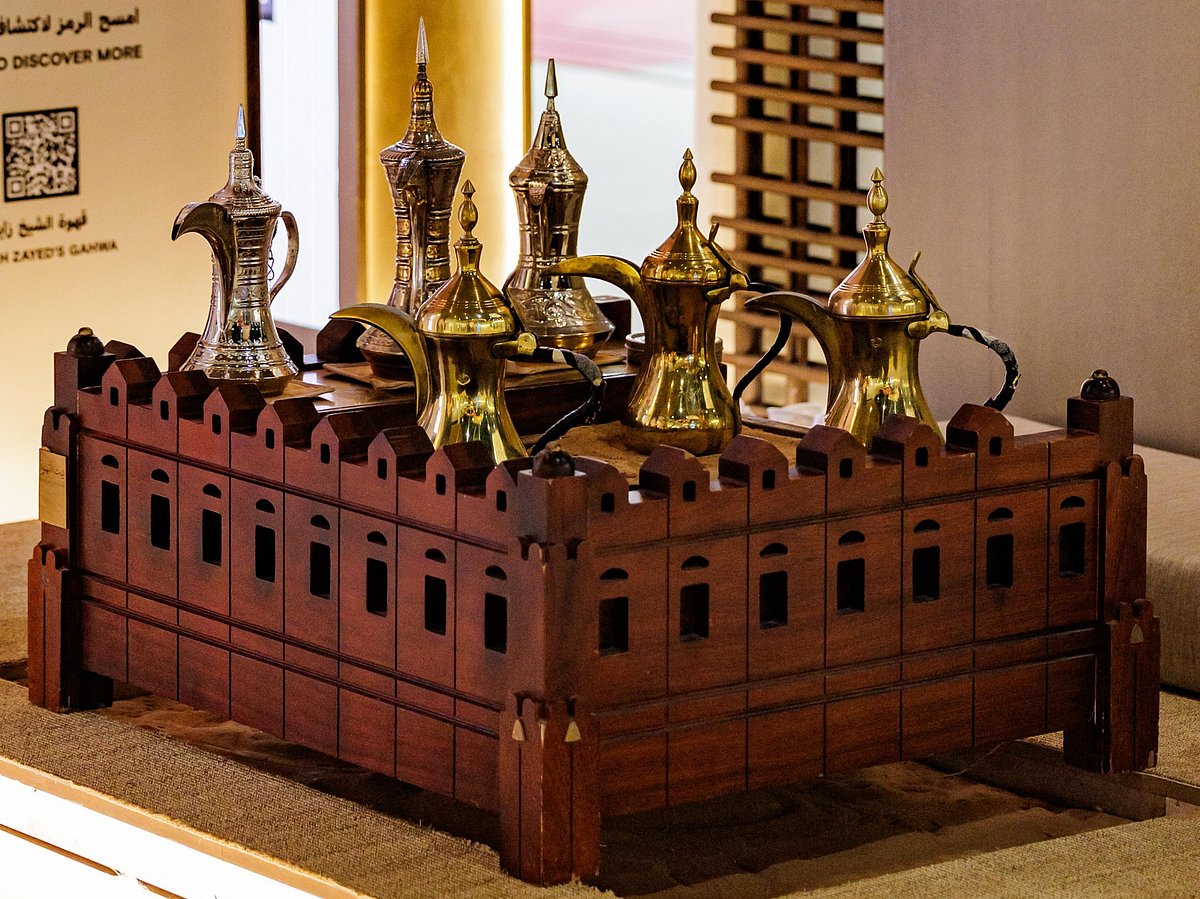
Gahwa itself is far older than any single recipe. For generations, it has done this same quiet work in almost every Emirati home across the country. For generations it was brewed in a simple copper or brass pot, known as a dallah, set over an open flame, the beans lightly roasted, then pounded and simmered with cloves until the scent filled the room.
The pot has since turned, in many homes, into gleaming gold plated brass, and the setting has moved from the desert floor into the majlis of a modern house, but the dallah itself has never lost what it stands for. It remains one of the clearest symbols of Emirati identity, familiar enough that its outline is stamped onto the UAE's one dirham coin.
Every dallah carries a story, and in Emirati households across the country, that story is still being poured out today, cup by cup, into small handleless cups called finjan and offered to whoever happens to walk through the door. In many ways, it is the country's original welcome, older than the skyline and just as present now as it has always been.
That significance has been recognised well beyond the UAE's own borders. In 2015, Arabic coffee, put forward jointly by the UAE, Saudi Arabia, Oman and Qatar, was added to UNESCO's Representative List of the Intangible Cultural Heritage of Humanity, a formal recognition of something generations of Emirati families already understood: that a small cup of coffee can carry an entire culture of generosity inside it.
A language spoken without words
Spend enough time around a majlis and you notice that gahwa comes with its own quiet language, one that has very little to do with words. The coffee is always poured and received with the right hand, a custom followed so closely that even left handed guests are expected to observe it. Whoever is serving traditionally holds the dallah steady in one hand and the finjan in the other, moving first to the eldest or most honoured guest in the room before working around to everyone else. The cup itself is never filled to the top, only part way, because a full cup would signal the visit is over, while a partly filled one is really an invitation to stay a little longer.
It is the guest, in the end, who decides when enough is enough, and this is done not by speaking but by a small tilt or shake of the cup before handing it back. Miss that gesture and the host will happily keep pouring, since in this tradition offering more gahwa is simply another way of saying you are welcome. There are quieter rules too. Gahwa is served hot and the dallah itself is handled with care, held and set down steadily and never shaken, so the fine sediment at the bottom stays put and the coffee keeps its clean, lightly spiced taste.
A recipe kept safe by memory
The Founder's Office did not piece this recipe together from a single old notebook. It drew on verified historical sources, specialised research and the first hand testimonies of people who once stood over the dallah and prepared coffee for Sheikh Zayed himself, including his personal coffee makers, who served in his majlis from 1966 until 2004 and watched the recipe move between grand official gatherings and quiet, informal ones, changing gently with the years while its essence stayed the same.
For The Founder's Office, this was never really about the exact weight of coffee or the number of cloves in the pot. Presented at their pavilion, running until 6th September, the recipe is a way of showing visitors what coffee actually meant inside Sheikh Zayed's majlis. It was not simply a drink offered out of habit. It was the medium through which he welcomed guests, opened conversations and stayed close to the people around him, from statesmen to members of the local community who came only to talk.
Mahra Al Shamsi, Head of the Strategic Communication Section at The Founder's Office, explains why a coffee recipe deserves this kind of care.
"Documenting Sheikh Zayed’s coffee recipe forms part of a much broader responsibility at The Founder’s Office: to preserve the details, memories and stories that deepen our understanding of his life and legacy. His coffee recipe may seem like a simple tradition, but it offers a meaningful window into his majlis and into the values that shaped his relationship with people. Generosity, hospitality, respect and open dialogue were not simply principles he spoke about, they were present in the way he welcomed, listened to and engaged with those around him.
"Preserving these details with accuracy and authenticity ensures that they are not lost to time, and allows future generations to know Sheikh Zayed not only through the milestones of his leadership and the nation he built, but also through the human moments, traditions and everyday interactions that reveal so much about who he was.
"This is what we sought to bring to our participation at ADIHEX. Through his coffee recipe, his values, the Zayed Oral Archive and other documented stories, we are creating opportunities for people to come closer to Sheikh Zayed’s life and gain a deeper understanding of the values he lived by and values that continue to shape the UAE and remain deeply relevant today."
The recipe itself
Ingredients (per litre of water)
1 litre of water
2 finjan, or small cups, of ground coffee, made from cleaned, dried Ceylon beans
2 to 4 cloves
A pinch of saffron
1 capful of rose water
Method
Check the coffee beans for quality and clean the Ceylon beans of any impurities.
Wash the beans in clean water and leave them to dry, historically under the sun for at least two days before roasting.
Roast the beans over charcoal rather than gas, since charcoal gives a depth of flavour gas cannot match, for no less than thirty minutes in a traditional pan, or tawa, until they turn a deep reddish colour.
Grind the roasted beans to a fine, even texture using a traditional grinder and pestle.
Fill the dallah with clean water and bring it to the boil.
Add two finjan of ground coffee for every litre of water.
Add two to four cloves and a pinch of saffron.
Boil the mixture until it reaches a full boil, about ten minutes.
Strain the coffee into a second, smaller serving pot that already holds a capful of rose water, so it takes on a light, lasting fragrance as it is poured.
Let the coffee settle, then it is ready to be served to guests.
The sound of pounding coffee has long been considered part of the UAE's cultural memory. In the past, people would wake for dawn prayer at the sound of the mortar, since coffee was traditionally prepared before prayer.
Sheikh Zayed himself preferred to take his gahwa together with dates, always in odd numbers, three or more, in keeping with the Sunnah.
More than a cup
Follow those steps exactly and you will have a proper cup of gahwa, though the measurements were never really the point. A cup of gahwa placed in front of you, still warm and fragrant with cloves, has always meant the same thing in the UAE. It means you have been noticed, and you are wanted here.
That is precisely what The Founder's Office is inviting visitors at ADIHEX to experience this year, not through a display case, but through a cup passed from one hand to another, carrying with it the same warmth that once filled Sheikh Zayed's own majlis.
Network Links
GN StoreAbout Gulf NewsTerms & ConditionsReach by GNSitemapContact usPrivacy PolicyGN FocusHave your sayWork with usAdvertise with usGulf News epaperPrinting Services
Download our app
© Al Nisr Publishing LLC 2026. All rights reserved.