Taking cues from Islamic art
Jones' ideas that transformed British Victorian era still evident to this day
His name may not a ring a bell for many, not even among art enthusiasts, but the contribution of British designer Owen Jones (1809-1874) to the world of design is evident to this day.
Jones was a British designer, architect and art theorist, who revolutionised British Victorian design by bringing principles of Islamic design to Europe.
Although Jones trained as an architect, his surviving reputation has been as a designer and decorator, a maker of books and educator. Jones travelled to Spain and Middle Eastern countries like Egypt, Syria and Turkey where he was fascinated by Islamic art.
His most famous work, The Grammar of Ornament, is an all-colour book summarising his design theories on colour, geometry and abstraction, and acting as a collection of the "best" examples of ornament and decoration from other cultures — all inspired by Islamic art.
Benchmark
The Grammar of Ornament is still in print 150 years after its publication and is widely studied by designers today. It has even been featured in Meggs' History of Graphic Design, considered a benchmark for the history of graphic design.
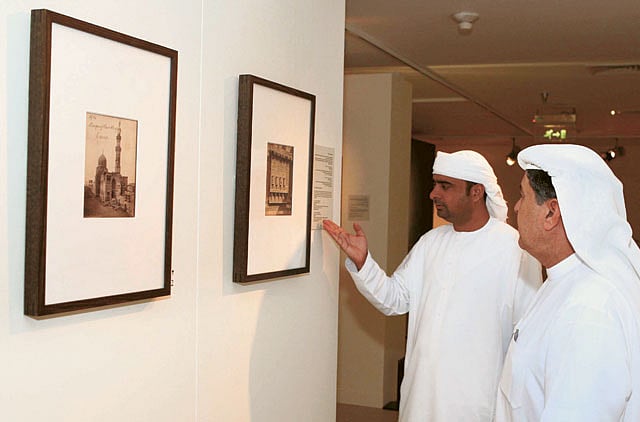
Dr Mariam Rosser-Owen, curator of the Victoria and Albert Museum's (V&A) Middle Eastern Department, took Gulf News on a tour of ‘Owen Jones: Islamic Design, Discovery and Vision' exhibition at the Sharjah Museum of Islamic Civilisation (SMIC), which opened on March 21 and will run until July 15.
The exhibition draws upon treasures from the V&A collections to tell the story of Jones, whose explorations of Islamic design contributed to the reshaping of 19th-century British design.
"Between 1830-1860, he [Jones] was particularly prominent in the design movement in London that was gathered around Henry Cole, the great reformer of education in the Victorian period," Mariam said.
The reason the V&A has so much of Jones' work, she explains was his connection with Henry Cole, who was the V&A's first director. (Incidentally, the V&A was called the South Kensington Museum when it was founded.)
Thanks to Jones, the V&A "was one of the first international institutions to collect Islamic arts."
When the Great Exhibition of 1851 was conceived at the Crystal Palace specially built to showcase it in Hyde Park in London, Jones played a great role in designing its artistic dimensions — thanks to Cole's admiration of his work.
"Jones and Cole, two great design reformers, were keen to bring examples of great design to the majority of the British people, who did not have the means to go to these places themselves," Mariam said.
The result of this shared belief was reflected strongly in The Crystal Palace, that set a new pace for the history of art and design in London. The widespread taste for the Alhambra style in Europe-Britain from late 1800s onwards, and later on in America, is largely a result of Jones' influence.
What made Jones different was his keen desire to understand and know how Islamic architecture and design was created and conceived.
Most people who visited the Middle East or the Alhambra during the 19th century simply saw an "oriental fantasy" and did not look beyond it to understand how the designs were created, Mariam said.
"Jones and his friend Jules Goury — who he met during a trip to Athens and later travelled to Egypt and Spain with — together had a much more scientific approach to the principles of Islamic design."
In The Grammar of Ornament, Owen listed all the principles. They were about 37 of them.
"These principles were statements of his theories about design," Mariam explained.
"What he tried to do was to apply those principles to his designs. So if you looked at a design of a wallpaper or a textile design by Jones [unless you were an expert], you could not immediately tell whether it was original Islamic design or something based on the principles extracted from Islamic design."
Landmark in European history
The Great Exhibition of 1851 is a landmark in European art history. The Crystal Palace was especially constructed to house the exhibition that allowed countries from around the world to display their cultural and industrial achievements.
The palace was built on an impressive 18 acres (around 72,843 square metres) and housed ten themed courts.
It was initially set up for six months of the year in Hyde Park; subsequently, it was dismantled and rebuilt in South London, in a district that is now called Crystal Palace.
"The interiors of the Crystal Palace were conceived as a more permanent display for educational purposes and Jones was involved in conceiving the ten architectural courts, each representing a phase of world architecture such as Assyrian, Egyptian, Medieval, Byzantine, Greek and Islamic one, which was the Alhambra Court.
In the latter, Jones rebuilt part of Alhambra in South London and this building survived until 1963.
"It was a place people visited with their families. A fire destroyed it in 1936," Dr Mariam Rosser-Owen, curator of the Victoria and Albert Museum's (V&A) Middle Eastern Department.
Jones spent most of his career designing textiles, furnishing fabrics, carpets and wallpapers.
Sign up for the Daily Briefing
Get the latest news and updates straight to your inbox
Network Links
GN StoreDownload our app
© Al Nisr Publishing LLC 2026. All rights reserved.