Abu Dhabi puts AI to work as global race shifts from hype to deployment
AI Everything brings 400 companies together as the emirate targets large-scale deployment
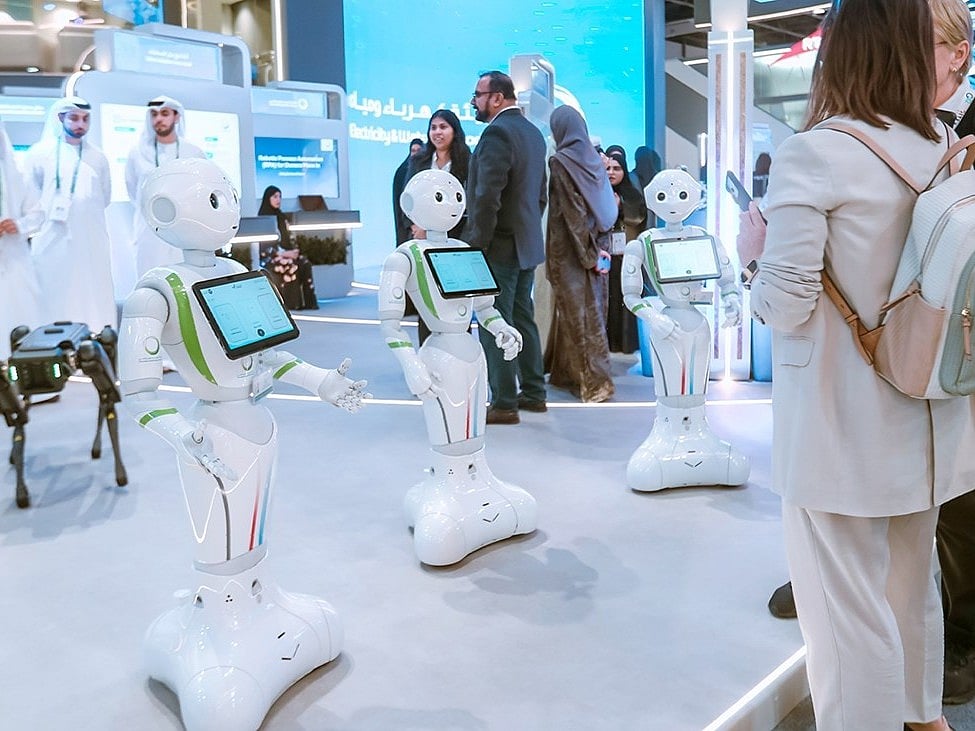
The question at the heart of the global artificial intelligence race is no longer simply: What can AI do? The more pressing question is how it can be deployed and operated at scale, and how its capabilities can be turned into measurable economic, government, healthcare and industrial services and solutions.
This shift in the global AI conversation will be at the heart of AI Everything Abu Dhabi, taking place on October 6 and 7, 2026, at the Abu Dhabi National Exhibition Centre (ADNEC). The event is positioning itself as the world’s largest AI-first exhibition and summit at a time when the UAE capital is seeking to consolidate its position as one of the world’s leading hubs for AI development and deployment.
Get updated faster and for FREE: Download the Gulf News app now - simply click here.
Significantly, the event is not arriving as a conventional technology exhibition showcasing the latest models, devices and software. Rather, it comes at a new stage in the evolution of artificial intelligence, with governments and businesses moving from experiments and pilot projects towards real-world deployment, and from standalone AI tools to intelligent systems embedded at the heart of the economy and public services.
Abu Dhabi summit showcases AI applications in healthcare
The AI Everything Abu Dhabi 2026 summit and exhibition will bring together leading innovators from the UAE and around the world to showcase the latest applications of artificial intelligence in healthcare.
The applications range from AI-designed drugs and Arabic-first clinical systems to digital health solutions linked to the digitisation of healthcare and medical services.
The summit is organised by in5, in partnership with the Department of Government Enablement as the host partner and Solutions+ — a Mubadala company — as the global partner. Its ecosystem of participants includes leading Abu Dhabi institutions such as the Advanced Technology Research Council, First Abu Dhabi Bank and Hub71, alongside global technology leaders including AWS, Alibaba Cloud, Mistral AI, ASUS and others.
The conference programme will also examine the role of autonomous AI in scientific research through a session focusing on the transition from AI simply assisting researchers with data analysis to actively participating in scientific research and experimentation.
The event brings together more than 400 companies and organisations from 60 countries, including more than 150 startups and 200 investors.
Why Abu Dhabi? Why now?
The event is being held in Abu Dhabi at an important moment for the global AI landscape. The emirate is not treating artificial intelligence as a standalone technology sector, but as a fundamental component of future economic and government transformation.
Abu Dhabi is positioning itself to build an AI-powered government, integrating data, artificial intelligence and digital services into a more interconnected government ecosystem.
400 technology companies, 200 investment partners and 180 global speakers
According to Abu Dhabi’s official AI platform, the emirate’s ecosystem includes more than 400 major technology companies and AI-focused startups, more than 200 investment partners and around 180 global speakers, with more than 60 countries participating in AI Everything Abu Dhabi.
This is where the significance of the event lies. Abu Dhabi does not simply want to host a global conversation about the future of AI; it wants to be part of the infrastructure that helps create that future.
From pilot projects to deployment
Perhaps the most important theme of the exhibition is the transition from pilot projects to deployment — from experimentation to implementation.
Many global organisations have spent the past several years testing generative AI tools. But the real challenge lies in integrating those tools into daily operations, connecting them to existing data and systems, ensuring security and measuring their economic returns.
For this reason, the AI 360 Conference in Abu Dhabi will focus on how organisations can move from initial experiments to large-scale AI deployment across sectors including finance, healthcare, energy, retail, manufacturing, transport and government.
The event agenda reflects a clear shift in priorities: agentic AI, computing infrastructure, data centres, energy, security, capital and governance.
This means AI is no longer simply software installed on a device or a service used by an organisation. It has become an ecosystem requiring energy, computing power, data, networks, investment, regulation and human skills.
400 companies — but what will they deliver?
One of the event’s prominent features is the participation of more than 400 AI companies and startups, alongside more than 180 speakers from around the world.
The speaker line-up includes industry figures such as Arthur Mensch, co-founder and CEO of Mistral AI, and Marc Raibert, founder of Boston Dynamics, as well as government officials and leaders from the technology and investment sectors.
But the significance of participation cannot be measured by the number of companies alone.
The question Abu Dhabi is effectively posing is: How many of these technologies can be converted into real-world applications?
That is why the event will feature demonstrations of practical applications across government, healthcare, energy, transport, finance, security and infrastructure, rather than focusing solely on the capabilities of AI models.
AI enters government
One of the most important areas to examine in Abu Dhabi’s AI experience is the government sector.
Abu Dhabi is working to transform AI from a tool that assists government employees into a new operational layer underpinning government services.
One of the most prominent examples is TAMM, which Abu Dhabi describes as an AI-powered government platform connecting more than 1,200 government and private-sector services, with millions of users.
The model points to the nature of the next phase. Instead of citizens and residents having to search for services across dozens of entities, the system can understand their needs, connect relevant data and services, and provide the required outcome more directly.
Here, AI moves from being a technology to becoming infrastructure for public services.
35,000 employees: when AI becomes a digital workforce
Companies participating in AI Everything are presenting further examples of this transformation.
According to event information, the applications being showcased include a digital worker capable of delivering approximately $3 million in annual savings, as well as AI tools designed to support around 35,000 government employees, alongside applications in scientific research and infrastructure.
These figures reflect an important trend in the global economy: organisations are no longer viewing AI solely as a means of improving employee productivity. They are increasingly treating it as a new form of digital workforce capable of performing specific tasks continuously and at high speed.
At the same time, this development raises a major question about the future of jobs and skills.
The emerging equation will not necessarily be “humans versus machines”. Rather, it will increasingly be people who know how to work with machines versus those who do not possess that skill.
Healthcare: from diagnosis to drug design
Healthcare offers one of the most compelling examples of this transformation.
AI Everything will highlight the use of artificial intelligence in drug discovery and design, clinical care, Arabic-language medical systems and digital medicine.
In Abu Dhabi, published data indicate that an AI-powered patient safety system now connects 100 per cent of the emirate’s hospitals and serves more than 60,000 users.
This highlights one of Abu Dhabi’s key advantages: an integrated healthcare ecosystem, extensive data, and capabilities in genomics and precision medicine that can provide a real-world environment for testing and developing AI-powered healthcare applications.
The energy challenge
But AI needs something else: energy.
Behind every AI model lies a vast infrastructure. Every large-model training process, every query and every agentic AI system requires computing capacity, data centres, telecommunications, energy and cooling.
That is why Abu Dhabi is bringing together AI, smart infrastructure, energy and data centres at AI Everything — an indication that the next global race will not simply be about who develops the best model, but who has the capacity to operate these models at scale, efficiently and securely.
This also explains the growing importance of investment in computing infrastructure, GPUs and data centres, alongside the search for reliable and sustainable energy sources.
Agentic AI: the next phase
If generative AI moved technology from searching for information to generating content, the next phase is moving towards agentic AI.
An AI agent does not simply answer a question. Within defined permissions, it can plan and execute a sequence of tasks, interact with other systems and take actions to achieve a specific objective.
That is why the Abu Dhabi conference is examining how governments and businesses can operate agentic AI as critical infrastructure, and how it can contribute to building AI-native economies and institutions.
This transformation could prove more consequential than the first wave of generative AI because it moves artificial intelligence from the role of an assistant towards that of an executor.
Capital moves to the heart of the race
An AI-driven economy cannot be built without capital.
The event therefore includes an investment programme bringing together more than 200 global investors, with the aim of connecting startups with capital, partnerships and opportunities for expansion.
This is strategically important for Abu Dhabi because global competition in AI is increasingly becoming a competition for talent, startups, intellectual property, capital and computing power — all at the same time.
Ultimately, the success of any city in this field will not be measured by the number of conferences it hosts, but by its ability to turn those conferences into deals, investments, companies, laboratories, research centres and real-world applications.
The real test: what will remain after the exhibition?
This leads to the most important question.
After October 6 and 7, the companies will leave and the exhibition halls will close. But the real challenge will remain outside ADNEC.
Will the ideas showcased at the exhibition be transformed into government and industrial projects?
Will startups move from the demonstration stage to large-scale deployment?
Will Abu Dhabi attract more researchers, developers and capital?
And can the emirate build an integrated ecosystem bringing together data, computing, energy, capital, talent, regulation and applications?
That is the equation that will ultimately determine Abu Dhabi’s position in the global AI economy.
Abu Dhabi bets on the intelligent age
The significance of AI Everything Abu Dhabi lies not simply in its description as the world’s largest AI-first exhibition and summit, but in the timing of the event and the message it carries.
The world is entering a new phase in which the question is no longer whether AI can be used, but how quickly it can be deployed, how extensively it can be scaled, how securely it can be operated and what economic and social returns it can deliver.
From government to healthcare, and from energy and data centres to transport and financial services, the scope of AI applications is expanding rapidly.
Through hosting this event and building its own AI ecosystem, Abu Dhabi is sending a clear message: the next competition will not be about who can talk most convincingly about the future of artificial intelligence.
It will be about who can build that future and put it to work in the real world.
That is the significance of the event’s defining message: the next era of intelligence is not waiting for the future. It is moving now — from ambition to deployment.
Sign up for the Daily Briefing
Get the latest news and updates straight to your inbox
Network Links
GN StoreDownload our app
© Al Nisr Publishing LLC 2026. All rights reserved.