The ceremony was attended by representatives from the public and private sectors
From pledge to impact: How UAE organisations are advancing gender balance
UAE organisations lead the way in promoting gender equality initiatives
Last updated:
6 MIN READ
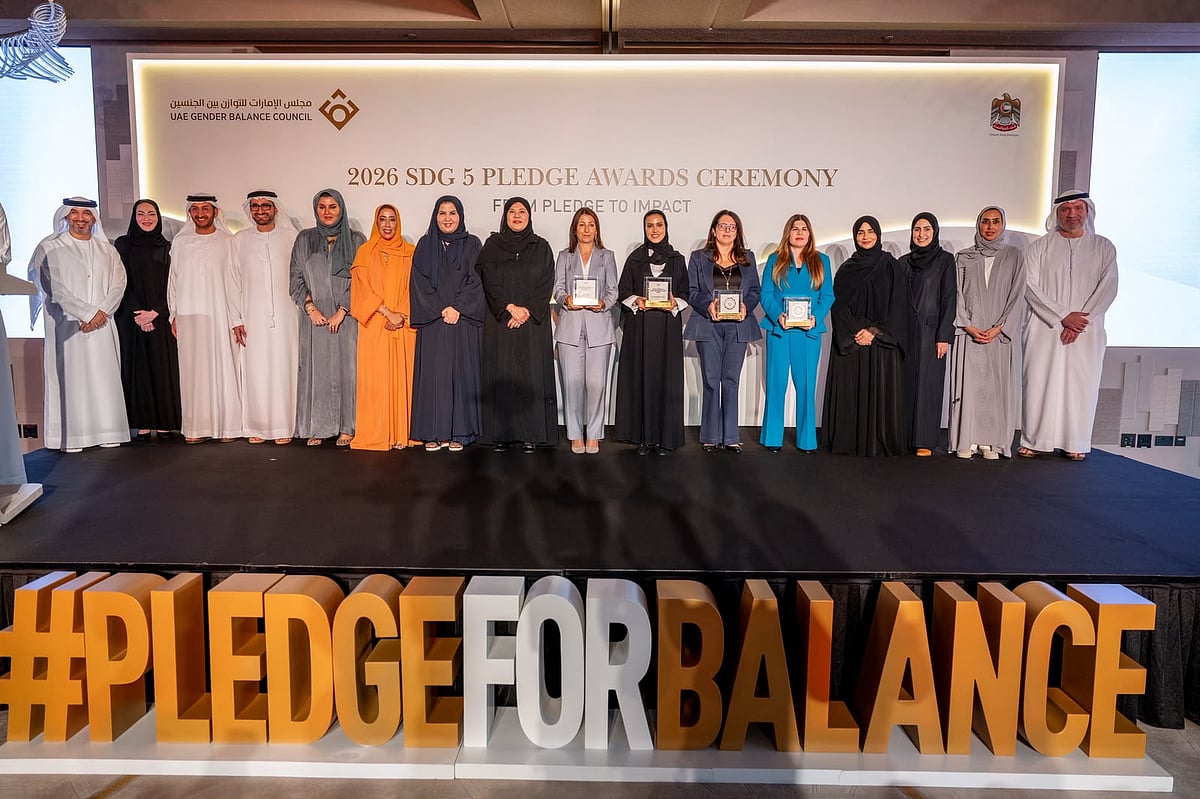
The UAE Gender Balance Council honoured the winners of the inaugural SDG 5 Pledge Awards at a ceremony held at One&Only One Za’abeel in Dubai
Supplied
Dubai: Gender balance is increasingly moving beyond corporate commitments and into measurable policies, leadership targets, and workplace initiatives, according to speakers at the inaugural SDG 5 Pledge Awards in Dubai.
The UAE Gender Balance Council has honoured four organisations for initiatives aimed at increasing women’s representation, developing future talent, and creating workplaces that better support employees and their families.
Standard Chartered UAE has received the Champions of Gender Balance in Policies Award, Abu Dhabi National Oil Company (ADNOC) won the Pioneer of Women’s Leadership Representation Award, Schneider Electric received the Exemplary Initiative Advancing Gender Balance Award, while Deloitte Middle East was named Family-Focused Employer of the Year.
The awards ceremony was held at One&Only One Za’abeel and attended by Sana bint Mohammed Suhail, Minister of Family; Mona Ghanem Al Marri, vice president of the UAE Gender Balance Council; and Mouza Mohammed Al Ghuwais Al Suwaidi, secretary-general of the UAE Gender Balance Council, along with representatives from the public and private sectors.
Get updated faster and for FREE: Download the Gulf News app now - simply click here.
From pledge to measurable action
The SDG 5 Pledge, led by the UAE Gender Balance Council, aims to accelerate progress towards the fifth UN Sustainable Development Goal, particularly women’s participation and equal opportunities in private-sector leadership and decision-making.
The initiative encourages companies to introduce policies and practices that support women’s representation in senior and middle management.
Speaking during a panel discussion, Wasim Ben Khadra, managing director, head of corporate affairs, brand and marketing at Standard Chartered Bank UAE, has noted that gender balance should be treated as a leadership responsibility rather than an HR initiative.
“It’s not an HR agenda. It’s not a women-only strategy. It’s leadership accountability, embedded in everything that we do,” shared Khadra.
The bank has been working towards a global target of having women represent 35 percent of senior leadership by 2028, with clear targets and a focus on building more success stories.
Wasim Ben Khadra, managing director, head of corporate affairs, brand and marketing at Standard Chartered Bank UAE
ADNOC targets 30% women in leadership
For ADNOC, representation is a key measure of progress, with women currently accounting for 26.4 percent of senior leadership through CEO and chief roles, according to Mariam Al Mazrouei, vice president of group people culture and employee experience at ADNOC.
She has bared that at least one woman is represented on the board of each of ADNOC’s entities.
“Representation is about how women are contributing to our agenda and how their decisions are shaping and influencing the direction of our business,” stated Al Mazrouei.
The SDG 5 Pledge has also strengthened ADNOC’s ambition to reach 30 percent of women in leadership by 2028.
Al Mazrouei has described the recognition as both a milestone and a responsibility for ADNOC leaders to continue accelerating progress.
Mariam Al Mazrouei, vice president of group people culture and employee experience at ADNOC
Building the next generation of women in STEM
At Schneider Electric, the focus has extended from the existing workforce to the next generation of female professionals.
Asli Cakir, vice president of human resources, Gulf countries, at Schneider Electric, has mentioned that the company had doubled the number of women in management positions in its local operations over the past five years.
She has highlighted the company’s “Fem in STEM” programme, which began as a small employee-led volunteering initiative and has since developed into a programme supporting young female students with Science, Technology, Engineering, and Mathematics (STEM) backgrounds.
The programme focuses not only on technical skills but also on communication, presentation, mentoring, and career development.
Asli Cakir, vice president of human resources, Gulf countries, at Schneider Electric
“It's really helping them a lot on soft skills,” Cakir told Gulf News, adding that 46 percent of students who took part secured an internship or job opportunity.
The initiative has been designed to help young women enter the workplace better prepared and eventually develop into future leaders.
“The gap between the leaders and the young generation becomes smaller every day.”
The company's internal gender initiatives and leadership policies have also aimed at creating a stronger pipeline of women who can progress into decision-making roles.
Family-friendly workplaces are evolving
For Deloitte Middle East, the focus has been on recognising that employees’ needs change throughout their careers and family lives.
Lamisse Muhtaseb, managing director of people and purpose at Deloitte Middle East, has pointed out that signing the pledge represented a milestone, but also the beginning of a longer journey.
“The agenda doesn’t stand still. It’s forever changing,” described Muhtaseb.
She has encouraged organisations to remain agile because the demands of parents and families can change at different stages of their lives.
“What works now might not work tomorrow. The challenge is to get that representation right but if you are intentional with your efforts and you have policies to back you up, then you have a strong foundation.”
Lamisse Muhtaseb, managing director of people and purpose at Deloitte Middle East
Supporting both women and men
Arwa Al Falasi, director of partnerships and communications at the UAE Gender Balance Council, has underscored several initiatives showcased by the award winners.
She has pointed to Standard Chartered’s provision of 20 weeks of paid maternity and paternity leave, saying that extending support to fathers as well as mothers helps reinforce a broader understanding of gender balance.
She has also highlighted Schneider Electric’s Fem in STEM programme as an example of providing mentorship to women entering the workforce.
Arwa Al Falasi, director of partnerships and communications at the UAE Gender Balance Council
On the other hand, Deloitte has introduced measures supporting employees and their families, including maternity and paternity leave and flexibility for employees with family responsibilities.
Al Falasi has also noted ADNOC’s representation of Emirati women across its workforce and boards.
“It’s amazing to see all these initiatives and we look forward to a future where we can see even more innovative initiatives that support both genders and ensure that everyone feels included and no one is left behind,” Al Falasi told Gulf News.
Eight new organisations join the pledge
In addition, the awards ceremony has seen eight organisations sign the SDG 5 Pledge, bringing more companies into the UAE’s effort to advance gender balance in the private sector.
The new signatories have included Veolia, Publicis Groupe Middle East, WPP, Epson, Havas, Stephenson Harwood, Augustus Media, and Advertising Business Group.
Eight national and international organisations join the Sustainable Development Goal 5 (SDG 5) Pledge
Al Marri has emphasised that the growing private-sector participation reflected a shift towards making gender balance an organisational priority linked to workplace sustainability and the effective use of diverse talent.
The initiative has been intended not only as a framework for commitment but also as a platform for collaboration and knowledge exchange.
“The experiences we celebrate today demonstrate that progress is achieved when a vision is translated into clear policies, measurable indicators, and practices that make a tangible difference to employees and organisations,” remarked Al Marri.
Mona Ghanem Al Marri, vice president of the UAE Gender Balance Council
From recognition to knowledge-sharing
For her part, Al Suwaidi has shared that the awards would provide an opportunity for organisations to exchange experiences and learn from practices that could be adapted elsewhere.
The council would continue working with signatories to monitor progress, share practical approaches, and encourage more organisations to take sustainable steps towards gender balance.
Meanwhile, Suhail has stressed the importance of family-friendly work environments in supporting quality of life, workforce participation, and work-life balance.
The UAE’s progress on gender balance has been aligned with the country’s broader development priorities, including efforts to strengthen family stability and quality of life.
A continuing national priority
Congratulating the four inaugural winners, Sheikha Manal has bared that gender balance remains a national priority.
“From the earliest days of the Union, our leadership recognised that women’s full and effective participation across all fields strengthens society, supports economic competitiveness, and helps shape the future. This vision has delivered significant achievements, strengthening women’s participation across sectors and in leadership and decision-making roles, while reinforcing the UAE’s standing in regional and global gender balance indices.”
For the organisations involved, the message is that gender balance is not a one-time target. It requires continued investment in leadership, talent development, and workplace policies that evolve alongside the needs of employees and families.
Network Links
GN StoreAbout Gulf NewsTerms & ConditionsReach by GNSitemapContact usPrivacy PolicyGN FocusHave your sayWork with usAdvertise with usGulf News epaperPrinting Services
Download our app
© Al Nisr Publishing LLC 2026. All rights reserved.