Visitors getting their queries answered during a panel discussion on the opening day of Gulf News Edufair Abu Dhabi.
Human skills will matter more in the age of AI, educators say
Educators urge universities to prepare students for cross-disciplinary careers
Last updated:
3 MIN READ
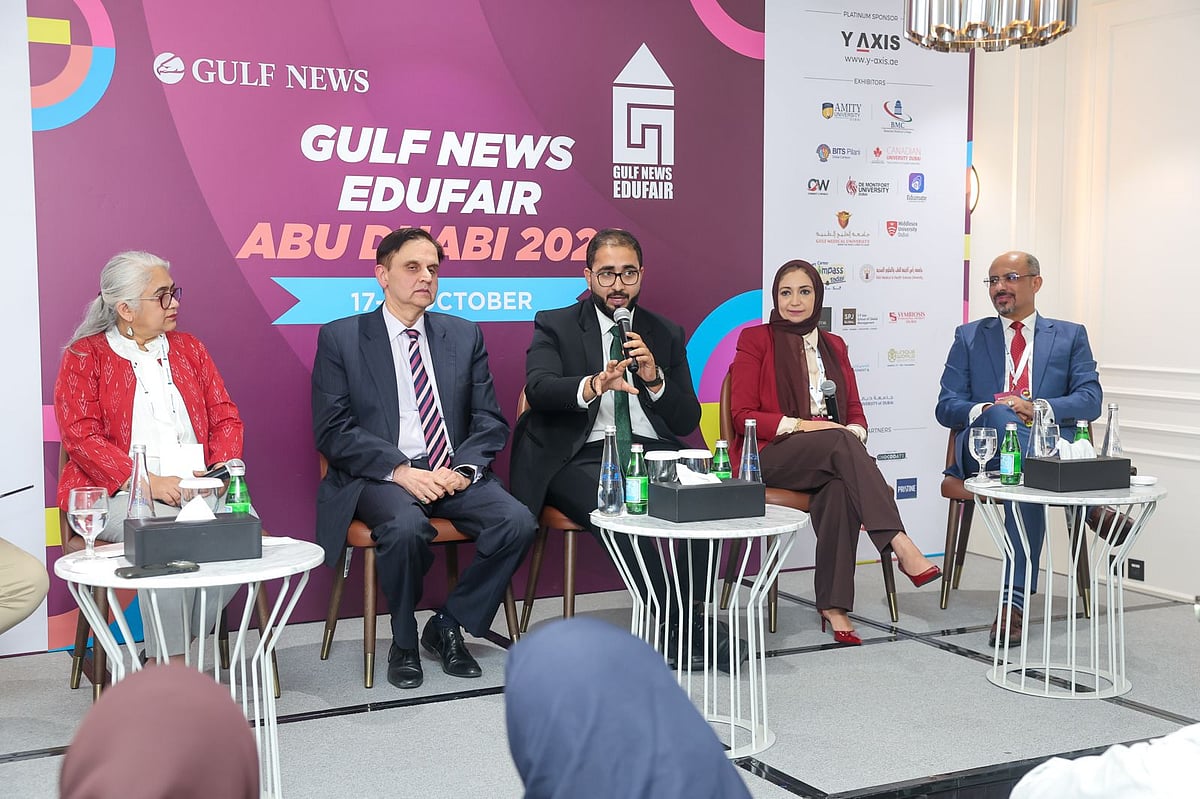
Moderator Lachlan Kitchen, Dr. Anita Patankar, Executive Director, Symbiosis International University Dubai, Dr. Umesh Kothari, Assistant Dean GMBA/MGB/GCGM and Assistant Professor, S P Jain School of Global Management, Dr. Vishnu Nair, Program Director (LLM) and Assistant Professor at the College of Law, University of Dubai, Dr. Riham Ahmed Ibrahim, Associate professor and Chairperson in-charge of Pathology Department, RAKMSHU and Dr. Mohamed Baraka, Vice President Dubai Campus, Batterjee Medical College – Dubai during a panel discussion on the opening day of Gulf News Edufair Abu Dhabi.
Virendra Saklani/Gulf News
Abu Dhabi: Human skills such as communication, judgment and collaboration will become more important as artificial intelligence changes the workplace, educators and experts said during the panel discussion at the Edufair Abu Dhabi 2026.
“Many academics and universities tend to look at disciplinary boundaries and silos. The world doesn’t, but universities do.” Said Dr. Anita Patagar, Executive Director, Symbiosis International University Dubai.
The human edge
Panellists said communication, judgment, curiosity and collaboration must sit alongside disciplinary knowledge and workplace experience as universities prepare students for changing careers.
While AI and digital tools can automate parts of a job, the panel argued that technology cannot replace the professional comprehension, curiosity and interpersonal abilities needed to interpret information, make sound decisions and work effectively with others.
“One thing I want to defend is primary discipline, the subject that you have, to the foundation that's still needed. AI would replace, some of the tasks we largely do. said Dr. Vishnu, Program Director (LLM) and Assistant Professor at the College of Law, University of Dubai
"But you need to have the substance to ensure that AI wouldn't replace you,” he added.
The speakers said graduates still need a strong foundation in their chosen discipline.
However, they should also understand adjacent fields well enough to see the broader context, communicate across professions and respond to workplace problems that do not fit neatly within a single subject area.
Learning beyond disciplinary boundaries
Patagar said universities could build this breadth through cross-disciplinary study, industry projects and exposure to subjects such as sociology, psychology and economics.
“I think the understanding is very simple: you won't be able to grow. You'll survive, but you won't be able to grow unless you're able to see everything in context,” she added.
The aim, the discussion suggested, is not to dilute specialist knowledge but to help students connect it to people, organisations and society.
Technology should also be embedded within existing degree programmes rather than treated only as a separate track, according to Dr. Umesh Kathari, Assistant Dean and Assistant Professor, S P Jain School of Global Management.
In areas such as marketing and finance, students need to understand analytical tools, interpret their outputs and explain what the findings mean for a decision.
Kathari added his views “we don't need to have technology as a separate vertical similar to sustainability.” Suggesting that its integration must be done into every discipline. “Disciplines of business, maybe marketing, finance.”
Healthcare was cited as a clear example of why technical and human capabilities must develop together.
Dr. Riham Ahmed Ibrahim, Associate professor and Chairperson in-charge of Pathology Department, RAKMSHU, said AI-assisted diagnosis can require clinicians to work with engineers, legal experts and managers, while also navigating questions about authorisation and liability.
“Nowadays we are working closely with AI techs and engineers to develop very important AI-assisted tools for diagnosing disease, for managing patients,” he added.
Workplace learning
Panelists called for internships, industry projects, volunteering, workplace visits and assessments rooted in real situations, to give students a clearer view of what different roles involve before they graduate.
Mohammed Baraka, Vice President of the Dubai Campus of the Battery Medical College in Dubai, described a curriculum-design approach that begins with labour-market needs.
He used the example of Pharmacy programmes, which have added AI applications in healthcare, digital health, informatics and digital pharmacy, alongside practical exposure to hospital automation facilities and software companies.
“We send them to the automation facilities, big automation facilities in hospitals, and we send them to the software companies to learn about the new software that companies are developing for the medical field.” Dr. Baraka added.
Adapting to change
Keeping programmes relevant will also depend on lecturers and institutions adapting as quickly as industries do, according to the educators.
For students, the message was to look beyond the degree title and investigate the realities of a profession through reading, conversations with practitioners, volunteering and direct exposure to workplaces.
Students among the crowd also took the opportunity to raise questions to the educators, marking the day 1 success of Edufair Abu Dhabi 2026.
Sign up for the Daily Briefing
Get the latest news and updates straight to your inbox
Network Links
GN StoreAbout Gulf NewsTerms & ConditionsReach by GNSitemapContact usPrivacy PolicyGN FocusHave your sayWork with usAdvertise with usGulf News epaperPrinting Services
Download our app
© Al Nisr Publishing LLC 2026. All rights reserved.