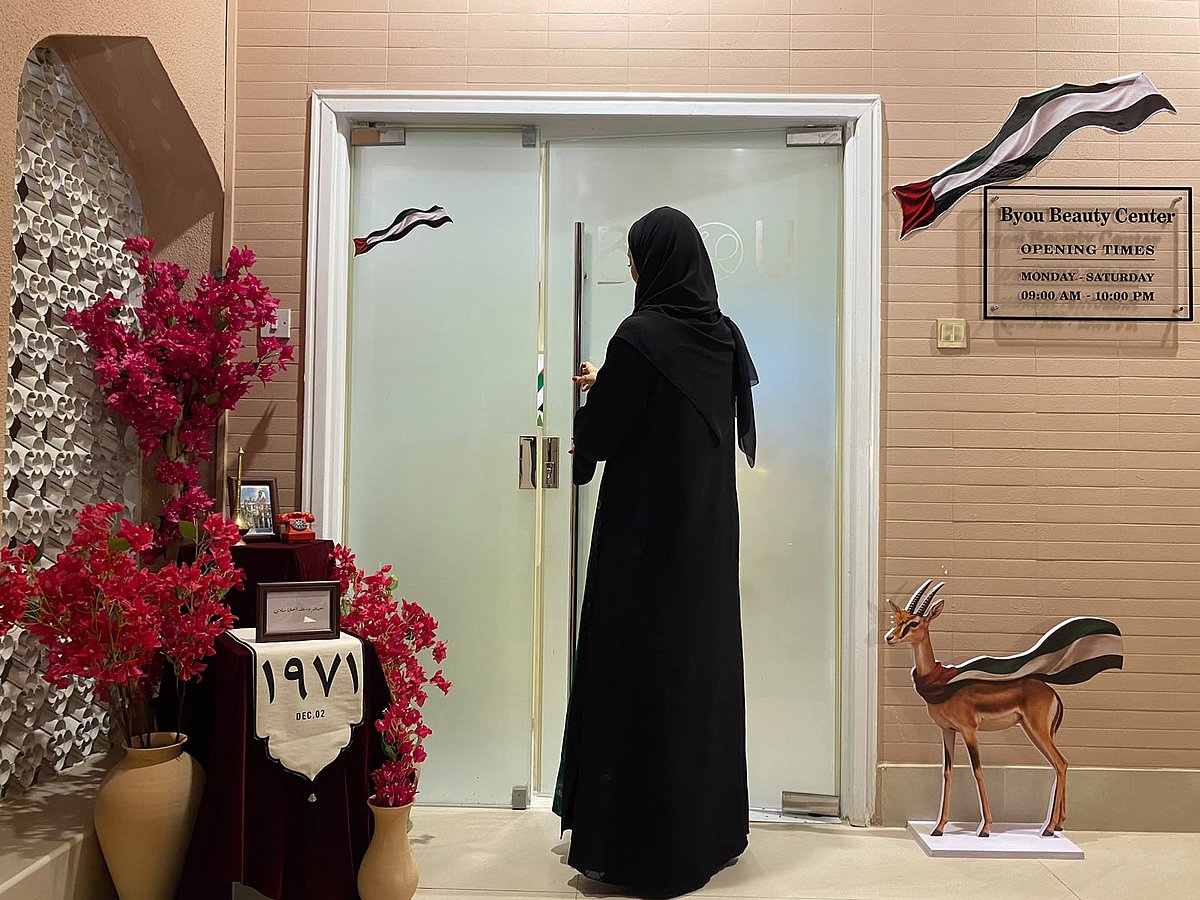
This year the theme is a desert flower and the gazelle
Abu Dhabi: The week before UAE National Day, the work starts in the hair.
Sidr, the crushed leaf of the lote tree, goes on first, to strengthen it. Then henna, worked in until the strands turn a deep reddish brown. Nails are done. Hands are drawn on, patiently, for the evening ahead. For the women who sit in the chairs at Byou, a salon in Abu Dhabi run by four Emirati sisters, none of this is a beauty appointment in the ordinary sense. It is rehearsal. The day itself will last from four in the afternoon until long past midnight, and there is a way it is supposed to look, and smell, and feel.
Salma Al Qubaisi, one of the sisters behind the salon, can describe that feeling in a single gesture. Asked what Abu Dhabi means to her; she laid both hands flat against her chest.
“It’s the soul,” she said. "And I will always try to give back to my beautiful country and to its leaders through everything I do.”
It is not one day. It is the whole month
For Salma, UAE National Day does not arrive on 2 December. It arrives on 1 November.
“When November starts, I already feel the spirit of preparing,” she said. “Which day is UAE National Day? I say it’s the whole month. Every single day. Wherever I go I represent the UAE.
But the day itself is different. It is the day that gathers everyone: a ceremony at work in the morning, heritage songs playing at home, and then, wherever you are standing, the dancing. “Everyone has to join,” she said.
This year the country marks its 55th National Day.
Byou chooses a theme for National Day, and it is never only decoration. Last year it was the date palm, the nakhla. This year it is a desert flower and the gazelle.
The flower grows in the harshest conditions and does not give way. “It stays in winter and in summer. It can survive with water or without it.” The gazelle, is the animal Emirati poets have always compared their women to. Grace on the surface, speed and endurance underneath.
“This flower represents the strength and resilience of the Emirati woman,” she said.
Inside Byou.
Four sisters and a name
Byou began as a dream between sisters.
Salma studied public relations at Zayed University and interned as a tour guide at the Sheikh Zayed Grand Mosque, where she picked up some Chinese to talk to visitors. Later, curious about finance, she took CFA classes. Her grandmother had been a hairstylist, and the sisters felt they had inherited her interest in beauty.
They chose the name Byou for a reason. “Every lady does not have to copy another lady. She should have her own beautiful characteristics.
Byou model
Salma runs marketing. One sister leads hair and makeup. Her sister Hamda runs the finances. And another sister, Mariam, supplied the belief. “It was very challenging,” Salma said. “But Mariam used to tell us: we can make it.”
When the salon opened in 2023, there were two women in the chairs. A year later, a pop-up with Café Aptitude, themed on the Barbie movie, put the salon on the map. “That was the moment of the salon’s launch,” she says. Today it works with women of every age and nationality, offers a Moroccan bath with henna alongside hair, brow and treatment services, and, in Salma’s phrase, “welcomes everyone.”
A room for mothers and daughters
In the lead-up to National Day, the room fills with a particular kind of customer. A mother who has decided it is time to go to the salon, and brings her daughters. Little girls who are allowed to choose their own hair and nail colour. Friends who bring friends who bring cousins. Coffee and karak arrive without being asked.
“They bring each other,” Salma said. “It starts a community.”
Afrah Ali getting her nails ready for UAE National Day.
The salon’s special offers for women and children sit lightly inside that. Henna for children is free before Eid. Around National Day, there are discounts on henna and sidr treatments. Salma mentions both quickly and moves on, because for her the point is not the price. It is that the day should feel open to everyone who wants to be part of it.
A girl asleep with her dress in her arms
Salma grew up in Mushrif, one of twelve children, six boys and six girls. The school was there, the friends were there, and so was the memory she goes back to when she thinks about the National Day.
“When I was a child, we used to go out together to celebrate with Sheikh Zayed, may God have mercy on him. I remember sleeping while hugging the dress I was going to wear from my excitement.
Seeing him, she said, left a mark. “Seeing him really affects you.”
The dress was never simply bought. Salma’s mother stitched it herself, over days, and sewed the talli, the woven trim on the sleeve, before the holiday so everything would be ready. Everyone in the family wore the traditional thobe. If it was a large family gathering, she said, you had to look beautiful.
Salma grew up in Mushrif, one of twelve children, six boys and six girls. The school was there, the friends were there, and so was the memory she goes back to when she thinks about the National Day.
Today Salma wears a modern version of what her mother made: a mkhawar with a khos, a tassel at the neck, and a 3D talli on the sleeve.
The afternoon follows a script every Emirati child learns by heart. The men in kandoora line up for the razfa, with the drums behind them and families sometimes standing opposite each other, almost in friendly competition
The young women move their hair in the naa'esh, heads swinging in unison, the hair itself part of the dance. There is gahwa, Arabic coffee, and lugaimat, the little fried dumplings, then rice with lamb, sometimes from an animal slaughtered for the occasion.
Then there is the smell, which Salma returns to more than once.
A country you can recognise by scent
Emirati women makes their own perfume, a blend called mkhamariya, and each women wears her own. “One lady is jasmine. One is more musk. Different oud. Every Emirati woman expresses herself through her scent.”
In her family’s house on National Day there is saffron or jasmine in the air, and oud, always oud, burning as bukhoor, so that women can sit by it and let it settle into their hair and their clothes. “It represents us,” she said.
Her grandmother’s generation wore henna as a simple dark mark on the hands, the same each time.
The jewellery is traditional too, and it is not the kind worn on an ordinary Tuesday. The matarsha around the neck. The tabla. The kuwashi. Pieces that come out for the occasion, hair worn open, scented, the whole look assembled from the head down.
What has changed, she said, is the surface. Her grandmother’s generation wore henna as a simple dark mark on the hands, the same each time. Today the designs are flowers or circles, and an Emirati woman can walk into a salon and choose.
The role of the woman
When she thinks of strong Emirati women, she firstly thinks of her mother, and the Emirati women who were first teachers and students became doctors, pilots, judges, ministers. “When I see what they accomplished, it gives me a motive to prove myself. To keep this going.”
Afrah Ali getting ready for UAE National Day.
What she is proudest of, she said, is who works here. Five local women are on the team. Salma looks for Emirati staff, many of them part-time, and tries to help them start side businesses of their own. The decor is Emirati-made, and she has insisted on that from the start.
“This is important to me,” she said
Asked what the UAE has given her, Salma does not make a speech.
“Safety, with my loved ones,” she said. “I thank God, and I thank my nation. And what I hope is to give back.”
For the second of December
Her message for the women of the UAE on National Day is short.
“The Emirati woman is not just a part of the story. She is the foundation of the story. She is the one who builds the society. She is the first, as a mother. So never feel you are only a part. You are an important element in society. Without her, there is no Emirates.”
In the salon, the henna is being mixed, the coffee is poured, and the oud is burning. The flower the salon chose this year grows in the desert. It doesn’t need much to stay. It lasts through winter and summer, with water or without.
On 2 December, you will see it everywhere.
Sign up for the Daily Briefing
Get the latest news and updates straight to your inbox
Network Links
GN StoreAbout Gulf NewsTerms & ConditionsReach by GNSitemapContact usPrivacy PolicyGN FocusHave your sayWork with usAdvertise with usGulf News epaperPrinting Services
Download our app
© Al Nisr Publishing LLC 2026. All rights reserved.