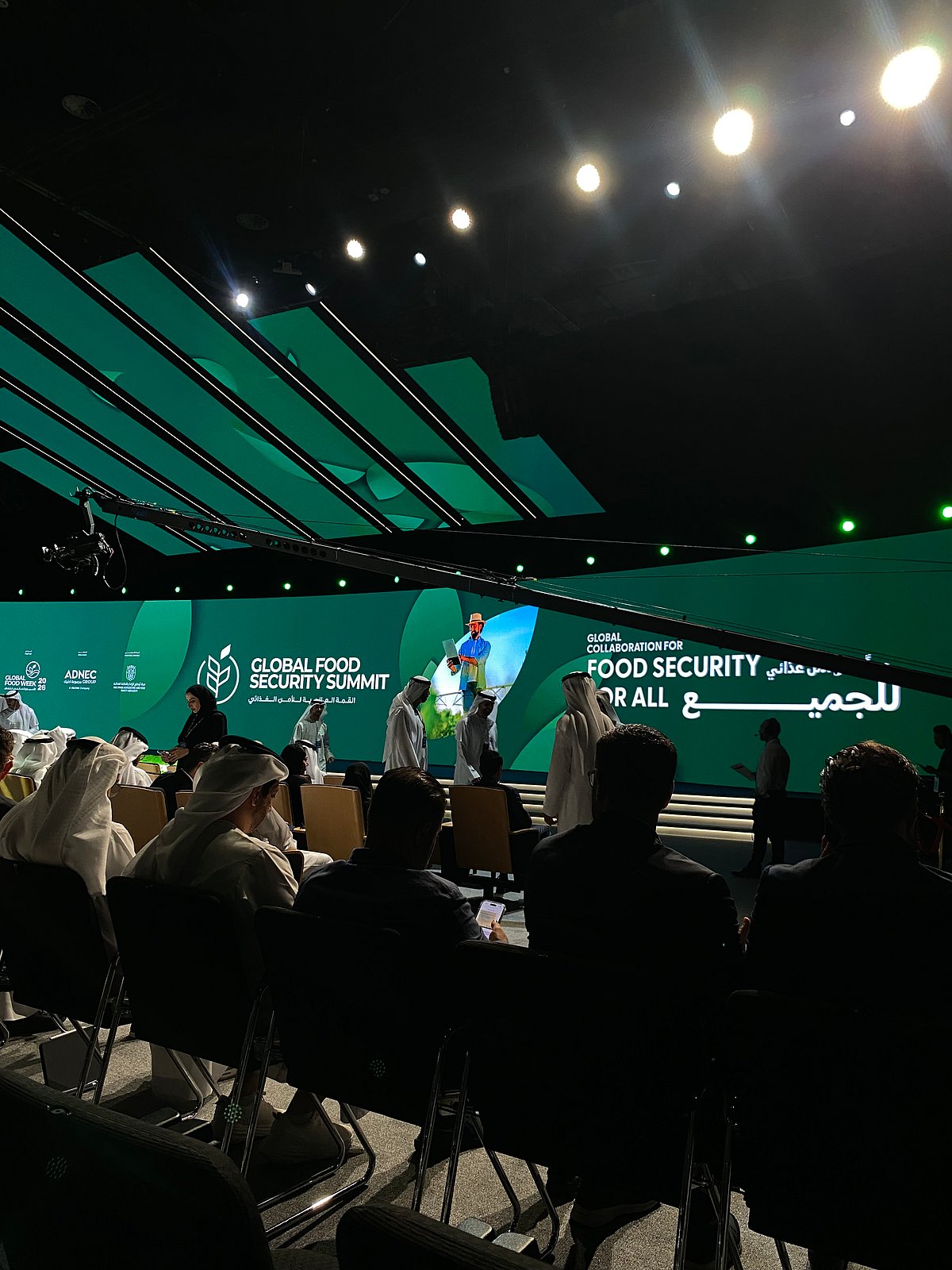
Abu Dhabi: Abu Dhabi aims to raise its self-sufficiency in basic food commodities from 30 per cent to 70 per cent by 2040 under a new strategy unveiled today at the opening of the Global Food Security Summit (GFSS) at ADNEC Centre Abu Dhabi.
Tareq Al Ameri, Acting Director General of the Abu Dhabi Agriculture and Food Safety Authority (ADAFSA), said the emirate is entering a new phase, moving from individual initiatives to an integrated system for the future of agriculture and food security.
"The question is no longer only what we grow from here," he said.
Five pillars, 13 programmes
Al Ameri said the authority's new strategy is built on five pillars and 13 programmes.
The first pillar focuses on producing more and strengthening Abu Dhabi's ability to meet its own food needs, with the target of lifting self-sufficiency in basic commodities from 30 per cent to 70 per cent by 2040.
The second aims to achieve greater value from fewer resources. He said the strategy seeks to improve water efficiency by cutting consumption from 24,700 cubic metres per hectare per year to 12,700 by 2040.
The third centres on resilience and supply security. Al Ameri said the food chain does not end at the farm and set an ambition for the UAE to rise from 26th in the Global Food Security Index to the global top five by 2040.
The fourth pillar is technology. By strengthening agricultural productivity, the authority aims to raise the sector's contribution to Abu Dhabi's from AED 9.5 billion to AED 34.6 billion by 2040.
The fifth is "A strategy does not succeed through what is written on paper, but through change on the ground," he said.
UAE trade minister: connect production to markets
Delivering the ministerial address, Thani bin Ahmed Al Zeyoudi, Minister of Foreign Trade, said the summit comes as trade routes and geopolitical alignments shift and the impact of climate change grows.
"The future of food is no longer just about our ability to increase production, but about the need for more interconnected, adaptable and more resilient food systems, from field to factory, ports to distributor, shop to table," he said.
He said the UAE has positioned itself as a key hub in the global food industry, drawing on its location at the crossroads of trade routes between Asia, Africa and Europe, and on its ports, airports, free zones and free trade network. The value of UAE trade in food, agriculture and related products reached $41.8 billion in 2025, he said.
The country is accelerating investment in agri-tech such as vertical farms, hydroponics and precision fermentation, and the Abu Dhabi Food Hub has already secured investments, he added. He called for government vision to be aligned with the private sector, which he said turns innovation into scalable solutions.
"How we produce more food is a question we are already answering," he said.
"The more important questions are how we build systems that can produce, connect and scale, and how they can withstand and adapt to a rapidly changing world." He invited delegates to "forge new partnerships, develop new projects and connect innovation to real-world needs."
A summit built around collaboration
Held under the patronage of H.H. Sheikh Mansour bin Zayed Al Nahyan, Vice President, Deputy Prime Minister, Chairman of the Presidential Court, and Chairman of the Board of Directors of ADAFSA, the summit is organised by ADNEC Group in strategic partnership with ADAFSA. This year's theme is "Global Collaboration for Food Security for All."
The ceremony, attended by H.H. Sheikh Hamdan bin Mohammed bin Zayed Al Nahyan, and opened with a film on Abu Dhabi's approach to food security, highlighting how artificial intelligence can connect signals across climate, crops, water and trade. "Scale matters only when food reaches where it is needed," the film said.
The programme focuses on international cooperation on today. On Wednesday, 7 October, it turns to innovation, technology and future systems, including AI, digital infrastructure, supply chains and sustainable water management. It brings together 70 countries, over 80 speakers, more than 350 registered CEOs and over 3,500 delegates. The opening also marked the official start of the Global Food Week exhibition.
Sign up for the Daily Briefing
Get the latest news and updates straight to your inbox
Network Links
GN StoreDownload our app
© Al Nisr Publishing LLC 2026. All rights reserved.