Gold, memory and the long view: Buccellati’s classical inheritance arrives in Shanghai
First presented in Venice, the exhibition now relocates to the Shanghai Exhibition Center
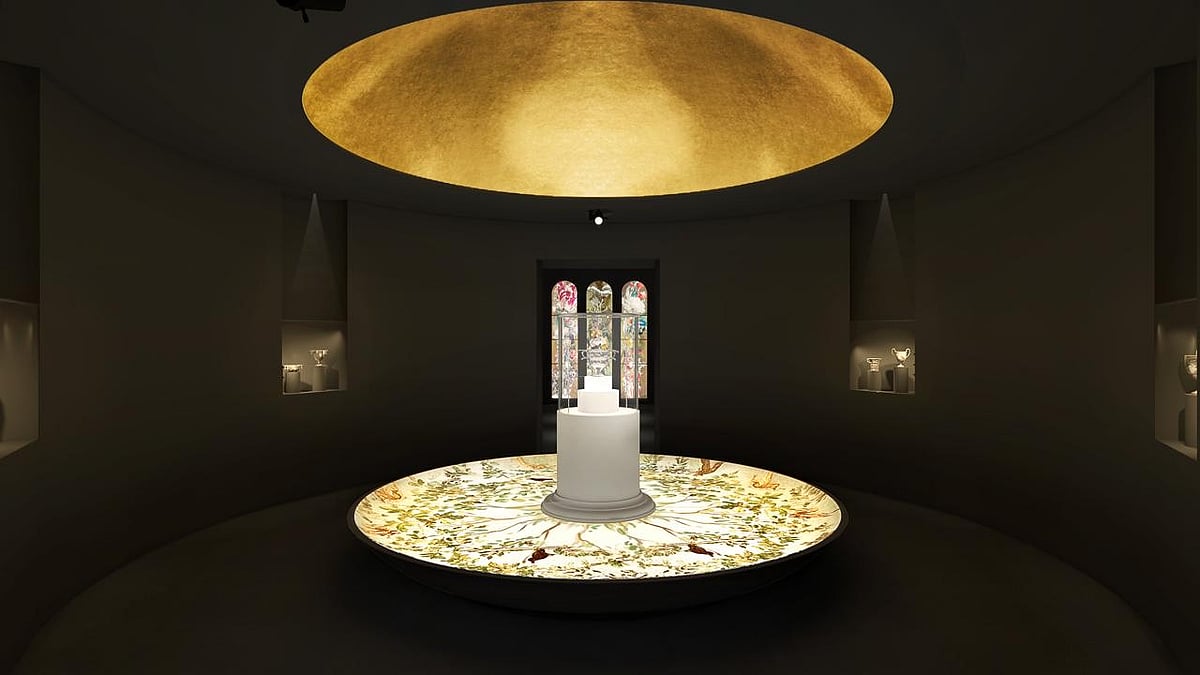
Luxury, when it is discussed seriously, is best approached obliquely. The Prince of Goldsmiths. Buccellati Rediscovering the Classics, opened in Shanghai this December runs till January 5, resists the language of curated extravagance and novelty that so often accompanies high jewellery. Instead, it offers a meditation on continuity: on craft as cultural transmission, and on ornament as a form of historical thought.
First presented in Venice in 2024, the exhibition now relocates to the Shanghai Exhibition Center, where it unfolds as a carefully composed retrospective of nearly a century of Italian goldsmithing. Its title derives from Gabriele D’Annunzio’s florid 1936 appellation for Mario Buccellati - “the Prince of Goldsmiths” - a phrase that today reads less as bombast than as an early recognition of Buccellati’s prime position at the intersection of artistry, erudition and technical mastery.
What distinguishes this exhibition from the familiar tropes of luxury retrospectives is its insistence on dialogue rather than display. Curated by the design historian Alba Cappellieri and conceived by Balich Wonder Studio, the exhibition situates Buccellati’s jewellery within a broader intellectual lineage, drawing on architecture, archaeology, natural history and Renaissance ornament. Classical columns and harmonic proportions coexist with digital interventions, not as concession to modernity, but as a means of sharpening historical perception.
The opening section, The Buccellati Generations, establishes lineage as both theme and method. A butterfly - an emblem of metamorphosis rather than rupture - guides the visitor through four brooches designed by successive generations of the Buccellati family. Subtle shifts in line, incision and surface treatment articulate change without disavowing inheritance. In an industry increasingly detached from its origins, the emphasis on familial authorship feels almost radical.
This sense of intimacy deepens in An Italian Family Story, a reconstructed study displaying archival photographs, correspondence and personal effects. It is a modest, almost domestic interlude that resists the myth-making often associated with heritage branding. Here, continuity is presented not as abstraction, but as labour: accumulated, transmitted and occasionally contested.
The exhibition’s intellectual core resides in Man Made Wonders, a sequence of rooms that examine Buccellati’s work through its formal and historical references. Cosmetic cases and evening bags, their surfaces incised with astonishing delicacy, are read through the lens of haute couture. Elsewhere, silver boxes and compacts echo the grammars of Renaissance architecture, while a group of Boscoreale cups gestures towards classical antiquity and the archaeological imagination that informed early twentieth-century decorative arts. Jewellery, in this context, becomes a site of scholarly conversation rather just embellishment.
Nature, long a central motif in Buccellati’s visual language, is addressed in Natural Wonders. Silver foliage, animals and botanical forms are suspended within an immersive environment informed by Renaissance herbals and contemporary projection. The effect is not illustrative but contemplative, positioning nature as an evolving system of forms rather than a sentimental refuge. Murano glass vases produced in collaboration with Venini extend this dialogue across materials and disciplines.
Perhaps the most affecting passage of the exhibition is The Buccellati Craftsmanship corridor, where tools and techniques are abstracted through mirrored, octagonal structures. Here, the gestures of engraving - patient, repetitive, resistant to haste - are foregrounded as acts of knowledge. The sequence culminates in a film by Yuri Ancarani, whose measured, almost ascetic visual language frames the Maison’s Mosaico collection as a study in rhythm and restraint.
The exhibition concludes with The Gallery of the Icons, a deliberately austere space in which high jewellery pieces from the 1920s to the present are displayed against a backdrop of immersive projections. Rather than narrating progress, the room collapses time, suggesting that Buccellati’s aesthetic has always operated outside fashion’s cycles, favouring instead a form of cultivated permanence.
That this exhibition is staged in Shanghai is significant. A decade after Buccellati’s arrival in mainland China, the Maison positions the retrospective not as a commercial overture, but as a gesture of cultural reciprocity. In a city defined by speed, scale and reinvention, The Prince of Goldsmiths advances a counterargument: that relevance may also be achieved through slowness, erudition and fidelity to craft.
In the end, the exhibition is less a celebration of a brand than an enquiry into endurance itself - into how objects accrue meaning, how skills survive modernity, and how beauty, when properly understood, is never just for decoration.
Sign up for the Daily Briefing
Get the latest news and updates straight to your inbox
Network Links
GN StoreDownload our app
© Al Nisr Publishing LLC 2026. All rights reserved.