A Manchester City fan gestures to the camera while walking at the airport in Porto, Portugal, where flights are arriving from England bringing soccer fans.
Champions League final: City-Chelsea duel a world away from forgotten Wembley clash
Best of global talent in coaching, players a far cry from their 1985 Wembley meeting
Last updated:
4 MIN READ
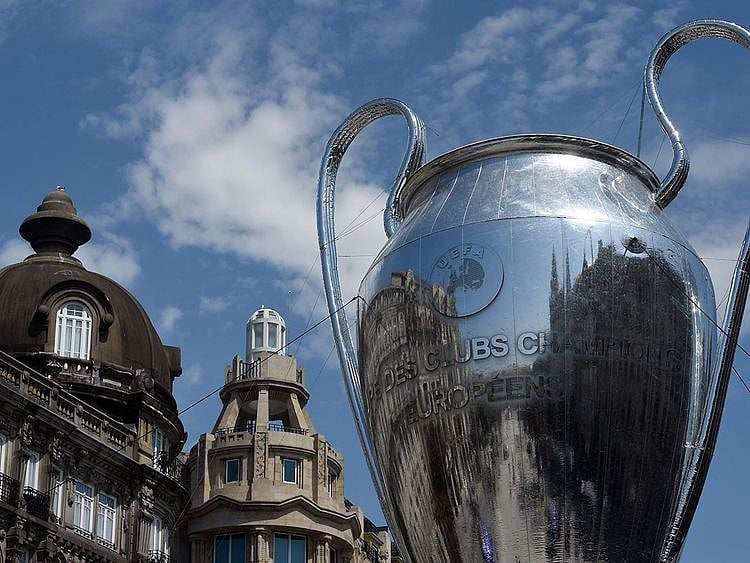
A giant inflatable replica of the Uefa Champions League trophy sits on the Aliados avenue in Porto on the eve of the final between Manchester City and Chelsea on Saturday.
Reuters
Also In This Package
Tears and cheers as Sergio Aguero says goodbye to City
Euro 2020: Take a look at squads for all 24 teams
Who said what in the world of sport at the weekend
IN PICTURES: Kobe Bryant inducted into NBA Hall of Fame
Sushil Kumar scandal - Sports stars who fell from grace
Transfer gossip: Man City to outbid rivals for Kane
London: Manchester City and Chelsea head into Saturday’s Champions League final as English football superpowers, but 35 years ago both clubs had endured such hard times that reaching the much-maligned Full Members’ Cup final was cause for celebration.
While City’s showdown with Chelsea in Porto is a high-stakes clash, their first-ever meeting in a final came in a competition that was shunned by the elite and no longer exists.
At the start of the 1985-86 season, the beautiful game was an ugly mess in England as rampaging hooligans clashed in decaying stadiums and attendances fell. Just months earlier, 39 people died during riots sparked by Liverpool fans before the European Cup final against Juventus at the Heysel Stadium in Brussels.
Also Read
Champions League final: Portugal relaxes Covid rules for English fansCOVID-19: Porto prepares as Portugal steps into the Champions League breach once againWhy Manchester City are favourites for Champions League gloryManchester City star Riyad Mahrez hails Middle East support ahead of Champions League finalThe Full Members’ Cup was born out of the ashes of that tragedy, an ill-conceived creation aimed at filling the fixture void left by the post-Heysel ban on English clubs from European competitions.
Liverpool, Manchester United, Arsenal, Tottenham and Everton all opted out of the competition, leaving City and Chelsea among only five top-flight clubs taking part.
Fans initially treated it with derision and just over 4,000 witnessed City’s 6-1 win against Leeds in the group stage, a record-low home attendance at that point in the club’s history.
Yet by the time City beat Hull and Chelsea dispatched Oxford to reach the 1986 final, the tournament had become a beacon of hope after decades of distress in east Manchester and west London.
For Chelsea, it was their first final since winning the European Cup Winners’ Cup 15 years earlier.
They were in only their second season back in the top-flight after coming within a whisker of crashing down to the third tier in 1983.
Chelsea were among the clubs most affected by the hooligan disease and Blues chairman Ken Bates briefly resorted to erecting an electric fence at Stamford Bridge in a bid to contain the violence.
City were in equally straitened circumstances as they prepared for their first Wembley appearance since the 1981 FA Cup final.
In their first season back in the top-flight after two years in second-tier purgatory, cash-strapped City were light years away from the current dynasty bankrolled by their Abu Dhabi-based owners.
In a sign of the chaotic thinking that bedevilled English football at the time, the final was played just 24 hours after both clubs were in First Division action.
City were weary after a draw with bitter rivals Manchester United, while Chelsea beat Southampton, with 10 players from each side featuring in both the league game and the final.
The fans did not care as around 67,000 watched one of the most entertaining, if long-forgotten, finals ever staged at the old Wembley.
“It was important. We all had aches and pains after the derby but we jumped straight on the bus to Wembley,” said City’s Mark Lillis.
Chelsea raced into a 5-1 lead fuelled by David Speedie’s hat-trick - the first Wembley treble since Geoff Hurst’s for England in the 1966 World Cup final.
Thanks partly to two goals from Lillis, City closed the gap to 5-4 but Chelsea held on to win their first trophy for 15 years.
“In the early rounds it wasn’t taken seriously but Chelsea hadn’t been to Wembley for a long time,” said former Chelsea winger Pat Nevin, who played in the match.
“It was a really memorable game. Any Chelsea fan that was there will never forget it. Boy did they make some noise.”
The Full Members’ Cup went extinct after 1992 and it would be a surprise if City manager Pep Guardiola or Chelsea boss Thomas Tuchel had even heard of it.
But for one sun-splashed spring afternoon at Wembley, the competition provided a welcome glimpse into the future for two downtrodden clubs who can now bask in their status as European heavyweights.
It is an ‘all-English’ final but both teams highlight the Premier League’s ability to recruit the finest coaching and playing talent from across the continent and beyond.
City are coached by Spaniard Guardiola, who won the competition twice when guiding Barcelona, while Chelsea’s German boss Thomas Tuchel led Paris St Germain to the final last season, where they were beaten by Bayern Munich.
It is the second all-English Champions League final in three years, confirming the long-standing fears of debt-ridden Spanish giants Real Madrid and Barcelona that the unmatched global commercial success of the Premier League will eventually be replicated on the field.
Roll of honour
2019-20: Bayern Munich
2018-19: Liverpool
2017-18: Real Madrid
2016-17: Real Madrid
2015-16: Real Madrid
2014-15: Barcelona
2013-14: Real Madrid
2012-13: Bayern Munich
2011-12: Chelsea
2010-11: Barcelona
2009-10: Inter Milan
2008-09: Barcelona
2007-08: Manchester United
2006-07: AC Milan
2005-06: Barcelona
Most European Cup/Champions League wins per club
Real Madrid (ESP) - 13 (1956, 1957, 1958, 1959, 1960, 1966, 1998, 2000, 2002, 2014, 2016, 2017, 2018)
AC Milan (ITA) - 7 (1963, 1969, 1989, 1990, 1994, 2003, 2007)
Liverpool (ENG) - 6 (1977, 1978, 1981, 1984, 2005, 2019)
Bayern Munich (GER) - 6 (1974, 1975, 1976, 2001, 2013, 2020)
Barcelona (ESP) - 5 (1992, 2006, 2009, 2011, 2015)
Ajax (NED) - 4 (1971, 1972, 1973, 1995)
Champions League final graphic
Sign up for the Daily Briefing
Get the latest news and updates straight to your inbox
Network Links
GN StoreAbout Gulf NewsTerms & ConditionsReach by GNSitemapContact usPrivacy PolicyGN FocusHave your sayWork with usAdvertise with usGulf News epaperPrinting Services
Download our app
© Al Nisr Publishing LLC 2026. All rights reserved.