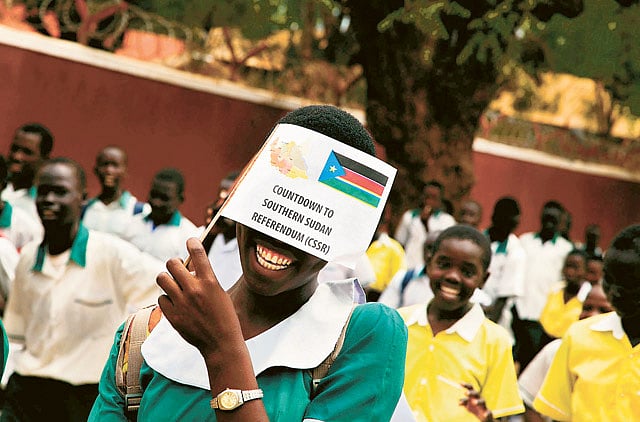
The referendum on South Sudan's independence is a success. The official results are not set to come in for at least two weeks, but only hours after the ballots closed the turnout had reached almost 90 per cent: secession from Khartoum was given overwhelming support. The bureaucratic stage of one of the most important geo-strategic events in modern history is concluded.
The people of South Sudan are rejoicing. The historical dream they paid for with two million lives during the civil war is set to come true in July 2011 when President Salva Kiir is to announce the formation of a brand new African state.
Until then, the authorities in the southern capital, Juba — mostly formed by ex-generals from Sudan People's Liberation Movement (SPLM) — will need to refocus. This must mark a break with the abstract politics and hot-headed rhetoric that suffused the times when Africa was throwing off the yoke of colonialism. Now is the time to replace all that with some inspired realpolitik.
South Sudanese officials, many of whom spent years in a frenzy of Eastern Europe-style transitional theft, will need to face-up to the realities they have created. In the relatively-quiet last few years, the leaders have moved the nascent state closer to the long and brutal tradition of African dictatorships.
The referendum-inspired euphoria should not incite naivety. Too much optimism, however welcome, could prove fatal.
Despite oil reserves and the vast untapped potential of the River Nile, South Sudan is still one of the planet's poorest places. Ninety per cent of the 10 million inhabitants have less than a dollar per day; about a third go hungry; and only six per cent have regular access to drinking water and basic sanitary facilities.
Hurdles
A total of 85 per cent of adults are illiterate. There is one teacher for every thousand pupils. Schooling and health care can be summed up by the fact that a 15-year-old girl has a better chance of dying during childbirth than of finishing primary school. Every sixth mother dies in labour, and 135 out of every thousand children fail to outlive their fifth birthday. In a country as vast as the Iberian Peninsula, there are only 60 kilometres of asphalt roads, and when enough rain falls, they are useless.
An overwhelming 98 per cent of South Sudan's budget comes from oil revenues — an entirely oil-based economy, but only foreigners and local oligarchs make a profit — billions of petrodollars have vanished, while millions continue to starve. Instead of investing in the future, the leaders enlisted the help of greedy neighbours like Kenya and Uganda and turned South Sudan into one of the world's most expensive countries.
Apart from oil, South Sudan produces nothing. If the Nile's potential were to be properly harnessed, agriculture would thrive — but so far, the authorities have not implemented proper measures. South Sudan could export food, some businessmen say — and yet it is forced to import food just to survive.
The country also has to import countless other things it does not need. Such economic chaos is a perfect backdrop for unpunished thieving raids undertaken by anyone with some money and no ethics.
In the words of the Kenyan publicist Ahmad Nasir Abdullahi: "The South Sudanese should thank their political leaders and military generals, give them the medals, acknowledge their role in the struggle, but deny them the claim they have over the government."
During the decades of conflict, the power-wielders of South Sudan learned much of what they should not have learned from Khartoum. In a few short years, they managed to almost completely usurp the nascent state. It seems absurd to expect them either to be willing or able to build a decent successful nation without extensive help and control from the international community.
The most important thing right now is for South Sudan to avoid any sort of armed conflict with forces sponsored by Khartoum. Literally no cost should be spared to escape that disastrous eventuality.
Based on their mutual economic interests, the north and the south have apparently come to agree on non-aggression; but the chance of war is still high.
The United States endorsed the secession of South Sudan and Obama needs to follow-up immediately on his claim that Washington would support the democratic decision of the people.
If done properly, without the usual exploitation of foreign powers, and more equal distribution of natural resource reserves, South Sudan could prove to be a model for successful separation. In the Horn of Africa, where fragmentation is synonymous to failure, this could be a step in the right direction.
Bostjan Videmsek is foreign correspondent for the Slovenian newspaper DELO and author of "War of (T)error, Ten Years after 9/11" due in the summer of 2011. Stuart Reigeluth is managing editor of REVOLVE magazine.
Sign up for the Daily Briefing
Get the latest news and updates straight to your inbox
Network Links
GN StoreDownload our app
© Al Nisr Publishing LLC 2026. All rights reserved.