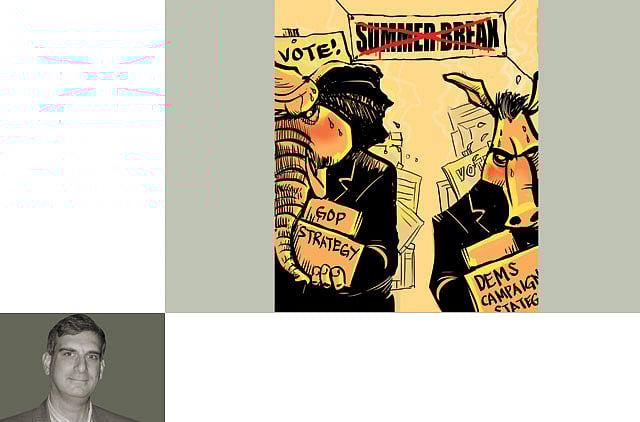
If you think US presidential campaigns are far, far too long, I’ve got good news and bad news for you. The good news is that most Americans agree. Even among people who work in politics or follow it for a living, one often hears complaints that the electioneering never stops. The bad news is that not only is this unlikely to change, it is getting worse.
Until recently, the normal practice in presidential politics was for the public portion of a campaign to take most of the summer off, while organisational work and strategising continued behind the scenes. Once a candidate locked down the nomination, some time in spring, everything was quiet until the party nominating conventions.
For decades these were held in the middle of the summer. The challenger’s party would go first, in mid-July; the party currently holding the White House would meet a month later. Then everything went quiet again for a few weeks until fall campaigns formally kicked off over the Labor Day holiday weekend at the beginning of September.
All of this has been changing. The traditional order of the conventions still holds — meaning that the Republicans will go first this year, just as Democrats went first in 2008 when a GOP [Grand Old Party] president sat in the White House — but pretty much everything else has evolved. Over the last 40 years, the conventions themselves have become ever-shorter, more tightly-scripted affairs. They also take place later in the year (at the end of August and the beginning of September) and are now held back-to-back rather than a month apart.
Along with the timing of the conventions, what has also changed is the nature of the summer campaign itself. Few candidates feel they can afford to slow down during June, July and August anymore. The stakes are simply too high.
This change began a generation ago. The first-mover was the elder George Bush. Bush did relatively little summer politicking himself during his successful run for the presidency in 1988. His team, however, used those months to launch a relentless campaign that successfully defined his opponent, Massachusetts governor Michael Dukakis, in the public mind as both weak (particularly on crime) and dangerously left wing. By the time the Democrats’ own operation ground into action, the damage was irreparable.
One would have thought that by now, the politicians would have learned. Yet, in the decades since that first successful Bush presidential campaign, one party or the other has consistently repeated Dukakis’ mistake. Bob Dole in 1996, Al Gore in 2000, John Kerry in 2004 and, to some extent, John McCain four years ago. All, at key moments, stood back and left the field largely to their opponents in the run-up to the traditional fall campaign.
Last week, Bob Shrum, a veteran Democratic campaign strategist, went on the US political chat show ‘Hardball’ and made the case that Mitt Romney is in the process of falling into the same trap.
“The summer is a very critical, important period when candidates get defined,” he said. “I think right now, Romney’s getting defined — whether it’s this outsourcing stuff, whether it’s his offshore accounts. He is getting defined in a way that is not going to help him.”
To be fair, Romney’s people would probably disagree with that analysis. They have certainly done their best to begin defining Barack Obama as an out-of-touch “tax-and-spend” liberal (a fairly standard Republican charge against Democrats that, historically, has been highly effective regardless of whether or not it is actually true).
This is what both parties are increasingly obsessed with avoiding — allowing their opponents to define them for that large swathe of the public that only begins to pay attention to politics in the final month or two prior to Election Day.
Fear of allowing this to happen is what drives today’s campaigns through the summer months — fear that if they take any sort of break, the opposition will seize the narrative and never let it go — as Bush the elder did to Dukakis all those years ago.
Combine this with a fierce desire to pay the opposition back in kind and it is easy to see how modern presidential politics came to be so relentless.
So, yes, the campaign is set to get even longer. Probably meaner, too. How many people are actually paying attention at this stage is open to question, but in the self-referential, self-reinforcing world that is electoral politics, that will not matter much.
Gordon Robison, a longtime Middle East journalist and US political analyst, teaches political science at the University of Vermont.
Sign up for the Daily Briefing
Get the latest news and updates straight to your inbox
Network Links
GN StoreDownload our app
© Al Nisr Publishing LLC 2026. All rights reserved.