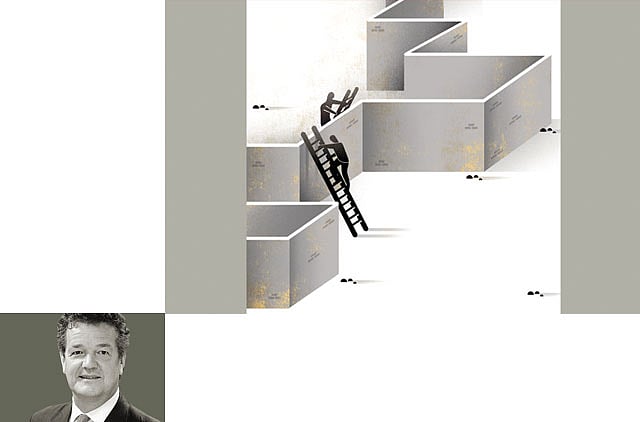
The political split between Sunnis and Shiites is in danger of becoming an irreversible reality, which will dominate Arab politics for the next generation. The tragedy is that it was not necessary, but was forced to the front by the absence of politics led by parties espousing successfully popular non-religious ideologies like Pan-Arabism or Arab Socialism, Nasserism, socialism, capitalism or even Communism.
This vacuum led to the politicisation of sectarian Islam, which is now one of the defining issues of the Arab world — also helped by the aftermath of the isolation of revolutionary Iran, the CIA-sponsored launch of the Mujahideen in Afghanistan, the US-led invasion of Iraq and the revolutions of the Arab Spring.
The vicious international reaction to Iran’s revolutionary leaders after 1979 led to the stigmatisation of their Shiite faith as well as their global viewpoint. The Americans actively sponsored militant Sunnis to take up arms against the Soviet forces in Afghanistan, so building a force that the Arab world has much cause to regret. Later in Iraq, the US interim government encouraged the launch of sectarian political parties. After the Arab Spring, the only political organisations with wide popular structures were the Sunni Islamists who moved to take advantage of the political chaos, entrenching their own sect’s views in the emerging new power structure of the country.
The religious divide between Shiites and Sunnis focuses on who can provide interpretation and guidance on religious matters. The Sunnis work through large schools of scholars and experts in jurisprudence, like Al Azhar in Egypt, where a consensus of religious thought is achieved. The Shiites allow more authority for personal interpretation to their religious leaders, who also work in concert in seminaries called Hawza, where Grand Ayatollahs gather to debate and lead their followers, who are free to shift to those whom they prefer.
Pernicious trend
There are many religious leaders in Islam who are working to build the essential bridges to stop this pernicious sectarian trend. “What does it matter if I pray with my hands at my side or in front of me?” I was told by Yousuf Al Khoei, who is one of the directors of the Al Khoei Foundation and is also the son of Abu Al Qasim Al Khoei, preeminent Shiite scholar and the predecessor to Ali Al Sistani, who was the spiritual leader of much of the Shiite world until his death in 1992.
Al Khoei was speaking at the recent World Economic Forum meeting on the Middle East held at the Dead Sea. During a vigorous workshop seeking suggestions on how to prevent interfaith and intercommunal relations from deteriorating, Al Khoei took pains to emphasise that any religious divide between Muslims was like division in a family, that can be sorted out while remembering that far more binds the parties together than forcing them apart.
The seminar defined some of the drivers of sectarian division. It listed issues like fear, anger, suspicion, humiliation and lack of mutual respect as the emotions that drive sectarian divisions, often fuelled by history, ignorance, stereotypes and a divided sense of cultural identity.
The purpose was to define these universal underlying issues which support sectarian hatred, so as to ease the political task of seeking tolerance. For example, anyone talking to the Lebanese Shiites in Hezbollah will have to talk in the context of today’s Lebanese and Syrian politics. However, if they ignore the underlying emotional issues the seminar was examining, they will miss a large part of what may help in reconciliation. The same applies to the complex web of parties and factions in Iraq’s parliament. Unless these sectarian concerns are tackled head-on, many of the political issues will remain intractable.
But even when there is no real political issue at stake, the depth of sectarian fears is startling. One of the participants at the World Economic Forum was Emad Abdul Gafour, the leader of the Watan Party, a breakaway from Egypt’s largest Salafist party — Al Nour.
In several seminars, he defended President Mohammad Mursi’s economic and political achievements in defiance of some of the miserable numbers he was confronted with, but later he also spoke about how Egypt should have better political and economic relations with Iran.
However, such apparent support for Mursi’s political dialogue with Iran did not stop him from telling Slate magazine that “With the Shiites, there are certain ideas that are a deviation from Islam and we hate these ideas”. Gafour backed up his concerns with the claim that Mursi’s dialogue with Iran might lead to Mursi “bringing the Shiites to Egypt” and that Egyptians “are afraid that Egypt will turn into a Shiite crescent”.
Such wildly exaggerated claims sound hysterical in the calm corridors of the supremely tolerant and rational World Economic Forum meetings, but they may well resonate more successfully in the heated atmosphere of Cairo’s political frenzy. The depth of the task that faces leaders across the Middle East is to avoid pandering to these fears and hatred and focus on more pragmatic political issues which can be resolved by negotiation.
Sign up for the Daily Briefing
Get the latest news and updates straight to your inbox
Network Links
GN StoreDownload our app
© Al Nisr Publishing LLC 2026. All rights reserved.