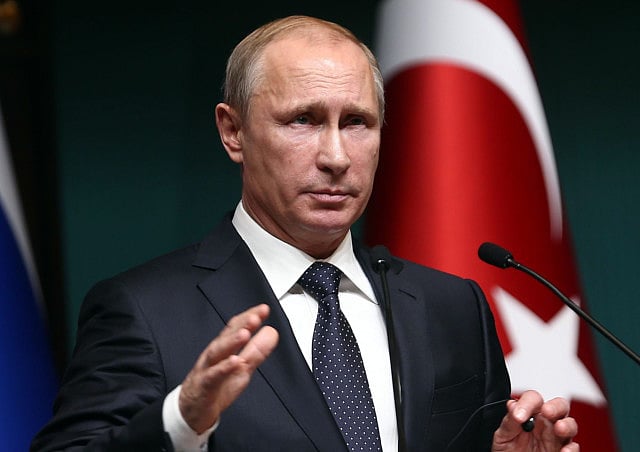
Is it worth reflecting about Ukraine when there are no dissenting views? To simplify, Russian President Vladimir Putin, an aggressor, is wrong and the West is right, because “Putin made a historical and strategic mistake. His ambition should have been to anchor Russia to Europe, allowing it to modernise its political culture along that of Europe” (Dominique Moisi, Les Echos, November 24).
The Ukrainian issue becomes peripheral to the only subject that matters; western liberal economic and political visions are the only ones of value and Putin is stupid enough not to recognise that. He supports Syrian President Bashar Al Assad (both lack enthusiasm for the Muslim Brotherhood and Daesh or the Islamic State of Iraq and the Levant) and he should be condemned for that. He supports dissidents in Eastern Ukraine, who speak Russian (despite the Kiev government forbidding it), who feel Russian (they used to be part of the former USSR) and he should be fought for that. The Ukrainian issue is nothing but another illustration of the ‘sphere of influence’ doctrinal controversy. Let us ponder here for a few minutes over some ‘truths’ which, although coming from the West, are not all that ‘independent’.
To start with, one should recall that an agreement had been reached between all the Ukrainian parties, Russia and the European Union (EU), at the height of the Maidan revolution. That agreement fell apart a few days later and the sole responsibility for that lay with Kiev. Russia then did not move and implicitly allowed the ‘coup d’etat’ to go ahead.
Secondly, why has information on the Malaysian plane crash always been so one-sided? Whatever the Russian government said has hardly been reported — and never in full. So the question is: Why should Kiev and its allies be intrinsically more trustworthy than Russia? This is especially true when one sees what is now happening in the war zone. What, for instance, does the ‘Free World’ think of the blind shootings and mortar attacks by the Kiev army on an unarmed civilian population? Nobody denies the principle of a government fighting against dissidents — unless of course in Syria. But what about indiscriminate attacks on civilians by an army of a government supported by the US and the EU? With no heating and water and no money (banks are closed), who would not consider Russian help?
Yes indeed, there are dissidents in the eastern part of Ukraine — as there were in Crimea before rejoining Russia, a country that was a part of it 60 years ago, until it was ‘offered’ to Ukraine, then a sister member of the erstwhile Soviet Union. Russia obviously has an interest in Ukraine, just like the US has in Panama or for that matter any country in its neighbourhood. A further evidence of their relationship is that Russia and Ukraine were part of the same country 25 years ago and a major part of the eastern Ukrainian population sees itself as Russian.
Two areas for discussion are thus emerging: The question of neighbouring minorities and the aforementioned ‘sphere of influence’. Regarding cultural and ethnic links between the populations of two different countries, history is full of problems that such situations may provoke and the unsatisfactory solutions offered. Interestingly, a comment by a former self-proclaimed leader of Ukrainian dissidents, Igor Gukin (Strelta), complaining that “he hoped Russia would have intervened”, shows how limited the room for manoeuvre can be at times, including for Russia itself.
‘Sphere of influence’
As for the concept of ‘sphere of influence’, in concrete terms, letting some countries believe that they could have veto rights over what goes on in their backyard is something that the US and the EU strongly oppose and they “stand by the right of sovereign democracies to choose their own alliance”, as mentioned by Tony Blinken of America’s National Security Agency. Financial Times columnist Gideon Rachman also commented in his article on November 24 (republished in Gulf News on November 26) that “there is a vast difference between a sphere of influence based on the willing consent and one that is constructed around intimidation and force”. For instance, will America ever allow Mexico to join any kind of anti-US military or economic alliance? Ask the civilian Cuban population what they think of the embargo they have been suffering from for the last 50 years.
Ukraine cannot obviously join Nato without Russia objecting to it. Ukrainian President Petro Poroshenko, reiterating last week the Nato request, which even former US secretary of state Henry Kissinger finds unrealisable, sadly confirms this.
Geostrategic players divide the stronger and the weaker, as in a game of chess. Putin faces some domestic economic issues; there are in Washington a few aggressive generals; EU is divided and the United Nations is hardly making its presence felt. France can temporarily put on hold the delivery of naval vessels paid for (and partly built) by Russia, but that cannot be a long-term strategy. In that game, Putin has always been three steps ahead.
Luc Debieuvre is a French essayist and a lecturer at Iris (Institut de Relations Internationales et Strategiques) and the Faco Law University of Paris.
Sign up for the Daily Briefing
Get the latest news and updates straight to your inbox
Network Links
GN StoreDownload our app
© Al Nisr Publishing LLC 2026. All rights reserved.