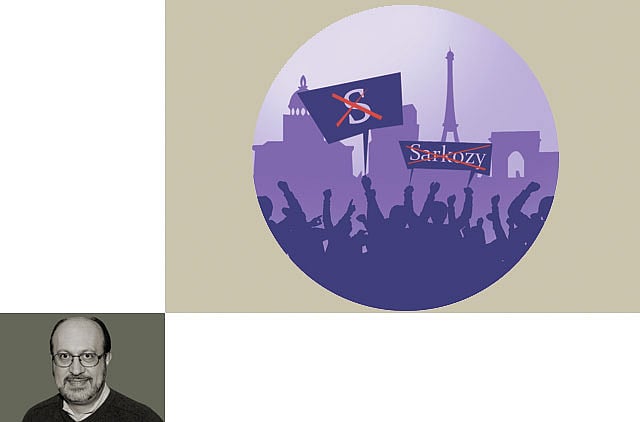
A majority in France revolted against Nicolas Sarkozy, and while a few commentators opined that the French would “miss him more than they realised”, the rejection went beyond the incumbent’s severe austerity measures or his pro-American preferences.
False praise aside, president ‘Bling-Bling’ lost his elections months, perhaps years ago. Simply stated, he was dropped because he tampered with the electorate’s sense of coherence, promising everything to everyone and essentially uttering oodles of nonsense that spilled over.
Among Sarkozy’s major flaws was his careless use of power that, naturally, made him look ridiculous. A republican official who took on royal trappings, Sarkozy compromised the office’s dignity and politicised his position, which alienated many. Omnipresent during five years, he literally strangulated ordinary citizens with his temperance, cursed in public, and paraded his private life as if he was a movie star. His obsessive behaviour turned people off as many grew tired of his “illusions of grandeur”.
In short, Sarkozy was a hyper-manager, not a president, and although some of his austerity policies were necessary, he did not respect the separation of powers. Executive privileges trampled over legislative and judiciary responsibilities that, at least in a democratising society, must be respected. By transforming the executive into the omniscient branch of government, Sarkozy earned hostilities galore that, logically, were bound to create insurmountable schisms within society. To say that he favoured the wealthy would indeed be an understatement but he was not alone in this respect. Sadly, he ruled, but seldom governed, which was a requirement in a country that compelled its head of state to enhance socio-political equilibriums.
Nowhere was this more evident than in Sarkozy’s policies towards the Arab world that were imbued in confusion. Simply stated, and unlike Charles de Gaulle to whom he liked to compare himself despite stature differences, Sarkozy started off on the wrong side of French foreign policy in the Arab world.
Shortly after his election, and prodded by his outgoing wife Cecilia, Paris secured the extradition of six Bulgarian nurses who were charged in 1998 with conspiring to deliberately infect over 400 children with HIV in Libya.
Sarkozy cut a deal with Colonel Muammar Gaddafi: freedom for the nurses in exchange for multi-billion security, health care and immigration accords. Though several of these contracts were negotiated by his predecessor, Sarkozy pledged to sell Tripoli three advanced nuclear plants, ostensibly to power desalinisation facilities.
In the event, business with Gaddafi was deemed valuable, as the eccentric pitched a tent in his Parisian hotel’s gardens in December 2007. The Libyan was granted formal honours at the Élysée Palace in what was, at the very least, a polemical official trip. When the Libyan dictator was no longer a useful business interlocutor, Sarkozy felt no compunction to launch air-raids on the North African country, which ended Gaddafi’s 41-year leadership record on October 20, 2011.
Despite a July 27, 2007, Senegal address that derided Africans by claiming that colonialism was not the cause of all of Africa’s problems, and inspired by his North African inroads, Sarkozy launched a half-baked Union for the Mediterranean at the July 13, 2008 Paris Summit that regrouped an odd planetary collection.
Critics dubbed the crackpot design Sarkozy’s “Club-Med”. The next day, Bastille Day, most of these “leaders” watched the traditional July 14 military parade on the Champs-Élysées that, in hindsight, was hugely embarrassing.
Sitting next to Sarkozy were 43 honorees, including Egypt’s Hosni Mubarak, Tunisia’s Zine Al Abidine Bin Ali and, especially, Syria’s Bashar Al Assad. At the time, commentators fumed that Sarkozy had made “a historical mistake,” given the legacy of recent ties that resulted in the death of 58 French paratroopers — as well as 241 American servicemen — in simultaneous 1983 bombings against peacekeepers deployed in Lebanon.
The Damascene was wined and dined, praised for his courage to tackle development projects and, more important, entrusted with reform minded political agendas. In the aftermath of the post-2011 Arab Spring, however, when France and its allies were caught with their hands in the cookie jars, the volte-face highlighted Sarkozy’s sheer amateurism.
When behind the scenes negotiations failed, all that the French president could do was to call on his Syrian counterpart to leave office, which did not happen. Al Assad waited. His foreign minister, Walid Al Mua’alem, reacted more forcefully as he rejected European Union sanctions in June 2011. Because the Syrian government was targeted “as the new enemy of Europe,” Al Mua’alem asserted, “we will [assume that] there is no Europe on the world map”.
Ironically, after Sarkozy’s defeat, the pro-government Damascus daily, Al Watan, hailed the reversal. Referring to foreign minister Alain Juppe and the latter’s forceful interventions at the UN Security Council that raised the prospect of military intervention to end the crisis, Al Watan headlined: “The Sarkozy-Juppe duo in the dustbin of history,” which was different from the praise lavished in September 2008 when Al Assad extended the red carpet to the visiting head of state. He declared on French television that his counterpart was a “pragmatic” and “realistic” man who was interested in “stability and dialogue.” Luckily for Sarkozy, his visit to Syria lasted more than 5 hours, a record that was achieved on June 7, 2008 when he headed a large delegation that made a pit-stop in Beirut between 10.15am and 3.11pm.
Animated beyond description, Sarkozy promised a new model, though he adopted “un-presidential manners” more than others. He met his political makers a few days ago, which should also be a lesson to his successor, for in the age of the Arab Spring, it behooves officials to learn how to respect citizens.
Dr Joseph A. Kechichian is the author of the forthcoming Legal and Political Reforms in Saudi Arabia.
Sign up for the Daily Briefing
Get the latest news and updates straight to your inbox
Network Links
GN StoreDownload our app
© Al Nisr Publishing LLC 2026. All rights reserved.