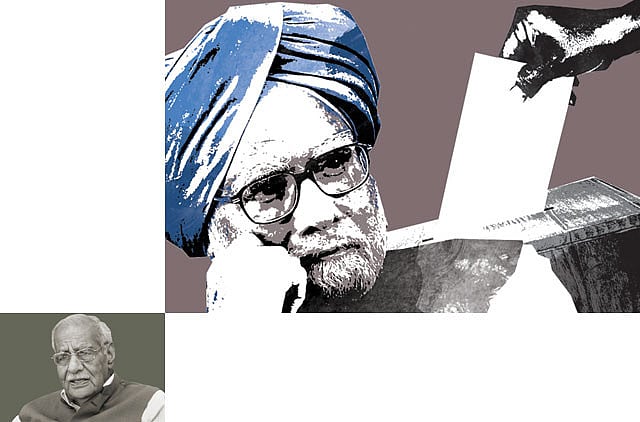
When Samajwadi Party (SP) chief Mulayam Singh Yadav said last month that parliamentary elections in India are possible this September, he was not indulging in sensationalism. He had been sounded out by the Dravida Munnetra Kazhagam (DMK) president, M. Karunanidhi, that he was withdrawing support to the Manmohan Singh government from the ensuing parliament session. The DMK patriarch has lived up to his utterance, putting the future of the United Progress Alliance (UPA) government in the realm of conjecture. Even when the government has agreed to support the resolution against Sri Lanka at the UN Human Rights Council, Karunanidhi has stuck to his word as conveyed to Mulayam.
The SP chief is in a spot because the government, which has been reduced to 277 members, is just more than the half-way figure of 273 needed for a majority. He can pull down the government, but what does he do afterwards? In fact, no political party is ready to face the next elections and even contradictions within some parties are so strong that it will be difficult for them to go through the requirements for the polls. However, with an eye on the future, Mulayam has praised the Bharatiya Janata Party (BJP) leader, L.K. Advani, describing him as the tallest. Does it mean that post-election alliance between the BJP and the SP is a possibility? It is still too early to say that, but one thing is sure — that SP may compromise with the forces which it once said were “communalist and anti-national”.
The overall scenario is dismal. The government, which is already known for non-performance, has become more halting in taking necessary steps. It does not know how long it will be in office and therefore it is reluctant to take any long-term measures. The UPA, over which Congress party president Sonia Gandhi presides, supports the Manmohan Singh government and is trying its best to placate its allies, which number more than 20. Now, even tiny parties, having two or three members each, matter because they hold the balance.
The UPA has already done the rope trick to keep the Manmohan Singh government in office for nine years. One cannot blame it for mismanaging the coalition because the BJP-led National Democratic Alliance (NDA), with 24 parties, lasted eight years. In fact, the UPA did very well in its first term and then went about methodically. It had constituted a coordination committee to keep in touch with all its allies and take them into confidence. This time, however, the Congress government has hardly consulted any constituent, not even big parties which were giving support from outside. Had it kept them in the loop, the government would probably not have been in such a sorry plight today. But it is still not too late to cobble together the alliance and give the allies a feeling of confidence, even if not governance.
The situation has affected the economy, which is now down to 4.5 per cent and India’s prestige has taken a beating abroad. Nobody seems to be bothered about the fact that economically India is a sad spectacle. Worse still is the impression that India has no worthwhile policy on foreign affairs because it is too engrossed in its domestic problems.
There was a chance when a resolution against Sri Lanka was discussed at the UN Human Rights Council. India was caught in a dilemma because it could neither annoy a neighbour like Sri Lanka nor could it afford to let down the DMK, which wanted a strong resolution of condemnation against Sri Lanka because the party was being pressured by the Tamils.
Indeed, Sri Lanka had indulged in unprovoked killings, especially in the last phase of war against the LTTE [Liberation Tigers of Tamil Eelam]. New Delhi preferred to placate the DMK, but it turned out to be a bit too late because by then, Karunanidhi had made up his mind to withdraw support from the government. New Delhi could have acted earlier. The question has been pending for discussion between the DMK and the Congress for some years. How one wishes they had found some common way out.
So where does one go from here? New permutations and combinations are possible, but the room for manoeuvrability with the Manmohan Singh government is very limited. Probably, the sick state of India will remain like this for some more time to come until somebody pulls out the plug and forces early polls. Both Mulayam Singh and Bahujan Samajwadi Party’s Mayawati are trying to extract their pound of flesh, but the Manmohan Singh government can concede only up to a point, not beyond. The Congress party is confident that the cases against Mulayam and Mayawati, being probed by the Central Bureau of Investigation (CBI), can be managed because the agency is a government department.
Mulayam Singh’s tiff with central minister Beni Prasad may be justified, but Manmohan Singh cannot afford to drop him from the cabinet, at least not yet, when he has a few seats left in parliament to prove the government’s majority. Bihar Chief Minister Nitish Kumar is a help in the sense that he has joined issues with the BJP. Nitish Kumar’s “no” to Gujarat Chief Minister Narendra Modi as the BJP’s prime ministerial candidate has put a spanner in the works of the BJP. It wants Modi, but at the same time does not like to jolt the alliance. One BJP leader has said that if the choice is between an NDA government without Modi and no government with Modi, the BJP will prefer the former.
Probably, the best way out for Manmohan Singh is to declare fresh elections. He should go to Rashtrapati Bhavan [the presidential palace], submit his resignation and recommend fresh polls. At present, there is not a single party that can claim to form the government in the place of Manmohan Singh’s. Therefore, elections become inevitable.
Whether elections will give India a strong government is yet to be seen. It is often said that the same hotchpotch alliance will come back. Maybe, some party will win around 200 seats and stake its claim to form the government. Much will depend on the mood of the electorate and this is the best part of democracy that nobody can take them for granted.
Sign up for the Daily Briefing
Get the latest news and updates straight to your inbox
Network Links
GN StoreDownload our app
© Al Nisr Publishing LLC 2026. All rights reserved.