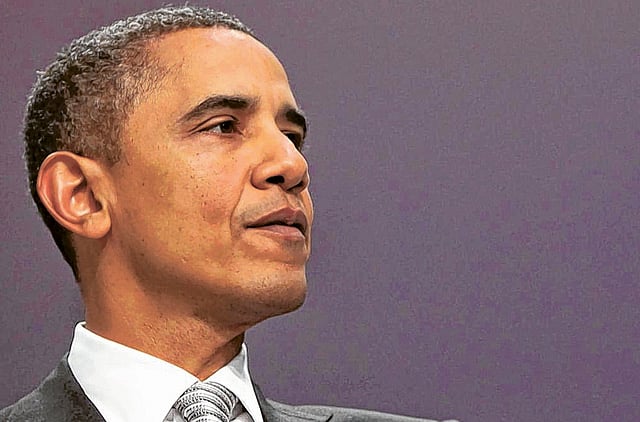
The ugly American is back. Can the handsome one do anything about it? When President Barack Obama addressed a shocked nation in Tuscon, Arizona, last week, he deployed the only weapon left to a crippled presidency: the power of rhetorical cliche. He deployed it brilliantly.
"Together we thrive," he cried meaninglessly. "For all our imperfections, we are full of decency and goodness." While American hearts were broken, "yet our hearts also have reason for fullness ... The forces that unite us are stronger than the forces that divide us." Despite pleas to keep war jargon out of political discourse, Obama asked: "How can we honour the fallen?"
More substantive was the president's remark that it "is part of our nature to demand explanations, to try to impose some order on the chaos". The process also involved "debating what might be done to prevent such tragedies in the future".
Americans had to make sure that they speak to each other "in a way that heals, not a way that wounds".
Foreigners are always surprised by the US's capacity to speak right but somehow not do it. Washington must contain more wisdom and talent than anywhere on earth, yet it contrives the disaster zone that is American foreign policy. This is normally put down to such impediments as the US constitution, the silent majority, sheer bigness and freedom of speech.
Today's culprit is freedom of speech, or at least the speech of the American right and its broadcast cheerleaders. Language that might not disturb a balanced mind can clearly stimulate and legitimise an unbalanced one.
The vitriol and inaccuracy of the campaign against Obama's public health reforms last year were like those against abortion and homosexuality. The debate was infused with nastiness and xenophobia, as if the US was a land composed of tribes bred only to hate the outside world, and often themselves.
Little knowledge
I was asked some time ago by a university-educated Texan, in the nicest possible way, what it was like to live in a country of "baby-killers" about to be "overrun by Muslim bad guys". I inquired where he had gained this bizarre impression of Europe, which he had never visited.
It turned out his sole information about the world beyond America's shore came from Fox News. He was not stupid. But he and millions of people like him considered this source of news a sufficient window on the world. He genuinely thought American troops would soon have to save Europe from "the Arabs".
Freedom of speech, like freedom of traffic, can only be defined by the curbs and regulations that make it real. The right wing seeks to curb WikiLeaks, and the left seeks to curb "hate speech". The right wants the freedom to finance unlimited political propaganda, and the left wants the freedom of unlimited access to state secrets.
There is nothing peculiarly American about this. Last month Julian Assange of WikiLeaks was in effect gagged when he was jailed. The motor racing boss Max Mosley went to court to seek a court order censoring journalists. There were efforts to censor the Twitter site of the crackpot celebrity Kenneth Tong for promoting anorexia. No sooner does free speech open its mouth than someone puts a foot in it.
Free speech is a Hobbesian jungle. It requires a marketplace where the trade in information, ideas and opinion has a framework of rules, including rules that maintain fair and open competition. Most will be voluntary, but others need enforcement.
Media polarisation
Yet Obama himself declined to champion the ‘fairness doctrine' that once governed broadcasting licences awarded by America's Federal Communications Commission, and governs them throughout Europe.
The doctrine was rescinded in 1987 under pressure from the right, stimulating the growth of one-sided broadcasting outlets such as shock-jock radio stations and Fox News. While Jon Stewart and others have counter-punched from the left, it strains credulity to maintain that this polarisation has had no impact on the virulence — and immobility — of American public life.
When it comes to Mosley's defamation or Tong's twittering, most Europeans would rely on self-discipline on the part of the media, and on the chaotic pluralism of the internet. Even so, they would argue for regulated airwaves, as they would for laws preventing libel, slander and incitement to illegality and racial hatred. Freedom can only flourish in a climate of discipline.
When the British art historian and TV presenter Sir Kenneth Clark was asked what quality best defined civilisation, he did not answer with liberty or wealth or equality. He answered with courtesy, the framework of rules governing people's tolerance of each other, so their discourse might be creative. Most of the time, it is best for that courtesy to be informal.
The best rebuttal of the politics of hate is a torrent of love — or, if not love, at least of facts.
But sometimes, as Obama said, there is a yearning "to try to impose some order on the chaos". If American politics is now going the way of wounding, not healing, it needs the tonic of order.
It is the great paradox of democracy. Free speech cannot exist without chains.
Simon Jenkins is a journalist and author.
Sign up for the Daily Briefing
Get the latest news and updates straight to your inbox
Network Links
GN StoreDownload our app
© Al Nisr Publishing LLC 2026. All rights reserved.