In this second article of a two-part series on environmental governance, let's look at how policy, institutional, technological and economic factors are responsible for desertification in the region. The expansion of cropland, overgrazing, infrastructure growth, increased aridity, and wood extraction have resulted in greater degradation and decreased land productivity.
For example, national food security policies adopted by many countries of the region have included provision of incentives such as subsidised agricultural inputs and free or cheap water for irrigation. The resulting intensification of agriculture has had a severe impact on the region's water and land resources. Overgrazing, agricultural activities and deforestation remain the crucial causes of land degradation.
There have been efforts to combat desertification through preparation of national action plans and technological initiatives in the agricultural sector.
The Gulf Cooperation Council (GCC) was till recently relying heavily on command-and-control (CAC) as the backbone of its environmental governance. Fines and penalties are present in GCC environmental legislations even though economic instruments are not yet integrated into environmental legislation and policies. However, in recent years, there has been some shift towards adopting some economic instruments as well as other educational, institutional and technological tools for environmental governance, especially in relation to water resources.
With regard to marine and coastal issues, the region faces severe pressure owing to diverse developmental and anthropological activities. Population growth, particularly in coastal areas, has seen an unprecedented increase.
Heavy industry
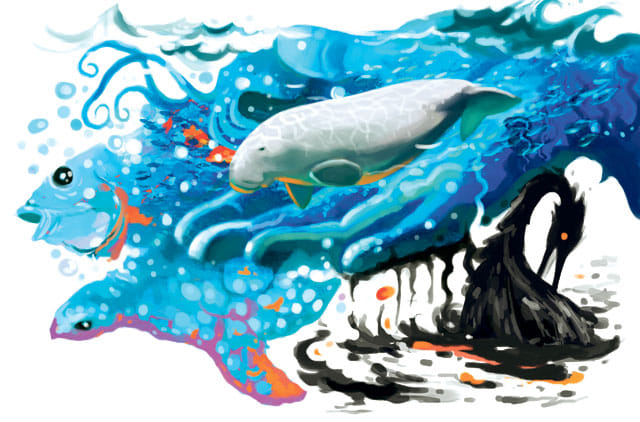
Together with the pressures imposed by the growth in coastal population, unsustainable fishing practices and over-exploitation of marine resources, the other major factors adversely affecting marine biodiversity in the region relate to the growth of heavy industry, especially petrochemical, the hazards of oil spills and pollution from desalinisation plants. Recreation and coastal tourism are also important factors.
In order to address the environmental challenges faced by coastal and marine ecosystems due to growing development activity, GCC countries have taken various steps, including policy and institutional measures at the national and regional levels as well as by participating in many international agreements and conventions.
Governments across the region have adopted some important marine policies such as an integrated coastal area management, establishment of protected marine areas and regulation of fishing activity. However, given its trans-national nature, the long-term sustainable management of coastal ecosystems in the Gulf requires an integrated approach at the regional level. This is especially relevant in planning and implementing conservation programmes for dugongs, sea turtles, coral reefs and mangrove forests.
To sum up, good environmental governance depends on a number of tools.
Policy mix
Tools vary between legal, institutional, educational and technological ones. No one single tool can achieve sustainable development and good governance. A number of tools — a mix of policies — are required to achieve good environmental governance).
There is no specific formula of a policy mix advised for all countries in the region. In fact, the combination of tools varies according to a lot of factors such as level of economic development, customs, level of environmental awareness, seriousness of environmental issue. Thus tools vary from country to country and over time in one country.
However, legislation is a prerequisite for good environmental governance. Continuous update of legislation is a crucial for good governance as conditions and situations change over time.
Finally, there is no one solution that fits all. Every country may need to tailor its own management system to fit its specific needs. Policy measures vary from state to state and from local to national and regional levels of governance.
Creating environmental change is a long process that requires at first a vision of what is wanted and then an understanding of how to make this happen. Several elements affect change and these can be reflected in a framework that proposes specific considerations, including mechanisms, instruments, actors/targets, influences and resources.
One hopes that the GCC adopts further steps on regional environmental governance which will help address common and joint environmental problems (water, marine, land, air and energy).
This will without doubt guarantee better and effective solutions and finally a better quality of life for all the people in the region.
Dr Mohammad Abdel Raouf is an independent environmental researcher.
Sign up for the Daily Briefing
Get the latest news and updates straight to your inbox
Network Links
GN StoreDownload our app
© Al Nisr Publishing LLC 2026. All rights reserved.