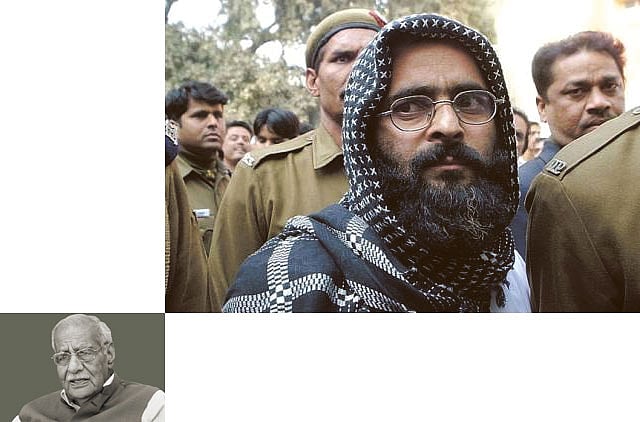
I WAS at the Parliament House when Afzal Guru and a few others attacked it in December 2001. Members like me were furious over the incident and the first suspicion was on Pakistan. It turned out to be true because the three who escaped were from Pakistan. Guru was from Kashmir and hence the same mix-up of Kashmir with Pakistan.
How to sort out the Kashmir problem or, more so, why it has been held hanging thus far are questions that need to be answered by the rulers — both in Srinagar and New Delhi. Jammu and Kashmir Chief Minister Omar Abdullah shrugs his shoulders and says that it is a long-term problem — as if it becomes less pressing by saying so. He says he has attended to the short-term problem of security and law and order following Guru’s hanging.
Has Omar really done so? Already, most towns in Kashmir are under curfew and there are reports of clashes between the youth and the security forces. The fact that newspapers have been advised not to publish stories about the trouble and the television channels told to black out footage are enough indication of how the situation is.
The effect on the youth, which are entrapped in a situation of not their doing, is there for everyone to see. Some 66 years of uncertainty, accentuated by three wars between India and Pakistan, should have been a long enough period to narrow the distance on the Kashmir problem, if not to find a final solution. What do the Kashmiris do when they are considered a problem in the rest of the country? Are they spotted out as Kashmiris who have not accepted their state’s accession to India from heart?
By repeating that Jammu and Kashmir are an integral part of India, the state does not become one. True, independent elections have thrown up the representatives who govern the state. Yet, they are always looking towards New Delhi for its rating. Shaikh Abdullah, who spent 12 years in detention, had to accept an agreement which he assumed would give the state an autonomy of sorts. However, his assessment turned out to be wrong. I can appreciate the argument that the centre wants to “do something”, but I find it hard to believe that the opponents are willingly endorsing what New Delhi does.
Pakistan could have helped the situation ease by not sending terrorists across the border. However, why should it oblige New Delhi when, from the Inter Services Intelligence (ISI) to Hafeez Sayeed — the man responsible for the 26/11 Mumbai attacks — are demanding the valley’s accession to Pakistan? Enemies can sit across the table for talks, but so long as they do not give up suspicion and mistrust, they do not reach anywhere. Therefore, the composite talks will not take the two anywhere, but composite approach can. For one year, the Atal Bihari Vajpayee government had kept the forces at the border, but had to withdraw them sheepishly.
Yet, it is not understandable why Guru — no doubt pronounced guilty by the Supreme Court and the constitutional head, President Pranab Mukherjee — was not given the due before being hanged. His family was not given access to him. Even a dictator like General Zia-ul Haq had allowed Zulfikar Ali Bhutto’s family to meet him a day or so before he was hanged. Why not Guru’s family?
Guru’s family could have been called to New Delhi on some “urgent work” if even a whiff of suspicion was not to be raised. The jail manual lays down meeting of the condemned with the family before hanging. It is understandable that the body cannot be handed over to the family, lest another centre of martyrdom should come up in Srinagar. But there would have been no harm in allowing the family members to say “fateh” at the place where he is buried at the Tihar Jail in Delhi.
When the Supreme Court bases its judgement primarily on “the circumstantial evidence,” it becomes all the more necessary to commute the death conviction to life sentence. It would have been better if it had been done so. I am against capital punishment, but the life sentence, till he breathes last in the jail, could have served the end of justice better.
If Guru’s hanging leads to serious discussion on Kashmir, the entire furore will take some concrete shape. However, if the government had considered this at all, it would not have detained the Hurriyat leaders. It is a pity that the whole thing does not seem to go beyond the temporary issue of a law-and-order problem. Omar himself could have initiated talks, to be taken further by Delhi subsequently.
Whether or not a dialogue begins, the experience of being in the Parliament House when it was attacked will always stay with me. I recall how tempers were frayed in the Central Hall. Two hours after the first shot was heard, the then minister for parliamentary affairs, Pramod Mahajan, stood up on a table to announce that MPs could now leave, women first. The members were not panicky even in the first instance, but appeared more than relieved when they heard that all was over.
The then information and broadcasting minister, Sushma Swaraj, refused to go with the caravan of women. I heard her saying something like: “Let me find out what really happened.” By then, the army had arrived. I saw some members thanking Mahajan, including those who had sought his resignation. It was a curious kind of camaraderie, reflecting a unity which the country assumes when confronting an external threat.
Democracy is an idea, a nation’s determination that extremists can never understand. They only strengthen the belief that no price is too high to sustain freedom and democracy. I returned to parliament the following day as usual, as others did, to reaffirm our faith in the institution and to warn the assailants and their masters to keep their hands off.
Still, the anger against Pakistan was voiced practically by every member. I often wonder if Pakistan is a solution or the problem.
Kuldip Nayar is a former Indian high commissioner to the United Kingdom and a former Rajya Sabha member.
Sign up for the Daily Briefing
Get the latest news and updates straight to your inbox
Network Links
GN StoreDownload our app
© Al Nisr Publishing LLC 2026. All rights reserved.