Monster in your inbox
Nowhere else does the monster known as information overload rear its ugly head more visibly than in our inboxes at work.
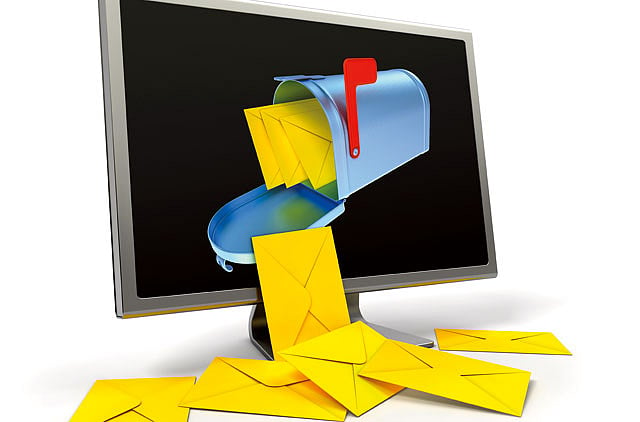
There are many ways to deal with an overflowing, overwhelming inbox. You can archive. You can spike. You can categorise.
But how do you sort out more than 2,000 emails? "Delete them," Bradley Boyer would say.
"No way!" you would retort. "What if I delete something important?"
Delete anyway, he would tell you. Just as he told one of his clients, a senior level executive, who had returned from maternity leave only to find thousands of unread emails.
"Those who wanted to get in touch with my client sent her another email or called her," says Boyer, the founder of US-based Boyer Communications Group, who for the past 20 years, has helped professionals perfect their communication skills. His motto: if there is no action in the communication, don't send it.
It makes sense. He says our brain, unlike microchips, cannot be upgraded. It cannot process infinite information. If people had a better philosophy, a better belief on the purpose of every piece of information, half of the problem will go away. The problem he refers to is information overload, especially in an office environment where it rears its ugly head in inboxes and through other electronic distractions. The problem hides other problems. Rather like a Russian matryoshka, the nesting doll that reveals figures inside one large casing. Information overload, hides under its broad definition, several issues.
The problem affects productivity, quality of life, job satisfaction and business cycle, among others. To mitigate, researchers and companies have come up with solutions, ranging from management methodologies to technical practices and computing tools. Xerox Corporation is one such solution provider. Over the past three decades, the company has studied how workers communicate and get work done. In fact, the company also sponsored International Data Corporation (IDC), the global provider of market intelligence, to conducta survey last year on tackling information overload at the source.
IDC responded withstartling findings.
"It is now commonplace to get too many emails, reports and messages. The inability to process this information to make sensible decisions could delay decision making or lead to wrong decisions," says Dan Smith, general manager for integrated marketing for the Middle East and Africa of Xerox's Developing Markets Operations.
Like Boyer, Smith makes sense. He says, "Increasingly, speed is of essence when dealing with a wide and varied workload. Thus, simple prioritisation, effective delegation and quick processing of information are skills needed to manage workload."
Boyer explains the problem of information overload through a metaphor. He says information is like food. When food was scarce, you didn't have a problem with your diet. You got sick only after there were too many food choices. To stay healthy, you have to be aware of what is or isn't nutritious. It is the same with information - you have to be aware of its intent.
He calls his metaphor infobesity,a neologism.
"We need to establish a conscious information policy instead of everybody spending hours creating communications that no one reads. It is a fairly new approach; people are just starting to nod their heads about it. I've tried this with a few clients and have seen positive results."
When Boyer asks employees to examine their inboxes, often he finds that they have 400-700 unread emails each.
So he asks, "If you read every one, how many would you say do not define the action you need to take?"
The answer is always between 50-70 per cent.
In other words, information that doesn't lead to someone taking action is a waste. "It isn't lean, it is infobese. Business runs on action," he says.
On a personal level, he follows his own advice. "When I email, I think about what I want the receiver to do. I do not write anything without an action in it. When I receive email, I follow the simple five seconds rule - decide, delegate or delete."
Eight ways to deal with it
Tackling information overload is important for global businesses. Xerox Corporation provides tips to reduce information overload in the office.
- Schedule breaks, even if it means stepping away from your desk for a few moments. This helps productivity.
- Try scheduling your meetings on specific days so you have more time on non-meeting days to process information coming in. It's easier to focus when you don't have a meeting in 20 minutes.
- No information is worse than too much. Make sure you have a solution in place for regular back up.
- De-clutter your physical desk and computer desktop. File, pile or toss papers as soon as you receive them. Scan and save important documents to reduce desktop clutter instead of filing. On your PC, get rid of folders and use search engines to find things when you need them.
- Often we waste time dealing with the same piece of information repeatedly. Respond as soon as you receive it, put it in its file or delete/shred it the first time you touch it.
- Choose quality over quantity. Manage your bills and accounts online and tick ‘do not call' and ‘no junk mail' options.
- Use your tools. For instance, don't waste time printing maps, access them from your phone.
- RSS reprieve. Sign up for an aggregator. It helps see all your news in one place.
Think before you ‘send'
Imagine that every unread email in your inbox is phone call that has to be returned. Your reaction? Alarm, according to Boyer.
He provides tips to deal with information overload in the office…
- Avoid an emotional relationship with information. If you do, you might hold on to emails and information titbits that you don't need or aren't good for you.
- Think before you click on the ‘reply all' option.
- Check your emails twice a day. We have unconscious expectations, and some are so obsessed that they check their inboxes every few minutes.
- Don't view news in the morning because it can be overwhelming. If you have missed something important, you will hear about it.
- If possible, use the subject line as your entire message, and end with EOM (end of message).
BTW
Xerox Corporation is also a member of the Information Overload Research Group (IORG).
FYI
IORG brings together research, solutions and people to help reduce the impact of information overload.
Did you know?
Boyer Communications Group has helped design over 25,000 verbal and written business presentations.
Sign up for the Daily Briefing
Get the latest news and updates straight to your inbox
Network Links
GN StoreDownload our app
© Al Nisr Publishing LLC 2026. All rights reserved.