A collector of unique maps
Prshant Lahoti’s growing collection is a treasure trove of historical information, gathered with passion for more than 13 years now
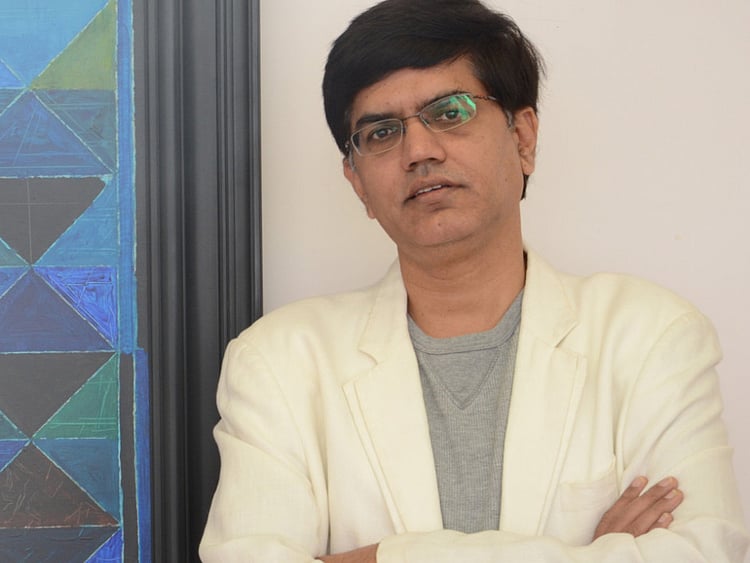
For the young generation, Google maps on GPS-enabled phones are the easiest way to find any location and reach their destination anywhere in the world. Therefore, they find it peculiar and difficult to fathom how people across the world found their way around a century or two ago.
Hyderabad-based Prshant Lahoti says, “For precisely this reason, I am now trying to create awareness regarding these old treasure troves.”
A real estate developer and owner of Kalakriti art gallery, Lahoti recently held exhibitions in Kochi and New Delhi that took the visitors back to an earlier era, beckoning them to imagine how our predecessors got by in a pre-internet world.
Lahoti has been collecting maps for more than 13 years. Speaking about his interest, he says, “The journey began in 2002 when I stepped into in a small antique shop in Edinburgh, Scotland, where I found myself looking at a rare map of India. I was quite intrigued going through its details and that’s where my fascination for maps started.”
Since then, his collection has grown to 3,000 and counting. “It is, in fact, the largest private collection of historical maps in India,” he says.
While some maps came cheap, others cost him more than Rs1 million (Dh56,666) each. Lahoti feels that since paper is becoming obsolete, collections such as these could be of great historical importance and a resource for a learning experience.
Even though some of the maps have been researched, Lahoti says, it is not possible for him to preserve them. “Apart from inserting them in archival sleeves and storing in a weather-controlled room, there is nothing much I can do about the collection. I want the younger generation to develop an interest in maps, so that the next time they find a map in their house, they don’t throw it, as these are in danger of getting lost to future generations.”
The art of map-making began centuries ago, as an attempt to chart the lineaments of the universe. The oldest surviving maps, for instance, were only cosmological representations of observed reality. In the decades that followed, maps acquired a newfound specificity and they became more pictographic, focusing on popular and accessible locales such as sites of pilgrimage, coastlines of major rivers and fortified castles. It was only after this transient phase that map-making evolved fully into the complex science of cartography.
Lahoti is so obsessed with maps that he makes it a point to visit antiques shops, including bookstores, on his national and international trips. “These are the places that generally sell maps. I also take part in auctions held across the world. One doesn’t have to be present at auctions these days and I participate in such events even while travelling, at the airports, during meetings or even at a party,” he says.
The earliest map in his collection dates back to the late 15th century and the latest was composed sometime during the early 19th century. The massive compilation reveals the origin of maps in India through works printed in Germany, Italy, England and Turkey.
From hand-drawn manuscript versions to watercolours and printed copies, these maps together tell a story of how, using map-making, people came to make sense of their surroundings. It also explains how the past was discovered.
The exhibition traced the evolution of map-making in India — from paintings depicting mythological visions of the cosmos to those charting courses of holy rivers, including the Ganga and Alaknanda rivers and places of pilgrimage.
One map features the dramatic struggle between the European powers and Indian states aiming to establish supremacy. The Rise of Raj focuses on Britain’s quest to scientifically map the subcontinent.
According to historians, the 16th century began with the gradual consolidation of the Portuguese hold over India’s western coast. And though other European powers were also eyeing it, it was not possible for them to make headway until the Portuguese route and the Indian subcontinent were mapped. Thus, the first international spies in a bid to outwit their rival European powers changed the history and geography of the world. But by then, the Moguls had already mapped their way into the subcontinent.
One of the maps in Lahoti’s collection is by Dutch merchant trader and historian Jan Huyghen van Linschoten. He served as the Portuguese Viceroy’s secretary in Goa in 1583 and later abused the trust given to him by the Viceroy as he copied secret maps page by page. His book “Itinerario”, published in 1596, graphically detailed maps of voyages to India for the Europeans.
According to curator Alex Johnson, the Linschoten map was based on stolen Portuguese manuscripts and helped to open the navigational routes for the English and the Dutch. The East India Company could finally end the 16th century monopoly enjoyed by the Portuguese.
Another map is of northern India, published in Istanbul in 1732, which was believed to be the first map of the country to be printed in the Islamic world and to employ Arabic script.
The map of River Ganga is quite fascinating. Read from left to right, it shows that at one point of time, action was mostly towards the right bank of the river.
Then there are maps of cities displaying the transition from the birth to becoming modern cities.
A fine plan of Old Delhi was issued during the siege of Delhi, which was a major event of the 1857 uprising. While the Delhi region had been settled as early as the 6th century BC, the city went through numerous reincarnations. The Mogul Emperor Shah Jahan, as depicted in the map, founded Delhi in 1633 to serve as his new capital.
Named Shahjahanabad, it comprised 1,813 hectares enclosed by great walls. The colossal Red Fort, considered the imperial palace built in 1648, dominated the city. Delhi remained the Mogul capital until 1858, but its role diminished during the 18th and early 19th centuries. It was captured several times by powers including the Marathas and the Sikhs.
Lahoti also possesses a beautifully executed original contemporary manuscript map depicting the Fall of Madras in 1746 — a great French military victory over the British East India Company. This exquisite yet unfinished manuscript was prepared by a French nobleman to illustrate the event, which represented the most severe defeat the British would endure in India during the 18th century.
During the late 19th century, many survey maps were translated and published into Indian languages, including Hindi and Urdu. The map of Jaipur state is an excellent example, made to coincide with the Jaipur Exhibition of 1883 that was held under the patronage of Maharaja Sawai Madho Singh II.
Likewise, Thomas George Montgomerie’s monumental map of Jammu & Kashmir, printed in 1861, is a masterpiece of scientific alpine surveying and perhaps the most impressive component of the Great Trigonometrical Survey of India.
These mapping programmes also aided projects that served to unite India into a coherent entity, giving the country’s people a sense of national identity.
Lahoti has many such stories to tell. He also recalls the times when he had to return empty-handed and missed buying the maps he so wished to possess. “I lost quite a few maps in auctions. One of these was a lovely manuscript map of a Rajasthan fort and a manuscript French map of North India dating back to the 1750s,” he says.
His excitement returns as he shares details of a couple of world maps in his possession. “The most significant is a big Jesuit Chinese wall map of the world in six scrolls and another is a manuscript of the Chinese map of the world,” he says.
Nilima Pathak is a journalist based in New Delhi.
Sign up for the Daily Briefing
Get the latest news and updates straight to your inbox
Network Links
GN StoreDownload our app
© Al Nisr Publishing LLC 2026. All rights reserved.