How trends are redrawing the career map for Gen Zs
Gen Z is exploring careers spanning aerospace, AI, robotics, medicine and economics
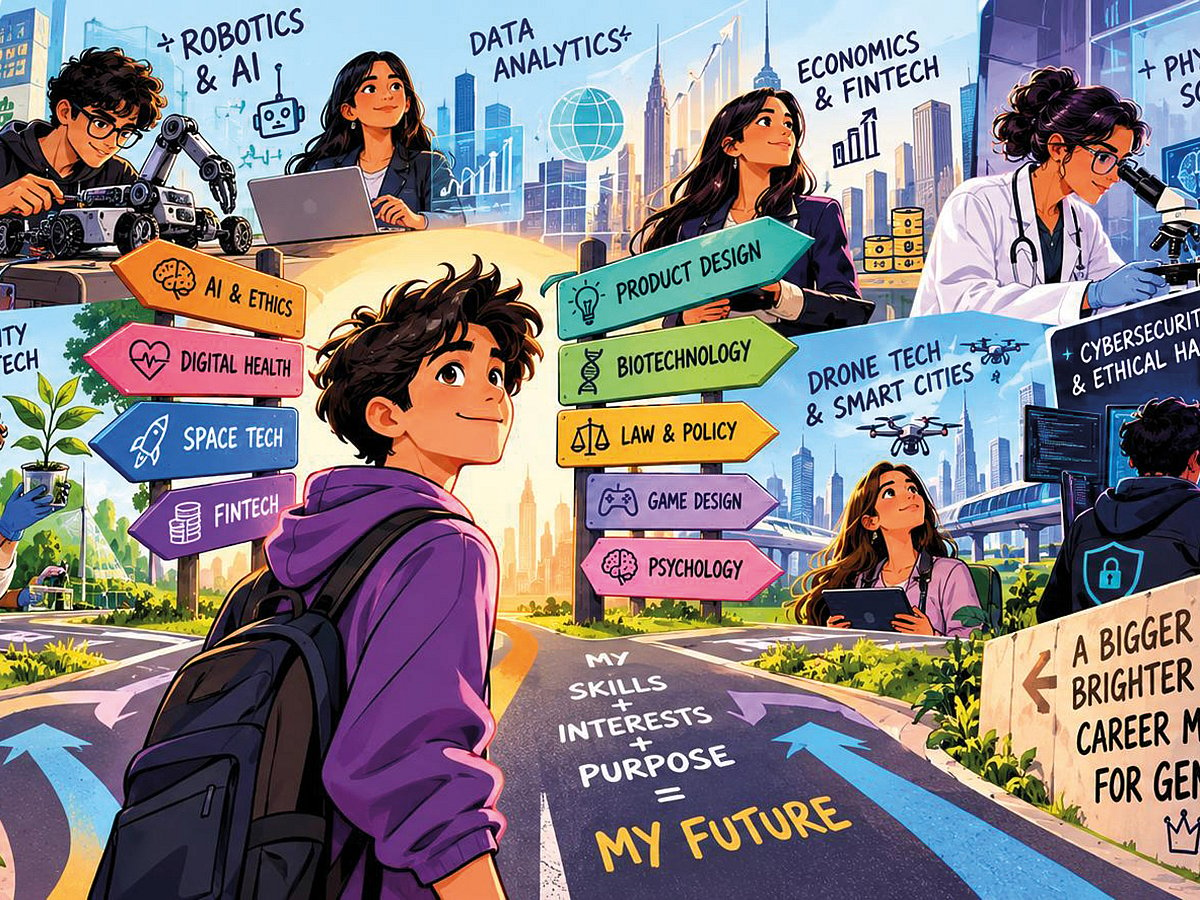
For Paarthav Karthik, the future does not look like a desk, a computer screen and eight hours of repetitive work.
“I don’t want to be in a desk job. I don’t want to just be at a computer,” says the Dubai student, who is a regular in international robotics and computer science competitions.
His idea of a career involves making things, solving problems, experimenting and being part of something new. To that end, he is preparing to pursue computer science, artificial intelligence and data analytics for his undergrad.
Traditional careers in medicine, engineering, law and accounting may still be alive. “But alongside it is a rapidly expanding menu that includes artificial intelligence, aerospace, robotics, fintech, data analytics, industrial engineering, digital health, cybersecurity, product design, creative technology, sustainability and combinations such as AI with ethics, law, and healthcare,” says Trupti Gokhale, Professor of Biotechnology and Associate Dean, Alumni Relations at BITS Pilani, Dubai Campus.
The World Economic Forum’s Future of Jobs Report 2025 identifies big data specialists, fintech engineers, AI and machine-learning specialists and software developers among the fastest-growing roles, while cybersecurity and green-transition careers are also expanding.
The challenge then for students today is not in finding an interesting course, but one that fits.
Aryan Gujarathi, 16, had set his sight on the stars thanks to his parents who’d regularly take him to the Al Thuraya Astronomy Centre in Dubai. “My early dream of becoming an astronaut gradually evolved into something more tangible: aerospace engineering,” he says.
Personalised career counselling helped him translate that fascination into a possible pathway. Research then filled in the practical details. Physics and mathematics are his strongest subjects, and aerospace engineering offered the combination of science, complex mathematics and propulsion systems he was looking for. “It’s perfect,” he says.
Rema Menon Vellat, Director of Counselling Point Training and Development, with more than two decades of experience in the career counselling space, says students need to choose a course based on “fit, not hype”. Psychometric assessments, counselling, internships, summer programmes and short courses can help them experience a field before committing to it.
Sreevidhya Santhosh, Career Guidance Expert and Founder of EdXGuider, Calibri Training and SREES Academy, agrees. “Job shadowing and job exposure, and conversations with professionals can reveal what the actual working day behind a glamorous job title looks like,” she says. With more than two decades of experience, she and her team offer personalised counselling sessions including tests to help students identify their strengths and career fits.
That said, sometimes the most useful career guidance could come from watching a child closely.
Nisha Yezdi, a Dubai-based mother of three, learnt this while watching her twin sons grow up. Raised in the same home and exposed to the same activities, the boys nevertheless developed very different interests.
“Atarsh had always displayed an instinct for accounting and value, moved towards economics and statistics, doing a BSc Double Majors in Economics and Statistics; he’s now preparing for CFA,” says Nisha.
“The other twin, Aryan, is very interested in science and loves mathematics, and is pursuing a Master’s in Bio Chem.”
The lesson for parents, experts say, is not simply to allow a child to “follow their passion” but to look for the intersection of interest and aptitude.
Evolving careerscape
The biggest change in the career landscape is that technology is no longer a career category in itself. It is becoming the connective tissue between disciplines.
Trupti points to digital health, robotics and automation, fintech, product design, creative technology, renewable energy and digital infrastructure where this inter-relatedness is becoming clearer. She also sees growing scope for hybrid careers: AI in healthcare, AI in law, AI in climate and AI in governance.
“Implementation of technology is now reflected in all fields and not limited to engineering,” she says.
Paarthav is already looking at this convergence. His psychometric assessment suggested possible strengths across engineering, business and creative fields. Rather than choosing one and abandoning the others, he is looking at a BSc in Computer Science with a double major in Business Analytics, with the computer science component specialising in AI engineering.
It sounds complicated. That is precisely the point. Gen Z may be increasingly comfortable with careers that sit between traditional categories underscoring that the course doesn’t have to fit into one box.
Universities, too, are responding.
Some of the more unique courses that are fast gaining popularity include climate technology and carbon management, smart cities and urban technology, drone tech and aerial mapping, and space technology and satellite data.
New technology-focused programmes, including mechatronics and AI systems engineering, are emerging as are programs such as AI and ethics for students interested in law exploring the implications of AI.
Sreevidhya underscores this aspect. “Today, AI and its applications are among the most popular choices, followed by finance and fintech, partly because of their perceived earning potential,” she says. “Psychology is also gaining popularity, driven by a growing awareness of mental health. Forensic science, fuelled by crime dramas and novels, is another fast-growing option, while cybersecurity and ethical hacking, gaming and related fields are increasingly attracting students.”
Adding value
Trupti believes students should look for courses that expand rather than restrict their future options. “Your career choice should not lock you into one career, but should open avenues to several credible paths,” she suggests.
That could mean electronics leading into biosensors and diagnostics, engineering moving into product design, economics leading into finance, policy or consulting, or psychology opening doors beyond traditional counselling. She similarly advises students to look beyond the qualification itself. “A course should add capabilities rather than simply another certificate,” she says.
Justina Jibin, a GenZ, offers an example of moving sideways rather than following the conventional science-to-engineering route.
Having studied PCM and Economics in high school, she could have pursued engineering. Instead, she chose a bachelor’s in Economics after exploring her interests and speaking to counsellors, seniors and professionals.
“Choosing economics was a deliberate choice that allowed me to combine analytical thinking with my interest in people, communication and business,” she says.
Her research revealed possible careers in consulting, international organisations and government.
The lifestyle angle
While financial security is a factor when choosing a career, Gen Z apepars to be laying a bitmore emphasis on other requirements: autonomy, intellectual stimulation, purpose, creativity, flexibility and the ability to keep learning.
For Zara A Zamir, for instance, purpose sits at the centre of the equation.
The 16-year-old is passionate about neurosurgery and sees herself eventually becoming a physician-scientist, combining clinical medicine with research.
Her attraction to the field comes from the intersection of science, problem-solving, continuous learning and human impact. “Success to me means becoming very good at something difficult, and then using that knowledge meaningfully, for a good reason,” says the Sharjah student.
Zara has her homework well - clinical observerships under neurosurgeons, and exposure to neurosurgery and spinal surgery helped her understand whether the work she found fascinating academically was something she could actually imagine doing.
Rema approves that. “Explore before you commit,” she advises, warning that some students are overwhelmed by the sheer number of choices, while others choose because a course is fashionable, lucrative or popular among their peers. “Self-awareness is key to making judicious choices,” she says.
While Sreevidhya makes it clear that students should ask themselves whether a career matches their academic profile, temperament, strengths, personality and working style, and if it aligns with their values and long-term goals, Justina sums up a perspective many GenZs would agree with. “If you’re happy doing what you’re doing, if you enjoy it and you’re excited to do it, then I don’t think anybody can tell you that you’re not successful.”
Sign up for the Daily Briefing
Get the latest news and updates straight to your inbox
Network Links
GN StoreDownload our app
© Al Nisr Publishing LLC 2026. All rights reserved.