Magdy Abdou, Director of Regulatory Affairs, Governmental Affairs, and Market Access, Servier Middle East and Dr Younis Qazzim, Director General Advisor, Acting CEO of Public Health, Dubai Health Authority (DHA) speaking at the panel
How the UAE is shaping the future of cancer treatment in the region
New investments and research put the UAE at the forefront of oncology treatment
Last updated:
5 MIN READ
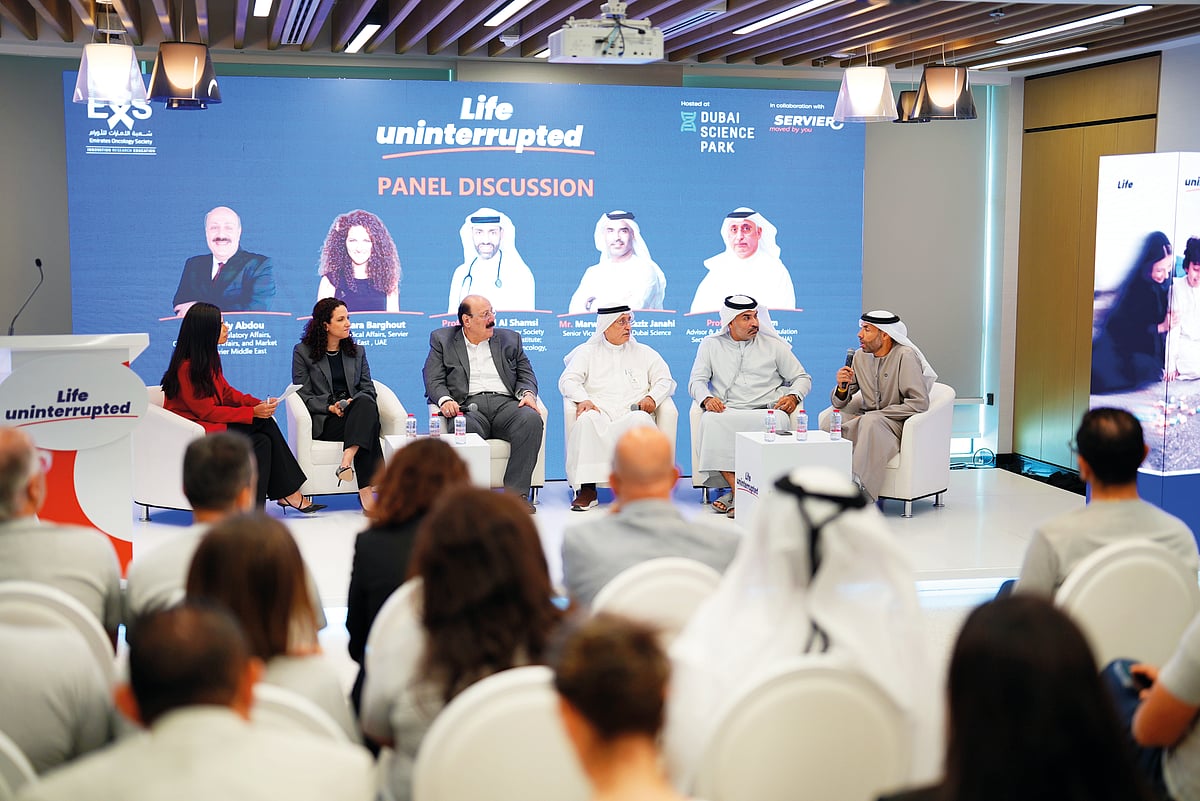
Tamara Barghout, Director of Medical Affairs, Servier Middle East (second from left); Magdy Abdou, Director of Regulatory Affairs, Governmental Affairs, and Market Access, Servier Middle East; Dr Younis Qazzim, Director General Advisor, Acting CEO of Public Health, Dubai Health Authority (DHA); Marwan Abdulaziz Janahi, Senior Vice President of Dubai Science Park, part of TECOM Group; and Prof. Humaid Al Shamsi, President of EOS, CEO, Burjeel Cancer Institute and Adjunct Clinical Professor of Oncology, University of Sharjah, during the panel discussion at Dubai’s Science Park
In Dubai’s Science Park conference hall, a distinguished group of oncologists, regulators, researchers, pharmaceutical leaders and healthcare innovators mulled one question in detail: What does the future of cancer care look like, and how much of that future is already here in the UAE?
The timing was perfect — Grey May is the international month for brain tumor awareness. As precision therapies are beginning to reshape clinical practice across the Gulf, experts explored how innovation in precision oncology can translate into better outcomes for patients in the UAE and beyond.
In attendance was Dr. Shaikha Almazrouei, Director of Reference National Laboratory, Emirates Drug Establishment. The panelists included Marwan Abdulaziz Janahi, Senior Vice President of Dubai Science Park, part of TECOM Group; Prof. Humaid Al Shamsi, President of EOS, who also serves as CEO, Burjeel Cancer Institute and Adjunct Clinical Professor of Oncology, University of Sharjah; Dr Younis Qazzim, Director General Advisor, Acting CEO of Public Health, Dubai Health Authority (DHA); Magdy Abdou, Director of Regulatory Affairs, Governmental Affairs, and Market Access, Servier Middle East; and Tamara Barghout, Director of Medical Affairs, Servier Middle East.
In his keynote address, Al Shamsi said, “Glioma remains among the most challenging cancers. This discussion is about turning awareness into action — identifying where progress is being made and where better coordination is needed so that every patient can benefit.
“Cancer care in the UAE is far more advanced than many people realise,” he added. “We in the UAE are already practising precision oncology at a very high level.”
The event marked the launch of Servier’s new awareness campaign, Life Uninterrupted, which seeks to spotlight the lived experiences of patients navigating rare cancers, particularly brain tumours.
Rare cancers, those occurring in fewer than 6 per 100,000 people, remain among the most challenging to detect and treat. Cancer is the third leading cause of death in the UAE, with brain cancer ranking tenth among malignancies.
At the heart of the discussion was a powerful idea: cancer care is no longer simply about chemotherapy, surgery or radiation. Increasingly, it is about decoding the genetic identity of every individual tumor and tailoring treatment accordingly. And the UAE is rapidly emerging as one of the world’s most ambitious laboratories for this new era of medicine, the speakers underscored.
A strong ecosystem is essential
A strong point that emerged from the event was that breakthroughs in oncology cannot happen in isolation. Innovation depends on an ecosystem that connects regulators, hospitals, researchers, pharmaceutical companies, startups and academia.
“That ecosystem is one of the UAE’s greatest strengths,” said Janahi. “When we established Dubai Science Park nearly 20 years ago, the vision was to build a community of companies,” he said. “You need large companies, start-ups, universities and researchers all working together. That interaction sparks innovation.”
He pointed to the increasing convergence between academia, healthcare institutions and industry, particularly as funding opportunities and artificial intelligence accelerate the pace of medical research.
“Drug development that once took 10 to 12 years is now being significantly accelerated,” he said. “The UAE is becoming a real testbed for innovation.”
The country’s diversity, he added, also gives it a unique advantage. “The UAE has government healthcare systems, private healthcare systems and international collaborations all operating together,” he said. “Everyone shares the same goal - to improve patients’ lives.”
Speed was another factor several speakers highlighted as a key reason the UAE is attracting attention in global healthcare circles.
According to Prof. Al Shamsi, the UAE recently became the first country in the world to approve a new breast cancer medication that had shown strong results in clinical trials.
“Many countries delayed approval because of cost concerns,” he said. “But the UAE placed patient health first.”
That agility is increasingly positioning the UAE as a regional hub for advanced therapies and medical tourism. “We are seeing more patients from across the GCC travelling to the UAE because treatments become available here earlier,” he said.
Dr Abdou echoed the sentiment. “Patients no longer need to travel abroad for many advanced therapies,” he said. “They can access them here.”
The campaign also aims to raise awareness about diseases that often remain under-discussed despite their devastating impact. “Brain tumours are still underrepresented when it comes to awareness,” Al Shamsi said. “We need to educate physicians, healthcare providers, patients and the public.”
AI and genomic science
Beyond cancer treatment itself, the discussion also explored how artificial intelligence and genomic science may fundamentally reshape healthcare in the years ahead.
Janahi pointed to initiatives such as the Emirati Genome Programme as examples of how the UAE is investing in preventive and predictive medicine. “The basis of prevention is understanding your DNA,” he said. “We now have an enormous bank of genomic information that can help us understand future disease risks.”
Artificial intelligence, meanwhile, is rapidly democratising access to medical information.
“Patients today are far more empowered,” he said, underscoring how healthcare is becoming increasingly data-driven, interactive and patient-centred.
Despite the optimism surrounding precision oncology, participants repeatedly stressed that major challenges remain.
One is research funding, particularly for rare cancers, a reason greater public-private collaboration remains essential, said Dr Younis Qazzim.
Tamara Barghout explained that Servier reinvests around 20 per cent of its revenue into research and development, with a particular focus on targeted therapies for difficult-to-treat cancers.
She also highlighted programmes such as Reach IDH, which supports molecular testing for patients with cancers including glioma, cholangiocarcinoma and acute myeloid leukaemia. “The goal is to ensure the right patient receives the right treatment at the right time,” she said.
Speaking to Gulf News on the sidelines of the event, Prof. Al Shamsi said that 20 years ago, most cancers were treated broadly the same way. “Now, because of genomic studies, we know there are multiple subtypes. Some respond to immunotherapy, some to targeted therapy, some to chemotherapy. The entire landscape has evolved.”
That transformation lies at the heart of precision oncology, an approach that uses genomic testing and molecular profiling to personalise treatment.
Prof. Al Shamsi described it in simpler terms. “We need to decode cancer,” he said. “We are trying to understand the biology, the mutations, the pathways that activate cancer cells. The future lies in decoding more and more of these cancer cells.”
It is a future that already appears tangible in clinics across the UAE.
“Every patient’s cancer is different,” he said. “Sometimes patients ask me why their friend with breast cancer received a different treatment. And I explain ‘your cancer carries different mutations. Therefore, your treatment is different’.”
To help patients understand the concept, he often reaches for an everyday analogy.
“If two people wear the same kandora, it still has to be tailored differently for each person,” he said. “Cancer treatment today is very personalised … more than people can imagine.”
Sign up for the Daily Briefing
Get the latest news and updates straight to your inbox
Network Links
GN StoreAbout Gulf NewsTerms & ConditionsReach by GNSitemapContact usPrivacy PolicyGN FocusHave your sayWork with usAdvertise with usGulf News epaperPrinting Services
Download our app
© Al Nisr Publishing LLC 2026. All rights reserved.