Zhandos Temirgali, President and CEO, 1Thirty Holding
GN FOCUS
1Thirty Holding: An industrial bridge from Kazakhstan to the Emirates
Linking Kazakhstan and the Gulf, building an industrial platform in powder coatings
Last updated:
4 MIN READ
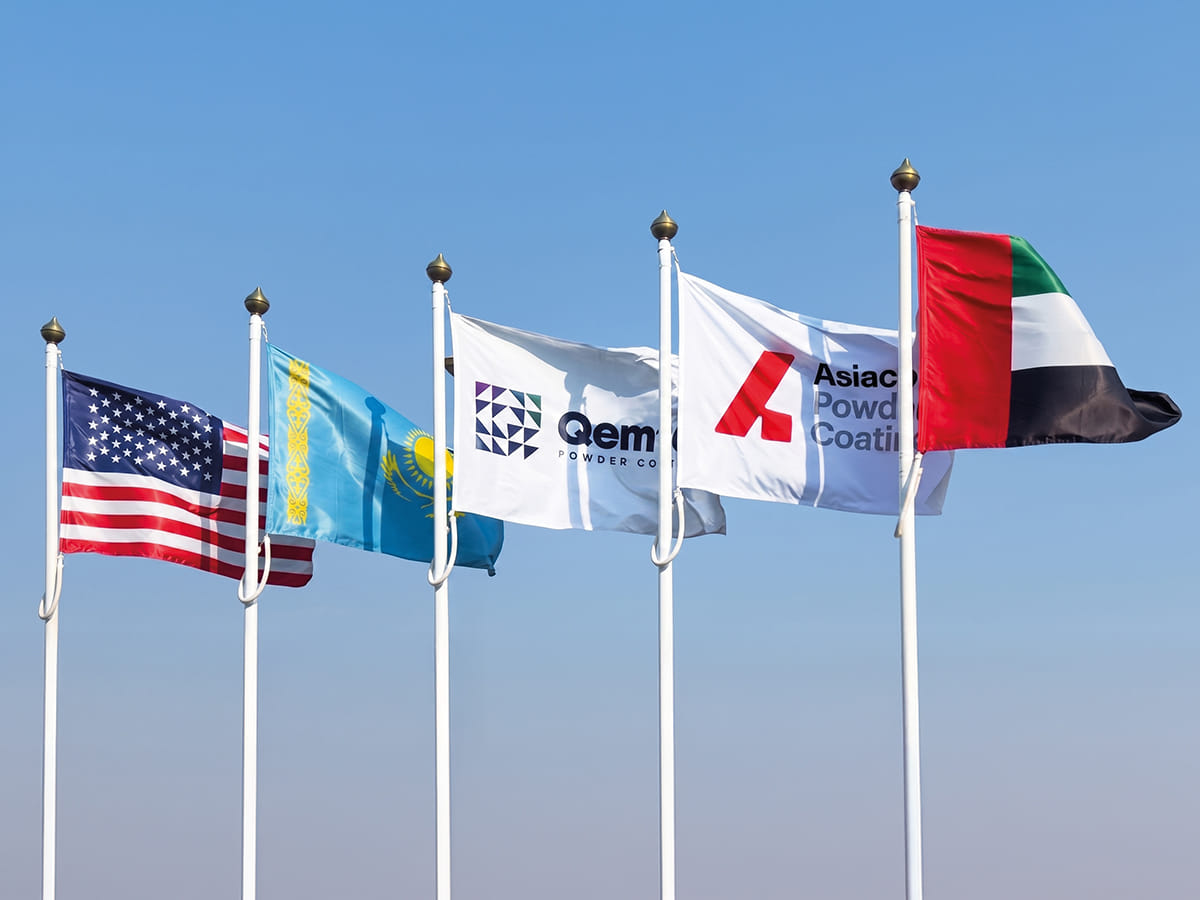
Industrial group 1Thirty Holding brings together manufacturing operations in Kazakhstan and the Gulf, including AsiaColor, its production platform in Kazakhstan, and Qemtex, its international project in the UAE. The group’s development mirrors the evolution of Kazakhstan’s powder coatings market, from early-stage distribution to industrial-scale production and international expansion.
In the early 2000s, powder coatings were largely absent from Kazakhstan’s industrial landscape. Long established in Western construction and manufacturing, the domestic market remained unfamiliar with the technology and the relevant technical standards. The advantages of powder coating systems and the application practices required for their effective use were also not widely understood.
In this environment, the business later known as AsiaColor began to take shape. In 2003, its founders launched a small trading operation in Almaty supplying powder coating materials to the domestic market. Demand was limited, and the primary challenge was not competition but awareness. Early initiatives centred on explaining the technology to manufacturers accustomed to traditional liquid paints and varnishes.
Throughout the following decade, AsiaColor grew alongside the market itself. As construction activity in Kazakhstan accelerated, with new façade systems appearing in urban architecture and industrial production modernising, powder coatings began to attract attention as a more durable and efficient finishing technology for metal products used in building, manufacturing, appliances and infrastructure.
By the early 2010s, the company had expanded its distribution network across multiple regions in Kazakhstan. In parallel, the domestic coatings market was undergoing structural change. Kazakhstan’s integration into the Eurasian Economic Union saw imports of finished coatings increase and price competition intensify. These developments forced local distributors to reconsider their business models.
For AsiaColor’s founders, the shift exposed a structural limitation: remaining purely a trading company left limited scope to compete with established foreign producers. The response was a gradual transition from distribution to production. In 2014, the AsiaColor brand was launched, marking the company’s first step toward developing its own product lines adapted to Kazakhstan’s industrial and climatic conditions.
The next milestone in the company’s development came with the construction of an industrial-scale powder coatings manufacturing facility in Kazakhstan. The facility’s design was informed by a years-long analysis of overseas production processes and formulations, before launching local production in 2019. From there, AsiaColor expanded its presence across the domestic market, with industry data estimating that the company accounts for close to two-thirds of total demand.
With domestic production established and market share expanding, the company began to explore opportunities beyond Kazakhstan. The Gulf quickly emerged as an attractive destination, given a construction boom supported by large-scale infrastructure projects, urban development and a growing metal-processing industry.
The company quickly entered the top tier in the UAE, with exports across the region.
Entry into the region came through the creation of Qemtex, a powder coatings manufacturing project established in the UAE’s Umm Al Quwain Free Trade Zone. For the company, expansion to the UAE marked the first step in adapting the Kazakh manufacturing model to a broader international market, while maintaining Kazakhstan as the group’s production base.
Since its launch in 2024, the Qemtex facility in the UAE has established the group’s presence in the regional coatings market. Analysis in Manufacturing Journal indicates that the company quickly entered the top tier in the UAE, with exports across the region and an annual production capacity of around 5,000 tonnes. The initiative has been characterised as the first manufacturing foreign direct investment project in the UAE by Kazakh entrepreneurs.
Alexander Glukhov, Chairman of the Board of Directors - 1Thirty Holding
Qemtex’s facility was developed to serve both domestic demand in the UAE and export markets across the Gulf and parts of the Middle East, Africa and South Asia. More than $16 million has been invested in the project, reflecting the scale of industrial infrastructure required for powder coating production, including formulation laboratories, testing facilities and specialised manufacturing equipment. The venture is regarded as a key example of Kazakhstan–UAE economic cooperation in the industrial sector, illustrating the broader expansion of bilateral economic ties.
With production bases in both Kazakhstan and the UAE, today the group serves customers across multiple regional markets while adapting to different industrial and climatic conditions, with UAE-made products exported across the Middle East, Asia and Africa.
The company’s expansion into the UAE reflects a broader trend among industrial groups originating in emerging markets. As domestic capabilities mature, companies increasingly seek to extend proven production models into new regions with established construction and industrial demand.
For AsiaColor and Qemtex, Kazakhstan remains the core production base, while 1Thirty Holding plans to develop a new facility in Astana, alongside a research and development centre intended to support formulation and technical testing.
The location of this planned expansion aligns with wider shifts in regional logistics. The development of the Middle Corridor has strengthened links between Central Asia and European markets, improving conditions for export-oriented industrial activity. From Kazakhstan, overland transport routes enable delivery to parts of Central Europe within relatively short timeframes, reflecting the growing role of continental logistics corridors. Meanwhile, on a global scale, the company is eyeing a potential expansion to North America as part of its longer-term international strategy.
The venture is regarded as a key example of Kazakhstan–UAE economic cooperation.
In sectors such as industrial coatings and construction materials, these shifts are contributing to a gradual reconfiguration of supply chains. In this context, the trajectory of 1Thirty Holding highlights how mid-sized industrial groups from emerging markets are positioning themselves across multiple regions, combining domestic production with selective international expansion. As industrial demand becomes increasingly interconnected across Eurasia and beyond, such models are likely to play a growing role in linking regional manufacturing bases with global supply networks.
Sign up for the Daily Briefing
Get the latest news and updates straight to your inbox
Network Links
GN StoreAbout Gulf NewsTerms & ConditionsReach by GNSitemapContact usPrivacy PolicyGN FocusHave your sayWork with usAdvertise with usGulf News epaperPrinting Services
Download our app
© Al Nisr Publishing LLC 2026. All rights reserved.