Raising India’s prison orphans
Fighting for the children who pay the ultimate price when their parens are sent to jail
Girija* was cowering in fear. The 12-year-old girl had seen her parents quarrel before, but this time her father was full of rage and was beating her mother mercilessly. Her father was bad tempered and sometimes he took it out on his wife. Girija gathered her younger siblings – three brothers and a sister – and hugged them close, shielding their ears from their father’s taunts and their mother’s screams.
She was trying to be brave but she couldn’t stop crying because she was sure her father would direct his anger towards her and her siblings once he’d finished with their mother.
All Girija could hope for, huddled in the corner of the one-room hut her family lived in on the outskirts of Bengaluru, was that her father would get tired and stop. His anger exploded and he grabbed her mother’s head and smashed it against the wall.
Blood was pouring out of a gash on her forehead and she wasn’t moving. Horrified, Girija began shouting while her father, pale with shock, ran out of the hut.
Neighbours came rushing in and took Girija’s mother to hospital, but it was too late. She had died from her head injuries.
The police caught Girija’s father and he was sentenced to 12 years imprisonment for the murder of his wife last March.
‘We were all alone’
Girija and her siblings had no relatives in Bengaluru as they had moved to the city several years before from a village in Karnataka. Their relatives there didn’t want to take care of them because they felt the children would be too much of a burden.
The children survived for a month on their own, living off food their neighbours gave them. But luckily, a retired bank employee, Venkataraghavachari Mani and his wife Saroja, both of who passed away recently, read about the children’s plight in the local newspaper and took them in. He was the founder of a charity, Society’s Care for the Indigent (Socare), based in Bengaluru, to help ‘prison orphans’.
“I still remember my father, who died last year of a heart attack, telling the children, ‘You can come to our home,’’’ says Sumathi Mani, 40, Venkataraghavachari’s daughter and a trustee of the charity.
After getting the required clearance from the local police Venkataraghavachari brought the children to his home. “If it wasn’t for him we would be on the streets,’’ Girija says.
Venkataraghavachari set up Socare in 1999 after seeing two boys aged three and four crying outside the Central Jail in Bengaluru while on his way to work one day. Seeing them in the same place on his way home as well, he stopped and asked what they were doing near the jail.
“We’re waiting for our father to come out,’’ the older boy said. Venkataraghavachari made a few enquiries with the authorities and found out that the children’s father had been given a life sentence – 14 years – for killing their mother. The children were too young to understand that they wouldn’t be seeing him for many years.
Moved by their predicament, he decided he had to help them. “The boys were pretty much orphans because the few relatives the kids had did not want to have anything to do with them,” Sumathi says. “So my father decided to bring the two boys home and look after them like his own.’’
Venkataraghavachari and his wife got the children new clothes, enrolled them in school and raised them just as they had their own daughter, Sumathi.
In 2003, Venkataraghavachari retired and invested all his end-of-term benefits into expanding his modest house and built a few more rooms so his efforts could reach more children. “My parents decided to take in children of convicts and provide them with care and education,’’ Sumathi says. Over the years, the organisation has grown and now houses 175 children aged three to 18.
‘The stigma of criminality’
Children of convicts are one of the most ignored sections of society in India, says a charity worker based in Bengaluru. The state usually takes charge of a convict’s children and houses them in a care centre. If the mother is the convict, some jails in India allow minors to live with her until they grow up and can be moved to a state-run care centre. Unfortunately many children fall through the cracks of the system.
In some cases a relative comes forward to take care of the children but, according to the charity worker, in many instances children in the care of relatives are ill-treated, forcing them to run away from home. They often turn to a life of crime or end up living on the streets.
The report goes on to say that children whose parents are involved with the criminal justice system should have the same rights as other children, it is common to see many children in India ending up with no place to go after one or both parents are convicted of crimes.
“Our organisation aims to help such children who might otherwise end up on the roads and could slip into a life of vice,’’ says Sumathi. She is based in Australia but takes an active interest in the charity, visiting Bengaluru as often as she can.
Every three months, the children are taken to the Central Jail to visit their parents. “We do this so the bond between parent and child is not cut off completely.’’ However, if the child is traumatised about the meeting, then a psychiatrist’s advice is sought.
Every year the children put on entertainment programmes at the Central Jail to entertain the inmates, including their parents.
Nine trustees, all retired senior citizens, manage the home and work hard to mobilise funds. Recently, a local philanthropic foundation donated a large sum of money to the charity and Socare is using it to construct a home that will house about 300 more children.
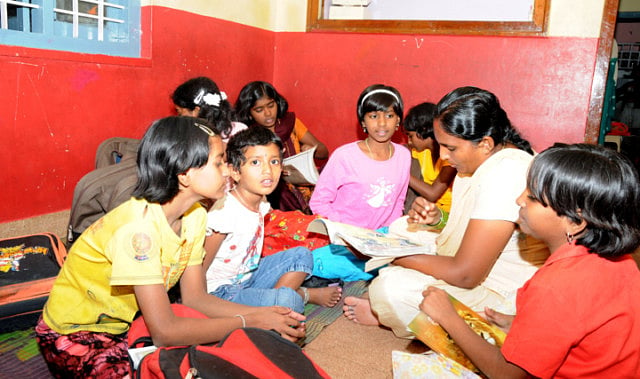
The Socare house in Rajajinagar, a modest suburb in Bengaluru, looks like any middle-class home in the area. The only difference is that while you may find one, two or three children playing in most of the gardens, at the Socare house there are close to 25 playing, at any given time.
‘You are no less than anyone else’
The children are returning from school now, lugging their bags and lunch boxes. It’s close to 5pm and everyone wants to know what’s for evening ‘tiffin’, which will be served in 30 minutes after the evening prayer assembly.
Girija stands shyly in a corner of the garden and is a picture of humility. Although she’s been at the home for just over a year where she is given love and care, she still hasn’t come to terms with loss of her mother.
Asha Narasimhan, a trustee of Socare, gently tells her to be more confident. “Look people in the eye and speak. And remember, you are no less than anyone else,” she says.
All the children miss Venkataraghavachari, the man who first helped them and Saroja. “I know they are feeling bereft without father and mother and I need to cheer them up. I let them know that nothing of their lives will change because they have passed on,” says Sumathi, hugging one of the girls, an 11-year-old named Swathi. The girl and her two younger sisters were witness to their father killing their mother in a fit of rage.
“It was Swathi’s testimony that convicted him,’’ says Sumathi. “It took a long time for her to get over the trauma. The panel of counsellors at Socare worked hard with the three girls so they could overcome their fear of people.’’
Another girl, Zeenath, 14, lost her mother early in life. Her father was convicted of killing her and is now in jail. “She has been so traumatised from the incident and is still reluctant to meet strangers,’’ says Sumathi.
“When we took her to a dentist recently for a regular check-up one of us had to hold her hand and be with her all the time.’’
Zeenath discontinued her studies, but now Socare is providing her with training in sewing so she will be able to stand on her own.
In the boys’ wing, Ganesha, 13, is busy playing with his friends. He came to Socare 10 years ago when he was just three years old, after his father murdered his mother. Although he will be released soon, Ganesha is not keen to return to his father’s house. “I’m happy here and do not want to leave my friends and this family here,’’ he says.
Socare’s mission is to give these children the dignity to become proud citizens and remain independent. All the children who are over five attend school, except for a few like Zeenath who are too traumatised.
Those who have completed their grade 10 and are not keen to go to college are encouraged to opt for vocational training. “The idea is to make them independent,’’ says Asha.
Dinner is finished and it’s time for the older children to help the caregivers. Some of them look after the younger children, while others do regular chores like cleaning and sweeping the home and laundry. There is a sense of camaraderie and love.
When the chores are finished the children study. Those who are weak in certain subjects are tutored by teachers who visit every day.
Some of the older children are preparing for their board exams and are taking extra classes at a local coaching centres.
“Their lives are no different from any children of that age,” says Asha.
The children have definite ideas about what they want to be when they grow up. Praveen, who is 12, wants to join the police force. “I have seen people do wrong and I want to be the policeman that catches them,” he says.
Ranjitha, 16, wants to become a government official, “so I can set right the ills in society’’.
With the constant love and attention of the caregivers at the home, she and the other children are being given every chance to escape their past and achieve their dreams in the future.
Sign up for the Daily Briefing
Get the latest news and updates straight to your inbox
Network Links
GN StoreDownload our app
© Al Nisr Publishing LLC 2026. All rights reserved.