Labour of love: Women on the job
The female workforce in the UAE says the advantages of working here far outnumber those in other countries
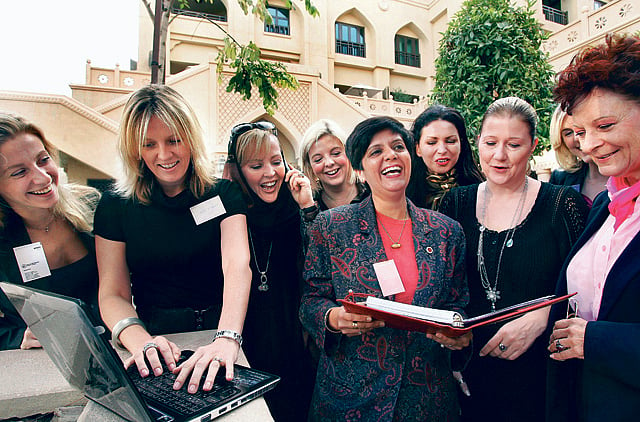
Dubai: Defying stereotypes of victimhood, exploitation and deprivation in emerging economies, women in the UAE say the benefits of working here are far greater than those in most other countries.
A cross-section of working women whom XPRESS spoke to in the run-up to International Women's Day on March 8 revealed that irrespective of the level at which they find themselves, they have high aspirations and dedication, and are less encumbered by issues concerning safety, childcare or caring for the elderly which would have weighed heavily upon them elsewhere.
As it turns out, these factors along with higher monetary benefits hugely compensate for issues like initial delays in getting started, lack of family support or job satisfaction, with even single parents preferring to stick it out in the UAE rather than going back to their home countries.
Shana Claus, a 48-year-old marketing and PR consultant in Dubai, said, "The fact that my daughter and I are safe here is most important to me."
A single parent, she came to the emirate from South Africa seven years ago when her daughter was just 10. "Unlike Johannesburg, I've never had to worry about sending her alone in a taxi here," she said.
On the downside, she felt women needed to be taken more seriously. "But I would sacrifice ambition for safety," she said, adding that her tax-free earnings are also a big plus.
The sentiment is echoed across levels. Jelyn O'Bette, a saleswoman who was earlier a house help, said she makes Dh3,000 a month and is the sole breadwinner for her family back in the Philippines. "I couldn't have provided for the education of my two sons who are with my mother had I not been in Dubai," she said, adding that her elder son is a computer science graduate while his brother is in nursing.
Working mothers
The financial empowerment is of great solace for those working mothers who may have otherwise developed a deep sense of daughterly or maternal guilt by staying away from their families back home or spending less time with their children.
One Indian executive in Dubai who did not want to be named said while she worried about her aged in-laws back home, the geographical distance eased the physical pressure in taking care of them, enabling her to focus more on her work.
In terms of childcare, while women in the UAE may lack family support, the easy availability of nannies or other shoulders to lean on is considered a blessing. "In Canada where I come from, it costs an incredible amount of money to keep a nanny, but here I can get one at $500 (Dh1,835) a month," said Hala Al Uraibi of Iraqi origin. Hala "vigilantly schedules" her time between her beauty business and her four-year-old daughter with the help of a stay-at-home nanny.
Some women make do with part-time help at lower cost or even fly down grandparents to take care of their children. "My mother comes down every six months. That's a huge relief, as it is one more person to look after my boy, along with the nanny," said Rawan Albina from Lebanon who is a life coach in Dubai.
It isn't always easy though as women explore part-time or work-from-home job options to strike a balance between family and work. The experience can be self-limiting sometimes, especially in cases where the family income needs to be supplemented. Add to this the adjustments that one has to make in a new land and the frustration only increases.
But, as Sue Sharyn Ward, a productivity solutions specialist and core committee member of the International Business Women's Group (IBWG) Dubai, points out, the presence of active community and business networking groups like IBWG serve as effective platforms for women to find support on a personal level or to explore entrepreneurial and other business options.
Diann Boehm, author and member of the American Women's Association and the American Business Council, pointed to how the groups help American women get connected. Similarly, Wafa Al Hamed, a Dubai-based Yemeni consultant and trainer, said she holds special orientation sessions to help expatriates settle in.
Big change
Sue, who has been in the UAE since 1979 providing support to women, said females in the country had seen a big change over the past three decades because of the support of the Rulers. "Expatriate women are riding piggyback on Emirati women today," she said.
The dynamics of how this happens is perhaps best explained by publisher and author Dedra Stevenson, a naturalised Emirati of American origin. "As Americans, we bring with us the I-can-do-it attitude and the UAE provides us the opportunity to be pioneers in many fields," she said.
"However, I feel there is still an attitude here that foreign is better. More opportunities should be given to nationals [to harness their talent]," she added.
The World Economic Forum also talks of how the UAE fares well on equal access for women to health, education and political participation, but lags behind in terms of economic opportunity and integration in the labour force.
But while society may remain male-dominated, women with whom XPRESS spoke said they had not been subjected to any gender discrimination or harassment.
Claire Malcolm from the UK, Cityscape Editor and IBWG Dubai core committee member, said, "I am used to working as an expatriate in different cultures." Having worked in the Far East and the UAE in the fields of advertising, hospitality and journalism, she said she had faced no difficulty in her 11 years of living here.
Initial hiccups apart, women setting up fresh businesses tend to settle down with time. People empathise with us, said Emma Sims, who has just put a HR design firm in place.
Mairead Slattery from Ireland, who is a life coach, said the UAE gave her an opportunity to start a venture even during the current recession when the option of her home country as a base seemed unviable.
Similarly, Jacqueline Khale, who established a funky gifts business in May last year, said although the sight of a woman like her getting cartons loaded into the boot of her Honda CRV from a warehouse in Al Quoz may not be a common sight, it is taken in its stride in a city like Dubai.
Progressive UAE
Dr Sylvia Ann Hewlett, a US-based economist, on a recent visit to Dubai, made public the preliminary results of a study conducted by Hidden Brain Drain, a high-profile private sector task force which surveyed the female workforce in the UAE, Brazil, Russia, India and China (BRIC). She said the UAE comes across as relatively progressive, with women outperforming men on many counts like higher education, high levels of ambition and lower drop-out rates at work.
Equal footing
- Women enjoy equal rights as men under the Constitution in terms of legal status, claim to titles, access to education and right to work.
- They make up 49.3 per cent of the national population.
- They are an empowered lot: UNDP’s Human Development Report 2009 ranks the UAE 25th on gender empowerment measures.
- They have registered the highest rate of higher education in the world at 77 per cent (PricewaterhouseCoopers).
- They account for 22.5 per cent of the Federal National Council.
- They constitute two-thirds of government workers with a presence in the judiciary, special security forces and even as fighter pilots.
Sign up for the Daily Briefing
Get the latest news and updates straight to your inbox
Network Links
GN StoreDownload our app
© Al Nisr Publishing LLC 2026. All rights reserved.