Endless cycle of turmoil
Pakistani artists peel off the many layers that contribute to the unrest in their country
Pakistani artists Abdullah M. I. Syed, Adeel Uz Zafar, Salman Toor, Ahsan Jamal, Mahreen Zuberi, Mohammad Ali, Cyra Ali, Saba Khan, Sara Khan and Seher Naveed are exhibiting their latest work in Dubai at a joint show titled “Stop, Play, Pause, Repeat”. Unlike the shrill coverage seen in the local and international media of the socio-political turmoil in Pakistan, these young artists have used irony and wit to present a sensitive and balanced, insider’s perspective on the situation in their country.
The light-hearted title, “Stop, Play, Pause, Repeat” is a reference to the recurring turbulence in the country, and expresses the anger as well as the resilience of the common man in Pakistan.
Nafisa Rizvi, curator of the show, says, “For ordinary Pakistanis, the persistent conflict in their country is like a never-ending war that disrupts their lives every day. The guerilla war waged by the Taliban, the failing economy and the deepening social disparity in society are elements of an insidious war that has created a fertile breeding ground for fear, anxiety and intolerance, with no respite in view. This show examines the ruptured social and political fabric of our nation. But we chose this playful title, because the artists have addressed these troubling issues with restraint, levity and a nuanced perspective, as opposed to the war narrative seen in the media.”
The artists have explored various themes in their unique styles. Salman Toor’s whimsical paintings are inspired by classical Dutch masters, pop-art, story books, lifestyle advertisements and Bollywood films. They comment on the huge chasm that exists between the poor and homeless and the wealthy Pakistanis, who are Westernised, own fancy homes, employ lots of servants and aspire to the idyllic lifestyle depicted in glamorous Bollywood films and glossy advertisements. His layered narratives also convey the undercurrents of insecurity and violence that all Pakistanis have to live with.
In Saba Khan’s work, an image of a power generator, embroidered on velvet and embellished with beads and sequins, becomes a powerful symbol of the divide between the rich and poor in Pakistani society. “Thanks to corruption and mismanagement, there is an energy crisis in Pakistan. With no electricity for 12 hours a day, people depend on diesel-guzzling generators, which are expensive. So, on one hand we have air-conditioned and illuminated malls, using huge, noisy generators and on the other hand small cottage industries such as embroiderers are unable to operate. The irony in these artworks is that I have asked craftsmen, who cannot afford to buy a generator, to make these embroidered generators for me,” the artist says.
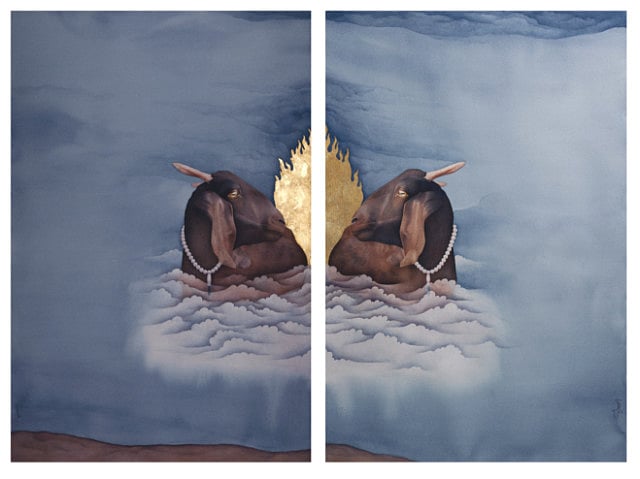
Ahsan Jamal’s poetic watercolour paintings featuring a goat in a surreal, heavenly landscape speak about the frequent terrorist attacks in his country. The sacrificial goat is an obvious reference to victims of terrorism. But by creating a diptych with mirror images of the goat, the artist questions whether the animal could also symbolise the terrorist. “The notion of sacrifice is an integral part of our identity as Muslims and as Pakistanis. This goat is a symbol not only of the loss of innocent lives, but also of the many other sacrifices the common people in Pakistan are making in the hope that things will get better. But, a deeper investigation indicates that even the suicide bomber is often a victim of poverty and could have been brainwashed or kidnapped. The glittering landscape in my paintings alludes to the Islamic concept of seven Heavens or levels of purification that a human spirit must aspire to achieve. But it also represents the exploitation of religion to suppress and mislead people,” he says.
Sara Khan’s work also deals with violence and the deteriorating law and order situation. Her circular paintings of brides bedecked with jewellery are pretty. But they carry an undercurrent of violence, because she has used an airgun to shoot holes in the target-shaped canvases. She has then transformed the holes to represent jewellery using red crystals and beads. The series, titled “Boom, Boom, Boom” was triggered by a robbery at a relative’s wedding. “Robberies have become common in Karachi and brides have become ‘beautiful targets’ because of their jewellery. I was shaken by the attack on my cousin on her wedding day, but by using my gun to create this jewellery I want to say that despite the negativity around us, we are strong enough to deal with it and move on,” the artist says.
Adeel Uz Zafar’s concern is the growing Westernisation in Pakistani society. His huge paintings of bandaged stuffed toys have been created by engraving lines on a black vinyl surface with knives. Through his depiction of a bandaged teddy bear, titled “I’m angry”, Zafar voices the angst and pain of the common man in Pakistan. “Besides dealing with the idea of concealment of reality and truth, this work also speaks about the imposition of Western capitalism in our society. The teddy bear is a borrowed object, completely alien to our society. And yet, among the rich and upwardly mobile middle classes it has become a coveted toy. As a symbol of our eagerness to become ‘modernised’ and the West’s hidden agenda of imperialistic hegemony, it represents the indignant but powerless voice of my country against all power plays foisted on us,” Zafar says.
The dollar notes in Abdullah Syed’s artworks also refer to capitalism and the terrible state of his country’s economy. He has cut out traditional Islamic patterns on sheets of $1 notes and on the out-of-circulation $2 notes to create his version of a flying carpet, thus alluding to the lure of capitalism and the migration of Pakistanis in search of prosperity. On another level, Syed’s work also comments on the age-old debate between oriental and Western art.
Seher Naveed and Mahreen Zuberi’s works are more soft and subtle and deal with nostalgia. Zuberi’s model of a white, moth-eaten party decoration and her delicate black-and-white miniaturist paintings of its mystical folds speak of her childhood memories of various celebrations and the fading joy in these uncertain times. Naveed also dwells in the past through her architectural artworks, inspired by colonial homes and made from layers of hand-cut paper. The series is poignantly titled, “and those houses, they will never live again”. “These days you often hear Pakistanis reminiscing fondly about the pre-partition, colonial era. These houses, which do not exist anymore, represent a collective nostalgia and a desire to escape from the bleak present and future,” she says.
Cyra Ali and Mohammad Ali’s bold and flashy installation , titled “Thunderbolt and lightening, very very frightening” after a popular Queen number, comments on issues such as sexuality, overt and covert power plays, delusions of grandeur among wealthy fashion-obsessed Pakistanis and the growing intolerance of “the other” in Pakistani society. The two artists have used traditional embroidery, rich textiles, cheeky motifs, playful religious and cultural imagery and over-the-top embellishments to make their statement.
Jyoti Kalsi is an arts enthusiast based in Dubai.
Stop.Play.Pause.Repeat will run at Lawrie Shabibi Gallery until October 31.
Sign up for the Daily Briefing
Get the latest news and updates straight to your inbox
Network Links
GN StoreDownload our app
© Al Nisr Publishing LLC 2026. All rights reserved.