A school for nannies
Norland College’s three-year course includes not just field-time and theory classes but self-defence lessons and paparazzi avoidance as well
“A spoonful of sugar makes the medicine go down.”
So went the lyrics to the timeless song from “Mary Poppins”, the 1964 musical film about a magical nanny who is hired to look after a London banker’s two children.
For many, the first image that comes to mind when they hear the word nanny is of the Disney character flying with an umbrella in her right hand, a long black coat and the London skyline in the backdrop. But how relevant an icon is Mary Poppins for the modern nanny?
“There are elements in Mary Poppins, such as how she loved the children she looked after,” says Claire Burgess, an education lecturer at Norland College which specialises in the training of nannies. “She put their needs first, she saw the family as a whole and she recognised her role. We all still work for that ideal but maybe some of the ideas are now dated.”
If anywhere in the world comes close to training aspirant nannies to become like Mary Poppins, it would have to be Norland College. When it was founded in 1892 by a woman called Emily Ward, the place became the first college to offer child care training. And in the more than 100 years since the college was established, the field of professional child care has been far from static.
“The role of the nanny has changed dramatically because obviously our families have changed,” Burgess says. “The role of the nanny 120 years ago was a very formal role, slightly more like a governess. Our family dynamics have changed, and lots of parents, both mum and dad, are required to go to work. The nanny’s role has evolved and become more part of the family, a person who provides care and education [to the children] while the parents are at work.”
The three-year degree course at the Bath-based college can cost £12,750 (Dh71,406) per year. Some may wonder whether three years is a bit too long a period to train to become a nanny?
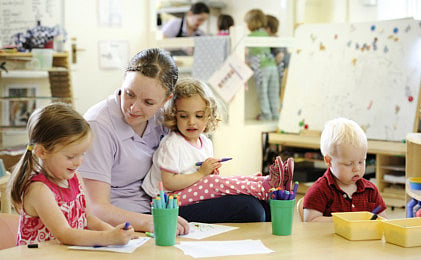
“The students do placements within nursery schools, hospitals, families so actually they spend half the time within lectures,” says Burgess, “and half the time out putting what they learn into practise. So that is why we feel it has to be a three-year course to make sure they are fully prepared to support children in family homes.”
Sarah Cozens is a graduate from Norland College who runs her own nanny agency, Nutkin Nannies. She echoes the view in favour of having a three-year period for the nanny training. “I think if you look at the standard of child care which is out there today,” she says, “some of it is very precarious. And there are girls who are going to become nannies because they didn’t know what else to do. Whereas the girls who go to Norland, obviously due to the fact that it is a fee paying college and it is an expensive one, they are the girls who really want to work with children, to dedicate themselves to that as a career. “Not just a ‘I will do this in the mean time’.
“So there is a different class of nanny because they have gone to college, dedicated themselves to three years of training,”
Cozens knew from a very young age that she wanted to work with children. She considered teaching but then thought she wanted to be a more one-to-one caregiver, dedicating more of her time and without the constraints of a national curriculum.
Intent on getting the best training, she came across Norland College and was taken on as a student there in 1993. She was 18 years old. It was a close-knit environment and in her year there were 24 girls. She is still in touch with about 15 of them.
Having the Norland brand as part of their training can offer distinct advantages when graduates are out in the real world. “It helped because at the time nannying wasn’t as regular as it is now,” says Cozens, who graduated in 1996. “There were less of us around. And so being a Norland-trained nanny we did stand head and shoulders above the others because most people have done a one-year or two-year course in college and gone straight to work with a family but without having that year working with a family first before they qualified — it makes a very big difference. The family that you work with in that first year know that you are trainees. And so the expectations are probably slightly different but on the same hand they expect you to be fantastic because you are from Norland College.”
“It was a very good course,” she says. “It prepared you for working life far more than other courses. For example, you only had four weeks of holidays a year. Whereas my friends at university were having four months over the summer. I had two weeks. So it prepared you for working life. In a real job you don’t get four months off in a year.”
One of the additions at the college in more recent times has been paparazzi avoidance and self-defence classes. “Self-defence is just giving the students the confidence to be able to defend themselves if they are walking down the street and someone approaches them and may be aggressive or not acting appropriately,” says Burgess. “Giving them some skills to be able to deal with that situation if they feel confident. It is definitely not martial arts. But they know how to protect themselves and the children they are caring for.”
The classes have been going on for a couple of years now and are taken by all students. “Predominantly the world of nannies tends to be female,” Burgess says. “Unfortunately we don’t tend to have a large number of men in the industry,” she explains. “And so actually ensuring that they aren’t going to be more vulnerable, it is an additional skill and we liked the idea.”
A big elephant in the room when it comes to the nanny industry is the overwhelming concentration of females who enter child care. Not long ago one male student, or a “manny” as they are called, was given admission into Norland College. It was such a rare development the news ended-up being covered in the national press.
“Generally, across the whole sector, child care tends to be predominantly female,” Burgess says. “We would love to see more men within the child care sector.”
It is a little known fact that the late Princess Diana herself worked as a nanny for an American family before she was married. With Prince Williams and Princess Kate expecting their first child, can we expect them to hire a Norland nanny?
“It depends very much on what Will and Kate decide to do,” Burgess says. “They may decide not to have a nanny. If they decided they would like to contact Norland, of course we would do our best to help them in their search. It is their choice. I think the royal family has changed, traditionally Prince Charles and the Queen all had nannies. But the modern day royals may have a different [attitude.]”
Cozens founded Nutkin Nannies, based in Surrey, after she had her own daughter. She finds the time she spent at the college still helps her all these years later with the running of her agency. “Norland training did help because you are dealing first-hand with parents and family from the very first day you walk into college,” she says. “You have to learn about their situation. I think that prepares you then and in later life to be able to talk to absolutely anybody in any situation and assess who they are. And I think that has actually helped me in running the agency.”
Syed Hamad Ali is a writer based in London.
Sign up for the Daily Briefing
Get the latest news and updates straight to your inbox
Network Links
GN StoreDownload our app
© Al Nisr Publishing LLC 2026. All rights reserved.