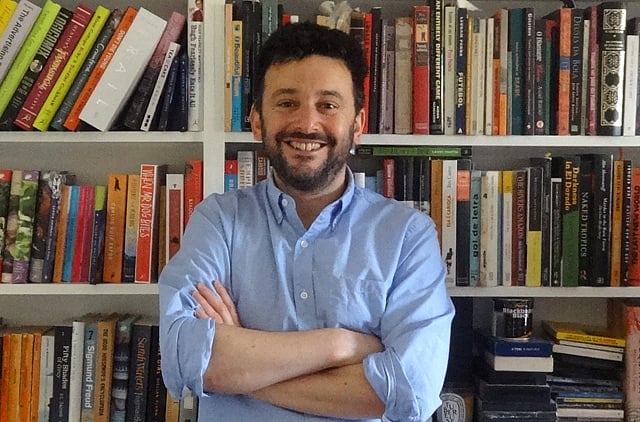
Alex Bellos counts on numbers for stories
He seems to have an endless fascination for mathematics and a knack for sharing it with the layman — and a football game is a good place to start
Alex Through the Looking-Glass: How Life Reflects Numbers and Numbers Reflect Life
By Alex Bellos,
Bloomsbury Publishing, 352 pages, £18.99
British writer Alex Bellos often gets asked what his favourite number is. The question first arose after he wrote his previous book on maths, “Alex’s Adventure in Numberland”, whose success was down to his easy-to-understand style of writing on a subject which is a nightmare for millions. “I would go and give talks in schools and universities and always at the end of the talk when I asked if anyone had any questions, someone would put their hand up and say, ‘What is your favourite number?’ And I would just ignore it because I just thought it was not a serious question. But I kept being asked this question.”
Even while going for dinner with friends, Bellos recalls, people would go: “Hey, you are the numbers guy! What is your favourite number?” He would tell them he didn’t have one. Yet the question persisted. So then, once at a talk he decided to turn the tables on the audience and asked them what their favourite numbers were. “About half the audience put their hands up. This to me was like amazing. I thought no adults have favourite numbers.”
When Bellos realised that lots of people had an emotional connection with numbers it fascinated him enough to investigate the matter in his latest book, “Alex Through the Looking-Glass”. It is also the reason why I am sitting with him in his flat in Kilburn, London, doing this interview. The book talks about maths in his usual engaging manner, mentioning along the way colourful characters he encounters, including an engineer in Germany who designed the first roller-coaster loop, a mathematician in the United States who looks at the Universe from his garage to a member of a secret maths society in France called Bourbaki.
But it was Bello’s quest to find out what everyone’s favourite number was that brought the biggest media attention after he conducted an online survey and ended up attracting 44,000 participants. It turned out 7 is the most commonly cited favourite number. “Throughout the world, culturally, ever since we know, it has been the most popular number. Especially the most mystical number. So in among ancient Babylonians, in Judaism, Christianity, Hinduism, Islam — everywhere 7 comes up more than any other number. We have 7 days in a week.”
Subconsciously, 7 feels different to many people. From the Jewish people observing Sabbath once every 7 days, to people looking at the sky two and a half thousand years ago and seeing seven planets, different explanations have been given. But Bellos could not find a clear answer. He feels there is an arithmetic reason. But he adds: “We know that 7 feels different because when we learn our arithmetic tables at school, ‘seven times’ table is the most difficult. So I think we internalise the difficult nature of 7 and because we are human we give it human or cultural characteristics.”
In Asian countries such as Japan, China and Korea, people are much more superstitious about numbers, notes Bellos, and yet they also have much better numeracy levels. “In Japan they really love odd numbers. So when you give gifts, you only give odd numbers of gifts. And I discovered in Poland whenever you give flowers you must only give an odd number of flowers.” While 13 is seen as an unlucky number in certain Western countries, for example, in China and Japan 4 is an unlucky number.
“In India, they have this tradition called Shagun under which whenever you give a gift you must always give a round number and one. You would never give 1000 rupees, it will always be a 1001 rupees.”
A strangely fascinating theory in maths talked about in Bello’s book is called Benford’s Law. It shows basically how in sets of data certain first-digit numbers occur more frequently than others. It is surprising because people expect all numbers to occur equally randomly. Instead the law has demonstrated the most frequently occurring number to be 1 at 31 per cent, 2 to be less frequent at 17 per cent, and a larger digit 9 to be even less so at 4.5 per cent. So useful is Benford’s Law that when a set of data does not follow the law it could mean a “red flag” indicating corruption, financial fraud or even electoral cheating (as was alleged in the 2009 Iranian elections).
In fact, this law can be demonstrated using a newspaper. I ask Bellos how our readers could go about doing it. “What you could do is write down all the numbers that occur in the newspaper. And then just go through all the numbers, and each number has a first digit. So the number can be very small, it can be a number 3, first digit 3. Or it can be big, 6000325 — that is 6.”
He demonstrates to me by picking up a copy of a financial newspaper and going through some of the numbers. “There will be more 1s than any other number — definitely. The more you do it, you need more different sources. If you were to do the entire page you would definitely get it. And it is really striking how quickly you get to that level of 31 per cent, 17 per cent and 4.5 per cent.”
We talk about historical contributions to maths by different civilisations. “You could argue that the invention of zero in India was the greatest advance in mathematics and therefore maybe in science because you need zero, or you need what is called the place value system,” he says. “They didn’t just invent the system of zero, they invented the system of 10 digits, 1 to 9 and zero. This meant that calculation and arithmetic became possible for everyone to do. It was like democratisation of arithmetic. And it was so powerful it first spread to the Middle East — you know Baghdad and Al Khawarizmi who was based there, and then it would now be called Islamic or Arab maths — and then to the south of Europe.”
So before that they had a different system? “Yeah, there were no zeros.” And there were no 1 to 9s? “No, in Europe the common thing in use was Roman numerals. So Roman numerals had no zero. There was I, II is two, III is three, IV is four, V is five.” So it wasn’t very practical? “No, to do a multiplication in Roman numerals is a nightmare. Which is why they didn’t, they had abacuses to do it.”
One of the worrying aspects about maths is not enough journalists appear to be good at it. I ask Bellos if this is a problem. “Yes this is, although this is changing,” he replies. “When I started out 20 years ago, there weren’t science journalists. And I never met anyone who studied a science subject in journalism, whereas now every newspaper has a science section, and there are lots of science blogs, and people such as Brian Cox on the telly. And Stephen Hawking wrote his book which is a bestseller. So there is a lot more numeracy now but then there is still quite a lot of innumeracy. Most people writing in newspapers haven’t got maths or science degrees, probably don’t like maths, and make lots of simple mistakes. And you get a bit afraid of numbers.”
Bellos himself, though, does have a degree in mathematics and philosophy, from Oxford University. Does he think journalists who are good with words also need to be good with maths? “Well they need to be numerate, especially since so much news is financial news, or in politics it is all to do with numbers. We want there to be class sizes, big or small. The word ‘statistics’ originated from information about the state. So, in fact, the whole idea of statistics and data is political and I think that you need to understand a bit about numbers to make sure that you understand what is going on in normal life.”
Besides his love affair with numbers, Bellos has also written about football. The same day “Alex Through the Looking-Glass” was released, a updated edition (with a new chapter) of an earlier book “Futebol: The Brazilian Way of Life” also came out — in time for the 2014 World Cup in Brazil.
“I had two books out on two totally different subjects on the same day. So half of the time I need to think maths, like talking to you about maths.” And the other half, of course, is football. In fact Bellos was running slightly late for our meeting because he was being interviewed by the BBC for a Gary Lineker TV programme on football.
I ask him if there is somewhere where football and maths meet. “Well lots of places,” he says. “One of things you try while surprising people with maths is a thing called the Birthday Paradox. The Birthday Paradox is, how many people do you think you need to have in a group to be more confident than not that two people share a birthday? There are 365 potential birthdays. So how big does the group need to be to show that two people share the same birthday? Turns out you only need 23 people.”
“So on a football pitch, you have 11 players and 11 players, and 1 referee,” he says. “That is 23 people. So that means that more often than not in every football game there are two people who have the same birthday. And it is true. I looked at the World Cup finals and something like 71 per cent of all World Cup finals had two people in it who shared a birthday. Which is surprising — you would have thought ‘no way would two people on a football pitch share the same birthday because there are 365 days in a year’. So that is where the football game is a wonderful method of surprising you with maths.”
Syed Hamad Ali is a writer based in London.
Sign up for the Daily Briefing
Get the latest news and updates straight to your inbox
Network Links
GN StoreDownload our app
© Al Nisr Publishing LLC 2026. All rights reserved.