Still life laden with satire
Othman Moussa’s works reflect the anger and turmoil felt by the people of the Middle East
Othman Moussa comes from the rural town of Zabadani on the outskirts of Damascus. The young Syrian artist and sculptor is well known for his still life paintings that speak about everyday life in his country. Moussa's hyper-realistic paintings, influenced by 17th-century Dutch realism, are tranquil, soft and poetic.
But the present events in his country and the region have provoked the artist to create something quite different. His new series, titled The Throne, also comprises still life paintings. But these are artworks that shout loudly in protest and reflect the anger and turmoil felt by the people of this region.
The series is an excellent example of realism in contemporary art and it makes a strong, satirical statement about the ambitions and policies of today's world leaders.
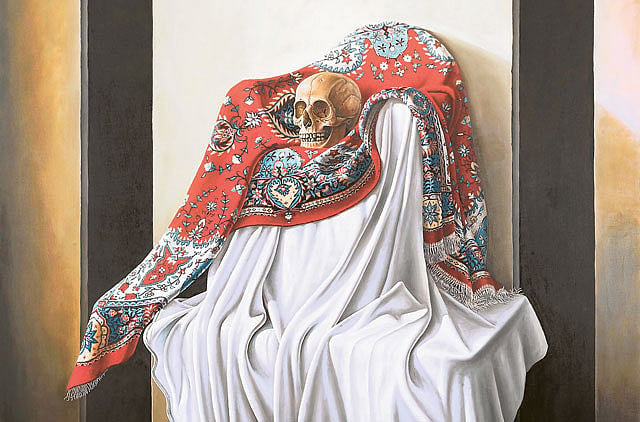
The central motif in every painting is the same — an armchair draped with a white sheet and then covered with a red oriental carpet. The beautifully rendered details of the design on the carpet leave no doubt that these thrones represent kingdoms in the Middle East. But the objects occupying the throne in each painting are different. And each one offers a sharp, cynical comment on the present political situation in the region.
A propane tank on the throne refers to leaders whose priorities are driven by oil and have led to explosive situations. A baby doll sitting on the throne comments on incapable, infantile heads of state, who have simply inherited their power without popular mandate. Other imagery, such as a lock, a butternut squash, an aubergine, a loaf of bread, a skull and a headless plucked chicken seated on the throne, speak about those who have deprived the people of basic necessities and have policies that are unacceptable for their people, along with those who have been exposed as cowards.
Some of the paintings stand out as quite different from the others in the series. In one painting titled, The King, the oriental carpet with beautiful floral motifs seen in the other works is replaced by a simpler, bold red carpet. And on this throne sits a soldier's worn-out black boot. This painting points to governments that control their people through military might and to the bloodshed in the countries where people have taken up arms against long entrenched dictatorial rulers. Similarly, The Empty Throne, depicting an abdicated throne, is a poignant reminder of the upheavals in the region and the aspirations of the people.
The painting that sums up the entire series is titled Khalaf, which is Arabic for "against", and is completely different from the rest. This one does not feature the throne at all. Instead it depicts a burning cigar as a symbol of royal luxury that has now been abandoned.
The brand name on the cigar says "emperor", and the artist has painted a skull at the top end. Most of the cigar is placed against a purple background depicting royalty. But its burning end pierces into a dark, black future. A card depicting the Ace of Hearts placed on the boundary between the purple and black backgrounds refers to the fact that before the French Revolution, the Kings were the highest in a deck of cards, but after the revolution the Ace became a symbol of the power of the people and was deemed higher than the king.
Due to the present situation in Syria, Moussa was unable to travel to Dubai for his first solo show in the city. "I am very excited to exhibit my work in Dubai and I am present there through each one of my artworks," he says.
His paintings speak louder than words and the artist prefers to leave it like that. "I do not want to comment on the imagery. I want viewers to engage with my work and come up with their own conclusions," he says.
The Throne will run at Ayyam Gallery, DIFC, until April 26.
Sign up for the Daily Briefing
Get the latest news and updates straight to your inbox
Network Links
GN StoreDownload our app
© Al Nisr Publishing LLC 2026. All rights reserved.