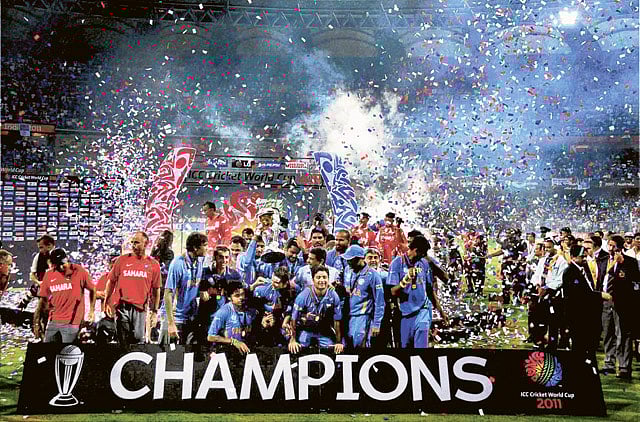
After the Indian cricket team's long-awaited second World Cup triumph last Saturday, Indian markets opened positively on Monday, extending the gains of the last month. At the end of the session the Bombay stock exchange closed 1.45 per cent up.
But can an Indian win in a one-day international cricket match be responsible for the way the stock market moves in the very next session? Or for that matter — agreed it's almost blasphemous to talk about an Indian loss right now — could a defeat in a one-day match produce a negative stock market reaction?
Believe it or not, it does, according to a research carried out by two Australian economists last year. Importantly, though, it is the defeat more than the victory that has a "statistically" significant impact on the downward movement of the market the next day. And also, even if the result holds over a period of time, there is no guarantee that it will hold every time the event occurs and so, the finding does not justify a trading strategy, according to several economists.
Importing insights from behavioural economics, such research tries to explain irrational economic behaviour observed in real life such as mood swing after a game and how it impacts investors' views on future stock prices.
"The result is consistent with the idea that the feeling of sadness associated with a loss is generally much greater than the feeling of happiness associated with the gain of same value," says Vinod Mishra, senior lecturer of economics at Monash University in Victoria, responding to Gulf News in an email. "A simple example would be that the feeling of sadness associated with losing $10 would be generally greater than the feeling of happiness associated with an unexpected gain of $10."
Such an asymmetry, he explains, is related to valuing gains and losses differently in many real-life situations.
"This is the reason [why] when Indian team loses, the Indian public, consisting of investors as well, becomes more dejected compared to the feeling of elation that they experience when Indian team wins," Mishra says.
Most of the cricket matches in the sample were elimination games, such that a win only advanced the team to the next stage of the tournament, whereas a loss eliminated the team from the competition altogether. Therefore the loss actually came as a bigger setback for the fans, Mishra points out. The data were from Nifty Index of National Stock Exchange and India's one-day international matches over the period 1995-2005.
Clear impact
For all those Sachin Tendulkar fans, again many of whom are likely investors, it is particularly hard. If he is in the team and India loses, the impact of their sentiment clearly reflects on the market. "The downward movement is bigger when the Indian team loses a match [with] Tendulkar," says Mishra, who co-authored the research paper, ‘An examination of the impact of India's performance in one-day cricket internationals on the Indian stock market,' published in Pacific-Basin Finance Journal in 2010, with Russell Smyth, head of economics department at Monash University.
Individual performance
Mishra adds: "In the 100 matches in which Tendulkar played and India lost, the average return the day after the match was 0.328 per cent, an 18 per cent higher drop compared to the average drop after losing a match."
"One would expect that if Tendulkar was playing, Indian cricket fans would be more optimistic of an Indian win than if Tendulkar was not playing. Therefore, if India loses when Tendulkar is playing this [is] a bigger setback to the Indian fans compared to when India loses in the absence of Tendulkar."
One likely reason for the "Tendulkar effect," Mishra says, could be the long-held notion that the Indian team was very dependent on Tendulkar's performance.
Similar to the Australian study, another paper published in the Journal of Finance in August 2007 and titled ‘Sports Sentiment and Stock Returns' reached similar conclusions when analysing the impact of football results on investor mood.
The authors, Alex Edmans, Diego Garcia and Oyvind Norli, found a significant market decline after national football losses when investigating stock market reaction to sudden changes in investor mood. In fact Edmans, assistant professor at the Wharton School, University of Pennsylvania, told Gulf News in an email that during the summer of 2004 which he spent at Morgan Stanley's Fixed Income Sales and Trading division in New York he saw how the results of the European Championships affected the mood of his colleagues. In an interview to Wharton Journal he said: "Observing traders' extreme mood swings gave me the idea for my paper on soccer and the stock market."
The paper's findings, for example, indicate that "a loss in the [football] World Cup elimination stage leads to a next-day abnormal stock return of -49 points." In monthly terms "the excess returns associated with a soccer loss exceed 7 per cent." And the loss effect is stronger in small stocks and in more important games, especially elimination games.
The authors also studied cricket, rugby, ice hockey and basketball games to study the loss effect after the games.
"Actually, the strongest relationship between sentiment and sport is in soccer, not cricket. However, the effect is still strong in cricket, particularly in India," said Alex Edmans in his email, And of the four, cricket, rugby, ice hockey and basketball, it is the cricket sub-sample that is the most "robust" — which however consisted of results of World Cup matches only. The Australian sample was broader taking all one-day international matches played between 1995 and 2005.
Edmans and his co-authors explain in the paper that the "finding is consistent with the fact that cricket is the number-one sport, and therefore a strong mood proxy, in half of the seven countries included as cricket nations".
They go on to add that "There is no evidence of a corresponding reaction to wins in any of these sports."
At the heart of such research is the effort to understand irrational behaviour — in this case, caused by moods more than anything else—behind certain economic decisions observed in real life.
"Traditional economics assumes that economic agents or investors are rational decision makers and they make economic decisions based solely on economic fundamentals," says Mishra. "In real world we do observe a lot of irrational behaviour, where non-economic events do impact people's economic decision-making abilities."
Among several references Edmans, Garcia and Norli mentioned in their paper were studies that "show that fans are subject to an ‘allegiance bias', whereby individuals who are psychologically invested in a desired outcome generate biased predictions ... Thus, if the reference point of soccer fans is that their team will win, we may find a greater stock price reaction after losses than after wins."
There is no evidence of improvements in mood of a similar magnitude after wins. In fact Edmans and his co-authors reject the view that loss effect stems from the reaction of rational investors. They point out that soccer results while affecting moods have little direct economic impact. Another important aspect is the effect being more pronounced on small stocks, which have been "previously found to be especially sensitive to investor sentiment and are predominantly held by local investors, whose mood is affected by the performance of the national soccer team".
Portfolio strategy
So does this information or trend justify a portfolio strategy or for that matter taking a position while trading?
Edmans and his co-authors say that the events they have covered do not occur with "enough frequency to justify a portfolio fully dedicated to trading on them".
"Though investors may obtain large excess returns by trading on these mood events, for instance, by shorting futures on both countries' indices before an important match," Edman, Garcia and Norli say, that even those who "face low transaction costs would find it challenging to take advantage of the price drop."
Mishra adds, "The nature of process is unpredictable for individual events. Someone can make money over a long period of time using this information. However, [that] he will succeed every time is not guaranteed." Like sport, the outcome is never quite certain, and in market terms nowhere near certain enough to place your faith in a result.
The Tendulkar effect
Sachin Tendulkar is arguably the world's best batsman and is the most popular cricket player in India. One would expect that if Tendulkar was playing, Indian cricket fans would be more optimistic of an Indian win than if Tendulkar was not playing. From 1995 to 2005 there were 118 matches in which Tendulkar played and India won the match while there were 100 matches in which Tendulkar played and India lost the match. In the 100 matches in which Tendulkar played and India lost, the average return the day after the match was 0.328 per cent, an 18 per cent higher drop compared to the average drop after losing a match. Similarly If we compare the matches in which Tendulkar played and India won with that of the matches in which Tendulkar played and India lost, the drop is roughly 32 per cent.
— Source: Vinod Mishra, Department of Economics, Monash University, Victoria, Australia
Losses hit harder
From 1995 to 2005 the Indian cricket team won 143 one-day international cricket matches and the average return after these matches was −0.032, which is statistically insignificant. In the 131 matches India lost over this decade the average returns on the following day was −0.231, roughly seven times lower than the winning day mean returns. The returns after losing a match in India were around eight times lower than the returns after winning a match in India, while the returns after losing a match in a country other than India were around six times lower than the returns after winning a match in a country other than India.
— Source: Vinod Mishra, Department of Economics, Monash University, Victoria, Australia
Trends over a decade
The stock market data for the Mishra and Smyth study is taken from India's largest stock exchange, the National Stock Exchange (NSE), (www.nseindia.com). They downloaded the daily closing price data for the main index, the CNX Nifty, for the period 1995 to 2005. "The reason for selecting NSE over BSE was the fact that, NSE is the biggest stock exchange in India and it accounts for 85 per cent of the total market turnover, whereas BSE accounts for only 12 per cent of total market turnover," says Mishra in his email. "Although BSE Sensex still remains popular with media, it is no longer a true representative of the Indian equities market."
The data on one-day cricket matches was collected from www.testmatchstats.com. This website maintains a database of all international cricket matches played between the major cricket-playing nations. In the current study we only use data on one-day international cricket matches. The reason is that ascertaining the effect of test match results on stock market performance can be ambiguous, given that most test matches are played over five days and the fortunes of a team can vary over that five-day period. Another reason for focusing on one-day matches is that in India they have become more popular than the traditional test matches, because one-day cricket is played for a shorter duration and is generally regarded as being more exciting. In order to measure the impact of team performance on stock returns we use the stock market index on the first day following the game.
Source: Vinod Mishra and Russell Smyth's ‘An examination of the impact of India's performance in one-day cricket internationals on the Indian stock market,' Discussion Paper, Department of Economics, Monash University
Sign up for the Daily Briefing
Get the latest news and updates straight to your inbox
Network Links
GN StoreDownload our app
© Al Nisr Publishing LLC 2026. All rights reserved.