Akshay Nair Chief Investment Officer, Century Financial
India's IPO boom defies its battered stock market
29 companies list this week as India's IPO market outpaces its struggling stocks
Last updated:
5 MIN READ
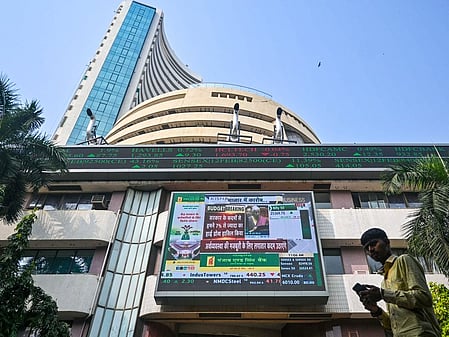
29 companies are scheduled to make their Indian stock-market debut, with eight listings on the mainboard and 21 on the SME platforms in the 2nd week of October, 2026
Dubai: The Indian stock market is having a difficult year, however its IPO market is telling a completely different story.
According to a recent Reuters report, the Nifty 50 posted its eighth consecutive weekly decline in the 1st week of October, extending its longest losing streak in 25 years. But on the other hand we saw companies continuing to tap investors for fresh capital via the stock market.
So while you have foreign investors who've pulled out close to $27.8 billion from Indian equities so far this year, the benchmark has delivered little in the way of gains.
Yet this week, 29 companies are scheduled to make their stock-market debut, with eight listings on the mainboard and 21 on the SME platforms. One would wonder why are so many companies deciding to go public amidst a weak market? Maybe the $4.2 billion raised through public offerings in September has enticed them enough.
The scale of activity highlights a growing divergence between India's primary and secondary equity markets.
Divergence in primary and secondary markets
Companies raised a record $25 billion through public equity markets during the first half of fiscal 2027, up about 75% from a year earlier, according to data cited by Reuters. At the same time, the Nifty 50 gained just 1.3% during the April-September period.
"The 29 listings this week should not be interpreted as 29 companies choosing to go public at the same time despite weak secondary-market performance," said Akshay Nair, chief investment officer at Century Financial.
"It is primarily a reflection of the exceptionally busy IPO pipeline in recent months," he said, adding that the current activity was being supported by strong domestic investor liquidity and accumulated demand for public capital.
A busy pipeline, not just a sudden rush
The listing surge follows a particularly strong September for India's primary market. According to Prime Database data, 34 companies raised about Rs39,340 crore ($4.1 billion) through IPOs during the month.
There is also a substantial pipeline ahead. A Reuters report shows that almost 250 companies are looking to raise a combined 4.65 trillion rupees, or about $48 billion, through IPOs.
The current activity reflects both companies seeking capital and a backlog of delayed offerings but more importantly a strong domestic demand.
"SEBI's extension of IPO approvals ran out on 30th September, and many firms rushed to launch before then," said Ranim Turfa, head of research and market analysis, MENA, at Tickmill.
"Primary markets focus on company-specific fundamentals and long-term prospects," Turfa said. "Secondary markets have reacted to macroeconomic pressures, foreign outflows, and volatility," she added.
Ranim Turfa- Head of Research & Market Analysis - MENA at Tickmill
Ross Maxwell, chief strategy officer at VT Markets, sees a similar supply-side component to the current wave.
"The current wave is predominantly a supply-side clearance of a swollen pipeline," he said.
Regulatory extensions granted earlier in the year allowed some companies to delay their offerings, Maxwell said, with the expiry of those extensions nearing many companies are accelerating their plans.
"While domestic demand remains supportive, the dense listing calendar, culminating in weeks with dozens of debuts, stems more from the need to execute pending plans than from a fresh surge in underlying market enthusiasm," he said.
The distinction is important because the large number of listings does not necessarily mean investors have suddenly become more bullish on Indian equities.
Ross Maxwell, Chief Strategy Officer, VT Markets
Domestic money is supporting the primary market
One of the factors helping companies raise money is the growing role of domestic investors.
Systematic investment plans, mutual funds and domestic institutional investors have created a relatively deep pool of local capital, reducing companies' reliance on foreign investors when accessing the equity market.
Nair said domestic institutions now account for about 33% of the money raised in IPOs, compared with 24% in 2021.
That has helped create a situation where foreign investors can sell existing stocks while companies continue to attract money through new share offerings.
Maxwell said foreign portfolio investors have also directed significant sums towards primary issuances even as they have recorded substantial outflows from the secondary market.
"The sheer volume of ready issuers has created concentrated listing clusters. This supply-side momentum continues independently of the broader index weakness," he said.
The IPO market is becoming more selective
The performance of individual listings shows why the broader IPO numbers do not tell the whole story.
Some recent offerings have attracted heavy demand and opened well above their issue prices, while others have struggled to gain traction after listing. The mixed performance is also visible in grey-market indicators ahead of this week's debuts, with some companies showing sizeable premiums and others indicating little or no premium.
That suggests investors are differentiating between individual companies rather than simply buying every new issue.
"Retail participation remains meaningful but has become more selective," Turfa said.
"Large pure offer-for-sale deals have sometimes drawn relatively muted retail bids compared with earlier periods," she said, pointing to greater caution among individual investors.
"Mixed post-listing performance across several large earlier offerings has tempered enthusiasm, leading to subdued bids in the retail category for some IPOs, even as institutional demand remains firm."
Overall subscription numbers can therefore remain strong even when individual investors are more hesitant, because institutional and high-net-worth demand can account for a significant portion of the buying.
A divergence worth watching
India's primary and secondary markets are therefore operating with different immediate dynamics.
The secondary market is being affected by foreign selling, higher global interest rates, geopolitical tensions and concerns over earnings. September alone saw foreign investors withdraw $2.7 billion from Indian equities, while the Nifty fell 6.1%, its steepest monthly decline since March.
The primary market, meanwhile, has continued to benefit from domestic liquidity, a large pipeline of companies seeking capital and investor demand for selected growth stories.
That does not mean the two markets are completely disconnected.
As listed valuations fall, IPO investors are becoming more sensitive to pricing. Companies with strong fundamentals and credible growth prospects can continue to attract capital, while those seeking aggressive valuations face a more demanding investor base.
Network Links
GN StoreAbout Gulf NewsTerms & ConditionsReach by GNSitemapContact usPrivacy PolicyGN FocusHave your sayWork with usAdvertise with usGulf News epaperPrinting Services
Download our app
© Al Nisr Publishing LLC 2026. All rights reserved.