"I am particularly encouraged by the focus on enhancing ease of doing business. The measures will not only strengthen India's position as a global economic powerhouse but also create new opportunities for collaboration between India and the UAE," says Dr. Dhananjay Datar, Chairman and Managing Director, Adil Group.
India’s 2025-26 Budget raises income tax ceiling, focuses on new jobs
India's middle class gets major boost through new income tax ceiling
Last updated:
5 MIN READ
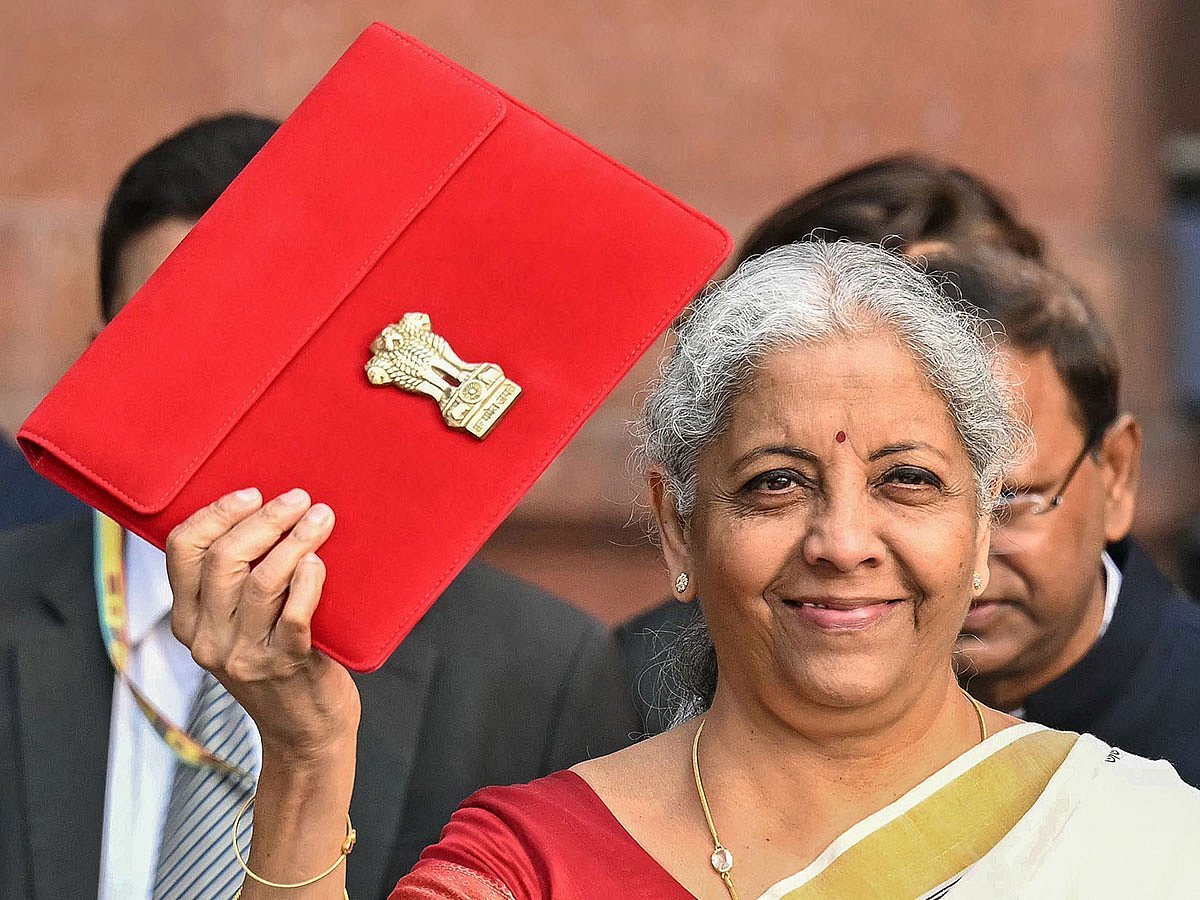
India's Finance Minister Nirmala Sitharaman has given extra attention to easier fund availability, job creation for youth, and agriculture in her latest budget.
AFP
Dubai: In a major tax reform, India has raised the no-income tax ceiling to Rs1.2 million from Rs700,000, the country's Finance Minister Nirmala Sitharaman has announced.
The market was expecting some sort of raising the no-tax ceiling, but pushing it to Rs1.2 million comes as a significant tax break.
Job creation is front and center
India is hoping to rev up higher growth and job creation with a budget that focuses on offering easier – and more - access to funds for small and mid-sized businesses as well as startups.
These will ‘generate employment for youth’ as MSMEs get better access to credit, said the Finance Minister, in a budget speech that focuses heavily on what the BJP-led government plans to do on adding new jobs.
More seats – up to 6,000 - will also be added to the 5 IITs (Indian Institute of technology) started after 2014, which was when the first Narendra Modi government assumed power. There will also be an expansion of India’s medical education sector.
New income tax bill
India will also be putting up a new income tax bill next week, in another push to incentivise consumer and business confidence. And by extension, for that to show up in higher growth chances for the Indian economy.
The decision to remove income tax for up to Rs1.2 million is a direct move to increase middle-class spending power
Adeeb Ahamed Managing Director of Lulu Financial Holdings
Prime Minister Narendra Modi addresses the media ahead of the Budget Session of Parliament, in New Delhi.
"What this means is a direct tax code to simply tax calculations and filing of returns through the new income tax bill," said Jeet Gianchandani, Managing Partner at the audit firm JCP. "By simplifying the tax system, it will encourage more people - particularly in India's Tier 2 and Tier 3 cities - to file tax returns.
"Except NRIs, most Indians will celebrate today."
From Rs250,000 to Rs1.2 million no tax
In 2014, the ‘nil tax’ slab was raised to Rs250,000, and then to Rs500,000 in 2019 and Rs700,000 in 2023.
"This is reflective of our Government’s trust on the middle-class tax payers," said the Minister. "I am now happy to announce that there will be no income tax payable up to income of Rs1.2 million - average income of Rs100,000 per month other than special rate income such as capital gains - under the new regime.
"This limit will be Rs1.275 million for salaried tax payers, due to standard deduction of RS75,000."
Changes to 'Tax Deduction at Source'
India is moving towards a more simplified tax reforms, according to FM Nirmala, which will also mean a reworks of the current 'Tax Deduction at Source (TDS) framework.
The (fiscal) deficit has been targeted at a lower level - from 4.8% to 4.4% - and shows discipline on part of Indian government in terms of increasing revenue and controlling expenditure
Jai Prakash Agarwal Vice-Chairman of ICAI Dubai Chapter
The number of rates and thresholds above which TDS is deducted will be reduced, according to the FM.
"Threshold amounts for tax deduction will be increased for better clarity and uniformity," said Nirmala Sitharaman. "The limit for tax deduction on interest for senior citizens is being doubled from the present Rs50,000 to Rs100,000.
"Similarly, the annual limit of Rs240,000 for TDS on rent is being increased to Rs600,000. This will reduce the number of transactions liable to TDS, thus benefitting small tax payers receiving small payments."
Tax Collection at Source
There are also changes to the Tax Collection at Source regime.
According to Adeeb Ahamed, Managing Director of Lulu Financial Holdings, "The decision to increase the TCS exemption limit for remittances - under the RBI’s Liberalised Remittance Scheme - from Rs700,000 to Rs1 million will provide relief to individuals sending money abroad, particularly for travel and investment purposes.
"The removal of TCS on remittances for education purposes when financed by an education loan is a positive step that will ease the financial burden on students studying abroad."
By simplifying the tax system, it will encourage more people - particularly in India's Tier 2 and Tier 3 cities - to file tax returns.
Jeet Gianchandani Managing Partner at JCP
Boost consumer spending
The FM is hoping quite a bit of pay-off from the changes on income tax slabs, in the form of higher consumer spending.
"While (India's) fiscal deficit would shrink further, the FM has provided a consumption boost by lowering tax rates for the middle-class," said Shiv Sehgal, President and Head, Nuvama Capital Markets.
"This is quite welcome."
Freelancer economy
In a nod to the growing presence of gig workers in the Indian economy, the government plans to issue identity cards to them as well as formally registering them, and ease their access to healthcare.
Ease of doing business
The Budget speech also emphasized the ease of doing business in India aspect. Again, on fairly expected lines, foreign direct investment in the insurance sector has been raised to 100% from the current 74% ceiling.
The budget introduces transfer pricing reforms, ensuring that benchmarking and arm’s length pricing will be determined for a 3-year period. This provides greater tax certainty to multinational companies and NRIs investing in India
Naveen Sharma Chairman of Taxation Society
India's stock markets has, for now, not viewed the latest budget with bullishness. The Sensex has trimmed some of the gains from yesterday (January 31). The impression is that investors were expecting the tax reforms to extend to the country's corporate tax framework as well. "From market standpoint, tax cuts for middle-class augurs well for consumption-oriented sectors, although capex support has been a bit moderate this time,” said Shiv Sehgal of Nuvama Capital Markets.
Sign up for the Daily Briefing
Get the latest news and updates straight to your inbox
Network Links
GN StoreAbout Gulf NewsTerms & ConditionsReach by GNSitemapContact usPrivacy PolicyGN FocusHave your sayWork with usAdvertise with usGulf News epaperPrinting Services
Download our app
© Al Nisr Publishing LLC 2026. All rights reserved.