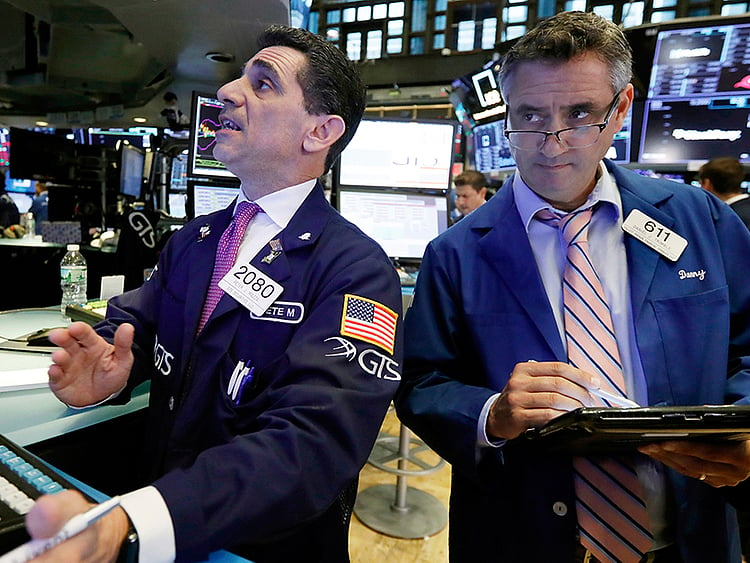
London: European stocks slumped to a 21-month low on Thursday after Wall Street’s worst losses in eight months triggered a surge of global selling that also hit Asia and emerging markets. Losses in London, Paris and Milan were at nearly 2 per cent ahead of what looked set to be another early dive from Wall Street, although it wasn’t quite as dramatic as the overnight session in Asia.
MSCI’s broadest index of Asian shares not including Japan ended down 3.6 per cent, having struck its lowest level since March 2017. China’s main indexes had slumped over 5 per cent. It meant MSCI’s 24-country emerging market index was having its worst day since early 2016, after Wall Street’s swoon had given the 47-country world index equivalent its worst day since February.
“Equity markets are locked in a sharp sell-off, with concern around how far yields will rise, warnings from the IMF about financial stability risks and continued trade tension all driving uncertainty,” summed up analysts at ANZ.
The sell-off, which came as the head of the International Monetary Fund, Christine Lagarde, said stock market valuations have been “extremely high”, erased hundreds of billions of dollars of global wealth.
Japan’s Nikkei ended down 3.9 per cent, its steepest daily drop since March. The broader Topix lost around $207 billion in market value, falling 3.5 per cent.
Shanghai’s drop was its most severe since February 2016 and left it at its lowest level since late 2014. Shares in Taiwan were even harder hit, losing 6.3 per cent. Seoul’s Kospi index dropped 3.8 per cent.
“I think what happened was that we were a maximum elevation of risk appetite and maximum valuation of (US) large caps and tech, so when you have that situation you are always vulnerable,” said UBP macro and FX strategist Koon Chow.
What’s next for US interest rates?
Sinking global shares had raised the stakes for US inflation figures which ended up coming in relatively tame.
High inflation would only stoke speculation of more aggressive rate hikes from the Federal Reserve — one of the things that has spooked markets. On Wall Street, the S&P500’s sharpest one-day fall since February on Tuesday (October 9) had wiped out around $850 billion as the S&P toppled over 3 per cent and the Nasdaq’s high-flying tech shares tumbled even more on fears of slowing demand.
Hawkish commentary from Fed policymakers triggered the sell- off in Treasuries last week and sent long-term yields to their highest in seven years. The surge made stocks look less attractive compared with bonds while also threatening to curb economic activity and profits.
“The rise in Treasury yields has been the primary catalyst for the sell-off in equities, since higher yields suggest a lower present value of future dividend streams, assuming an unchanged economic outlook,” said Steven Friedman, senior economist at BNP Paribas Asset Management.
“It is also possible that equity investors are growing concerned that the Federal Reserve’s projected rate path will choke off the expansion.”
Oil prices skidded in line with US equity markets, even though energy traders worried about shrinking Iranian supply from US sanctions and kept an eye on Hurricane Michael, which shut down some US Gulf of Mexico oil output. Brent crude fell 1.6 per cent to $81.75 a barrel. US crude dropped 1.5 per cent to $72.07.
Sign up for the Daily Briefing
Get the latest news and updates straight to your inbox
Network Links
GN StoreDownload our app
© Al Nisr Publishing LLC 2026. All rights reserved.