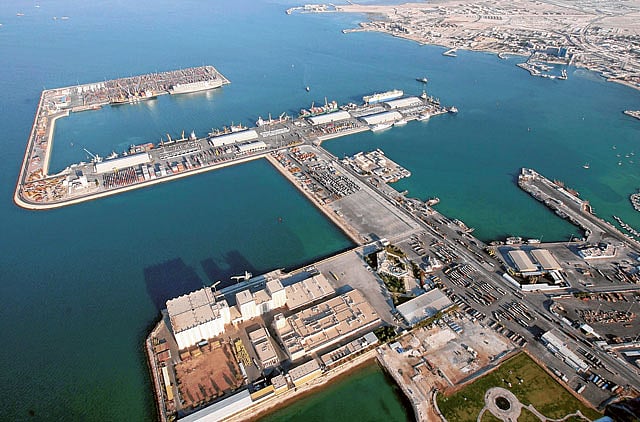
The Kuwait-based Arab Investment and Export Credit Guarantee Corporation has announced an ambitious outlook for trade by Arab countries in 2011. Recently published statistics put trade at $2.28 trillion (Dh8.36 trillion) in 2011, up by 20 per cent compared to 2010.
Exports accounted for $1.32 trillion and imports $960 billion. As such, the 22 Arab countries are projected to enjoy a combined trade surplus of $360 billion in 2011. Still, stronger trade activities pave the way to register notable growth in gross domestic product (GDP) of Arab economies by 4.2 per cent in nominal terms to $2.34 trillion in 2011.
Undoubtedly, it is not easy to dispute the corporation's conclusion by virtue of its being based on hard statistics, namely firm oil prices for 2011. Total oil output of Gulf Cooperation Council (GCC) countries plus that of Algeria, Iraq, Yemen, the Sudan and Libya is put at 21.6 million barrels per day in 2011. Of this, some 16.2 million barrels per day is destined for export.
Oil prices are projected to remain above the $100 per barrel level throughout 2011 on the back of complex issues including political uncertainty in oil-producing countries such as Libya together with firm global demand. By one account, oil prices could average around $107 per barrel in 2011.
Needless to say, the six-nation GCC grouping is critical for the economic wellbeing of the 22 Arab economies. Led by Saudi Arabia, the GCC countries are primary contributors to exports of Arab countries.
Largest exporter
In reality, Saudi Arabia is the largest exporter of crude oil worldwide. To be sure, Russia is the largest oil producer as it accounts for around 13 per cent of global oil production. Saudi Arabia follows suit with regards to oil output, but stands out in exports of oil.
In its turn, Qatar is the largest exporter of liquefied natural gas (LNG) in the world. The country's LNG capacity, almost entirely destined for export markets, amounts to 77 million tonnes per annum, up from 54 million tonnes in 2010.
Aside from exports, Arab countries suffer from the phenomenon of limited bilateral trade.
At the moment, inter-Arab trade is limited at best, hovering around 12 per cent of total trade of Arab countries.
Still, the utmost majority of this inter-Arab trade takes place among GCC states, and for good reasons. The reasons include steady implementation of integration schemes of GCC economies.
Reference is made to implementation of the customs union project starting in 2003. The agreement requires adoption of a common external trade policy with non-members.
Also, the GCC countries started the common market in 2008, which allows for unrestricted movement of factors of production within the six-nation grouping. Several factors explain the low level of trading among Arab countries including geography, which requires dependence on air rather than port logistics.
GCC carriers
Still, the air link among Arab countries is not necessarily frequent or direct. Nonetheless, GCC carriers, notably Emirates, Etihad, Air Arabia, Saudi Arabian Airlines, Qatar Airways and Kuwait Airways and Gulf Air deserve commendations for strengthening air links amongst Arab nations.
Strengthening trade activities is badly needed to meet the needs of the expanding Arab population from around 335 million in 2008 to 350 million in 2010 and still further to about 500 million by 2025 on the back of growth rate of 2.3 per cent per annum.
Clearly, all roads are leading to the Arab countries these days.
Dr Jasim Ali is a Member of Parliament in Bahrain.
Sign up for the Daily Briefing
Get the latest news and updates straight to your inbox
Network Links
GN StoreDownload our app
© Al Nisr Publishing LLC 2026. All rights reserved.