Motorcycles stand on display at a Harley Davidson motorcycle dealer in Amersfoort on March 13, 2025, as The European Union has announced tariffs on US goods in response to US tariffs on steel and aluminium.
OECD unemployment rate at 4.9% in July 2026, its lowest level in a year
Youth unemployment still more than double overall OECD rate despite decline
Last updated:
2 MIN READ
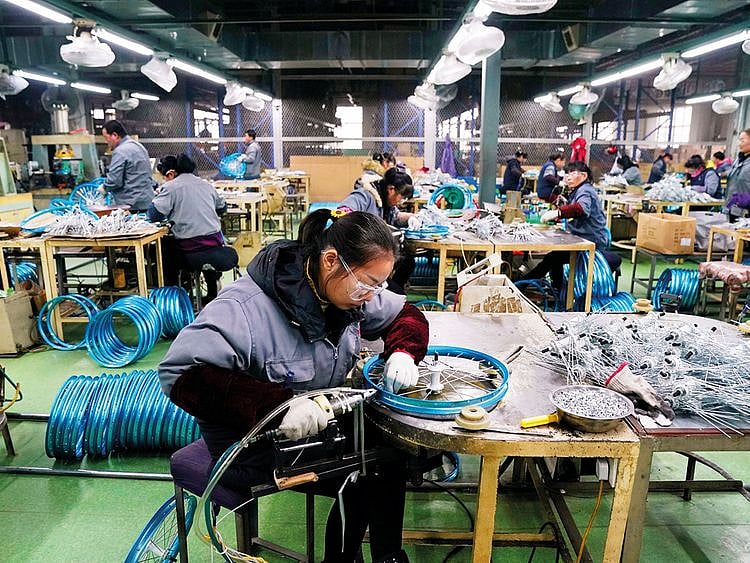
A bicycle production line in Kunshan, China. The OECD believes a sharper slowdown in China would have ‘significant adverse consequences for global growth and trade.’
Reuters
PARIS: The OECD unemployment rate reached 4.9% in July 2026, down from 5.0% in June and close to its historic low of 4.8% recorded in June 2023.
The number of unemployed individuals in the OECD fell to 34.7 million, the lowest level in a year.
In July 2026, unemployment rates remained steady at 6.1% in the European Union and 6.4% in the euro area. Japan, Mexico and Korea maintained unemployment rates below 3.0%, the lowest among OECD countries.
By contrast, Finland and Spain reported double-digit unemployment rates, with Finland nearly 5.0 percentage points (p.p.) above its historic low from almost two decades ago.
Compared with June 2026, unemployment rates remained broadly stable in July in most OECD countries (21 of the 33 OECD countries with available data). Similarly, among European Union OECD countries, unemployment rates remained broadly stable in 14 countries.
In July 2026, the OECD youth unemployment rate (aged 15-24) dipped by 0.2 p.p. to 11.0%. It was still markedly higher, by 6.8 p.p., than the rate for workers aged 25 and over which has stayed around 4.2% since February 2022.
Double-digit youth unemployment rates were recorded in 30 OECD countries, with rates exceeding 20% in Chile and seven OECD countries in the European Union.
The OECD unemployment rates for women and men remained stable in July at 5.1% and 4.8%, respectively, leaving the OECD unemployment gender gap unchanged at 0.3 p.p.
The gender gap was also stable, at 0.4 p.p., in both the European Union and the euro area. In the G7, it remained stable and negative, at -0.3 p.p.
Sign up for the Daily Briefing
Get the latest news and updates straight to your inbox
Network Links
GN StoreAbout Gulf NewsTerms & ConditionsReach by GNSitemapContact usPrivacy PolicyGN FocusHave your sayWork with usAdvertise with usGulf News epaperPrinting Services
Download our app
© Al Nisr Publishing LLC 2026. All rights reserved.