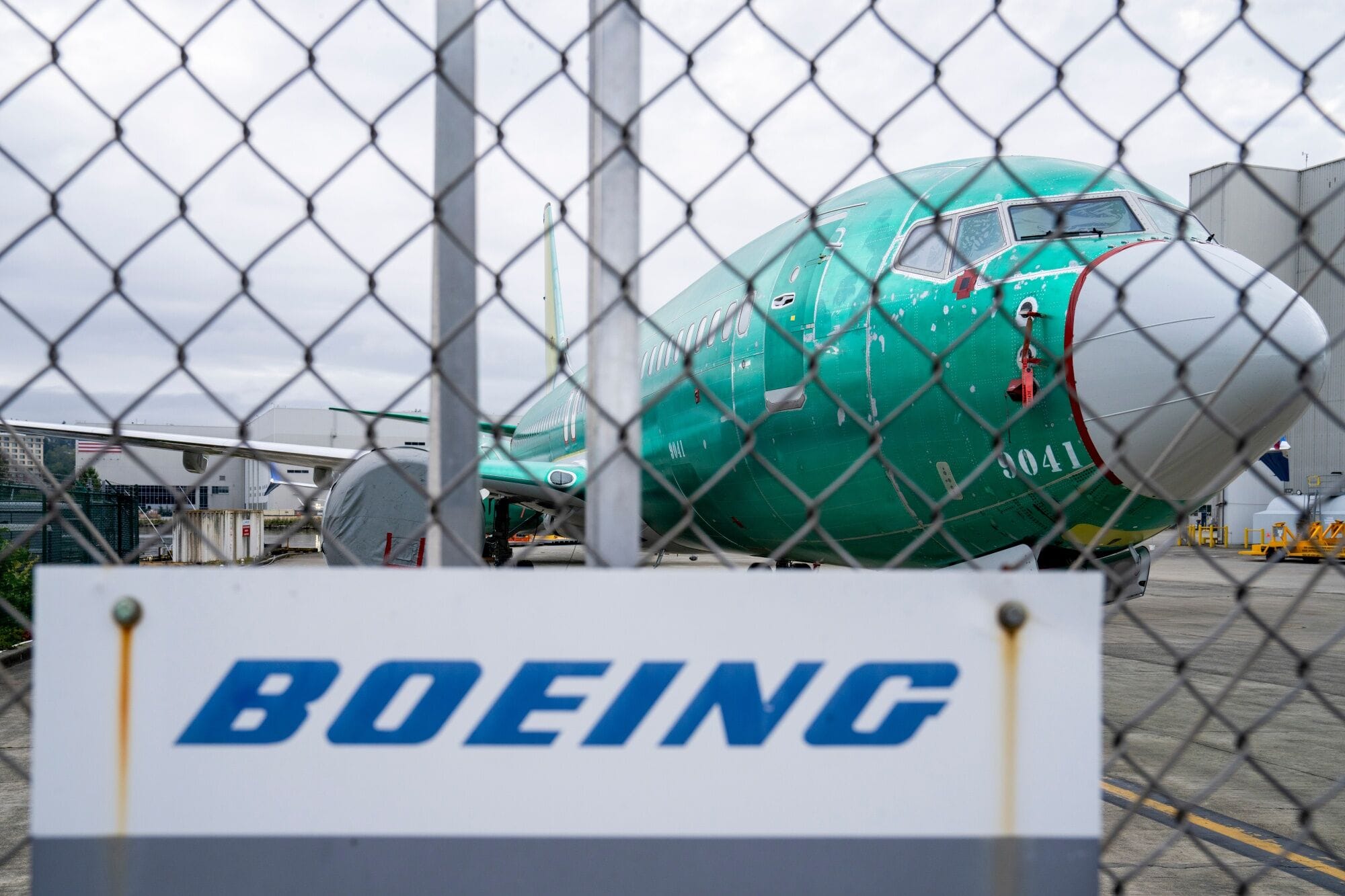
Boeing Co. Chief Executive Officer Kelly Ortberg said he's optimistic the company can return to a closely watched production target for its all-important 737 airliner this year, a key milestone to turning a corner after reporting its the second-worst annual loss in its history.
Barring any unforeseen setback, Ortberg hopes by midyear to boost output of its 737 aircraft beyond the 38-jet monthly pace capped by the Federal Aviation Administration a year ago as it delved into quality breakdowns.
"All those metrics are trending in the right direction for us to have a successful authorization to move beyond 38 a month," Ortberg said in an interview Tuesday. "I would say that overall, I'm pretty pleased with where we are."
The US planemaker's dismal fourth-quarter results, much of which it announced late last week, underscore the urgency for Ortberg to pull Boeing out of a six-year nose dive. The company burned through a total of $14.3 billion of free cash during a calamitous year marked by near-catastrophe on an airborne 737 Max, leadership turmoil, federal investigations and a lengthy worker strike.
The operating loss per share was $5.90 for the quarter, worse than the core loss of $3.07 that analysts had expected, according to data compiled by Bloomberg. For the year, the company lost $20.38 per share, one of the worst showings in its history, and Boeing's sixth straight annual deficit.
Boeing shares advanced as much as 6.8% in New York, the biggest intraday gain since July 2023, as investors gained confidence Ortberg is making progress in ramping up production of the top-selling 737 Max.
The planemaker has adjusted its factories and supplier base for higher production levels going forward, and is addressing money-losing defense programs, Ortberg said in a memo to employees earlier on Tuesday.
The CEO and Chief Financial Officer Brian West provided additional detail around the company's turnaround during a conference call later Tuesday. Ortberg told CNBC that the company expected to complete a few transactions this year, and said some were in advanced stages, although he didn't identify any assets that might be cut or sold.
The company also refrained from providing a financial outlook for the year.
For January, Boeing expects to deliver "in the upper 30s" of the its 737 aircraft, though some of those planes are coming out of inventory, Ortberg told CNBC. He expects an average production rate of about 38 of the jets for the year, and then to start increasing every six months after that.
The earnings put the spotlight on the troubled defense and space business, which racked up additional charges on programs including the mid-air refueling tanker and the new Air Force One presidential jet.
Among possible divestments is the Jeppesen navigation unit, which is attracting major aviation suppliers and private equity suitors and could fetch $6 billion to $8 billion for Boeing, people familiar with the talks have said.
The CEO faces a drawn-out recovery as he works to settle Boeing's factories back into the steady operating tempo that was the norm before two 737 Max crashes in 2018 and early 2019 and the Covid pandemic hammered suppliers. But new challenges loom as Ortberg works to shore up Boeing's quality controls and finances amid a leadership vacuum at the FAA and uncertainty over global trade under the Trump Administration.
After raising about $34 billion in debt and equity in 2024, the US manufacturer should have a cushion as it slogs through operational difficulties that span its commercial and defense portfolios. Boeing ended the year with $26.3 billion in cash and short-term securities after pre-paying $3.5 billion of debt that is due in May.
Ortberg reiterated that Boeing is prioritizing the health of its production system and ensuring that suppliers can support any step-ups in jetliner output. The US manufacturer returned to producing five of its widebody 787 Dreamliners per month in December, Ortberg said, a target it initially set for the end of 2023.
The earnings included almost $3 billion in charges, including a larger-than-expected $1.7 billion accounting loss for the defense, space and security business.
Company officials have completed deep dives into five fixed-price defense and space programs, and Boeing is now "more proactive and clear-eyed on the risks," Ortberg said.
Sign up for the Daily Briefing
Get the latest news and updates straight to your inbox
Network Links
GN StoreDownload our app
© Al Nisr Publishing LLC 2026. All rights reserved.