Iranian Armed Forces Chief of Staff Maj. Gen. Ali Abdollahi and IRGC Aerospace Force commander Brig. Gen. Majid Mousavi attended the unveiling. Tasnim neither identified the location of the "new" missile city, nor disclosed the number or types of weapons in the facility.
Iran's IRGC unveils 'new' underground ‘missile city’ amid war tensions
Guards' Space Force unveils 'new' IRGC missile city with ballistic, cruise weapons
Last updated:
3 MIN READ
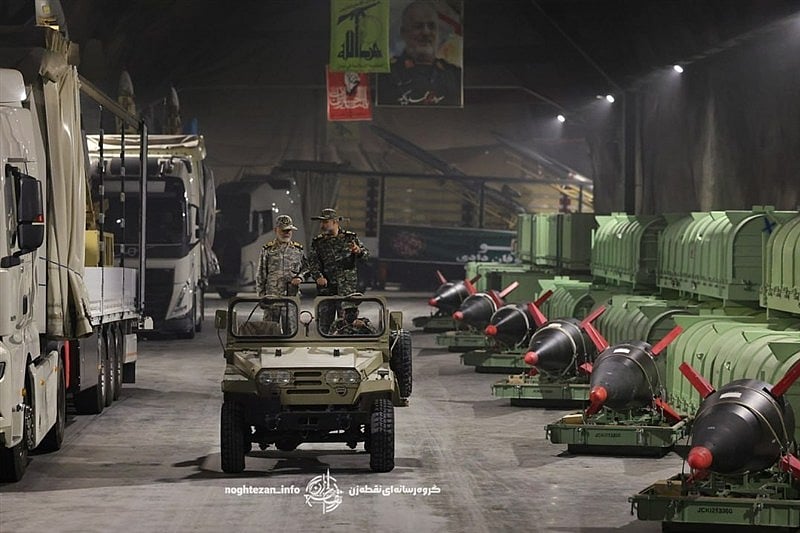
An undergound site that houses IRGC's “various ballistic and cruise missiles” and launchers in Iran.
Tasnim
Iran’s Islamic Revolutionary Guard Corps (IRGC) has unveiled what it describes as a "new" underground “missile city,” displaying ballistic and cruise missiles alongside their launch systems.
The IRGC-linked Tasnim News Agency published images of the facility on Tuesday, Nov. 10, during the force’s Aerospace Week.
Iranian Armed Forces Chief of Staff Maj. Gen. Ali Abdollahi and IRGC Aerospace Force commander Brig. Gen. Majid Mousavi attended the unveiling.
Tasnim said the site houses “various ballistic and cruise missiles,” as well as launchers, but did not identify its location, disclose the number or types of weapons, or provide independent evidence of the facility’s scale or operational status.
The announcement followed a pledge by IRGC spokesman Brig. Gen. Hossein Mohebbi that the Aerospace Force would reveal a new underground missile city and other military achievements during the week.
Get it: Fast, verified news for FREE ... download the Gulf News app — simply click here
Iran’s missile arsenal remains one of the central pillars of its military strategy.
It's unclear how many missiles remain under Iran's control or stored in its underground bunkers.
For years, the benchmark fior Iran's missile warchest figure was more than 3,000 ballistic missiles, based on a 2022 assessment by the US Central Command. Latest publicly-reported assessment puts Iran’s ballistic-missile stockpile at fewer than 2,000 missiles, following sustained US and Israeli attacks. Earlier this year, the Israeli military estimated that Iran had about 2,500 ballistic missiles, while reporting that Tehran was producing "dozens" of new missiles a month. A Reuters report, meanwhile, estimated Iran's missile inventory at roughly 1,000 to 1,500 functional missiles out of a pre-conflict baseline of about 2,500.
More significantly, up to 90% of Iran’s heavily fortified "missile cities" and tunnel storage sites are thought to remain partially or fully operational despite targeted airstrikes.
In terms of launcher availability, however, roughly 60% of Iran's missile and drone launchers remain intact or have been recovered from damaged site, CNN reported.
The exact numbers remain uncertain.
IRGC-linked Tasnim news agency published this photo showing a scene claimed to be inside the "new" missile city unveiled recently by Iranian Armed Forces Chief of Staff Maj. Gen. Ali Abdollahi and IRGC Aerospace Force commander Brig. Gen. Majid Mousavi.
Missile production moves underground
Mohebbi said Iran had moved missile and drone production lines from surface facilities into underground complexes, describing the sites as “missile production cities” rather than merely storage depots.
He argued that Iran’s domestic expertise, large territory and flexible infrastructure would allow weapons manufacturing to continue even under heavy bombardment.
The claim cannot be independently verified.
Outside reporting noted that the site’s status as “new” and its actual capabilities remain unconfirmed.
IRGC Aerospace Force commander Brig. Gen. Majid Mousavi said Iran had moved missile and drone production lines from surface facilities into underground complexes, describing the sites as “missile production cities” rather than merely storage depots.
Why it matters
The unveiling is part of Iran’s effort to demonstrate resilience and deterrence as the US maintains sanctions and a naval blockade.
It also signals Tehran’s intent to protect missile production from air strikes by dispersing and burying key facilities.
What’s next
IRGC commander Mousavi used the event to warn that Iran could strike enemy assets across and beyond the region if necessary.
The disclosure is likely to sharpen concerns about escalation, even as diplomatic and military pressure on Iran continues.
The IRGC Aerospace Force oversees Iran’s missile and drone programmes.
Underground facilities are central to Iran’s strategy of preserving launch and production capacity against potential attacks.
Network Links
GN StoreAbout Gulf NewsTerms & ConditionsReach by GNSitemapContact usPrivacy PolicyGN FocusHave your sayWork with usAdvertise with usGulf News epaperPrinting Services
Download our app
© Al Nisr Publishing LLC 2026. All rights reserved.