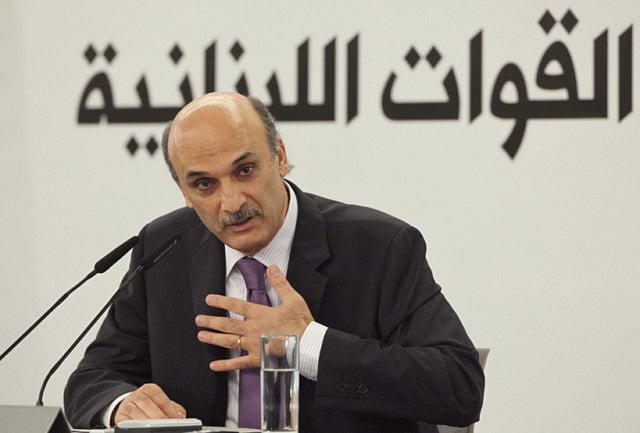
Beirut: In an effort to break the well-entrenched political impasse in contemporary Lebanese affairs, Samir Geagea, the head of the Lebanese Forces who is the March 14 candidate for the office of President, offered to quit the race to avoid a prolonged power vacuum.
A flurry of activities mobilised Maronite officials during the past 24 hours, with several seeking to find a way out of existential dilemmas, though few were optimistic that a solution might be reached before May 25, the day when President Michel Sulaiman is scheduled to leave office.
Former President Amin Gemayel continued his consultations and met with the head of the Marada Movement, Sulaiman Franjieh, after which he declared: “We must elect a president capable of confronting all challenges. This can only be achieved through understanding with each other [in order to] rescue the country.”
Franjieh, blunt and specific, chimed in that Gemayel was “overly optimistic,” adding that he could not see how parliament would actually hold the presidential election on time because of profound political divisions.
“We always say we are against a vacuum and we should work together to hold the election before May 25,” said Franjieh, before he added: “I am saying things as they are: Neither March 8 would elect a March 14 candidate, nor March 14 would elect a March 8 candidate.”
It was this reality that literally guaranteed Beirut headed towards a constitutional crisis, similar to developments that proceeded Sulaiman’s election in May 2008, when the office of president was left vacant for six months.
Undeterred by Franjieh’s pessimism, Gemayel also met with the head of the Progressive Socialist Party, Walid Junblatt, to determine whether the Druze chieftain would alter his backing of Henri Helou were he, Gemayel, to throw his hat in the ring.
Although nothing was leaked from the Thursday night meeting, it was noteworthy that it occurred over dinner in Gemayel’s Bikfaya residence, which was unusual given that such gatherings between Maronite and Druze officials were uncommon.
For his part, Geagea went to the Maronite Patriarchate Seat at Bkirki — which was also rare because of security considerations after various assassination attempts — where he met Cardinal Mar Besharah Butrus Rai, who quickly headed to Baabda Palace to consult with the president of the republic.
One assumed that Rai and Sulaiman assessed whether a common ground may finally be found to settle on a candidate acceptable to one and all, which was a vintage form of what passed for democracy in Lebanon.
Although neither revealed the substance of their discussions, Rai was unsuccessful in various past efforts to reconcile the four Maronite leaders — Geagea, Gemayel, Franjieh and General Michel Aoun.
According to the pro-Hezbollah daily Al Akhbar, high level contacts were apparently held between the party and senior Saudi officials, with Hezbollah allegedly telling Riyadh that its candidate for the presidency was the Free Patriotic Movement leader, Michel Aoun.
In turn, Saudi Arabia inquired whether Hezbollah wished to hold the elections or whether it preferred vacuum.
Notwithstanding the veracity of this report, which was promptly denied by Riyadh, Aoun refused to declare his candidacy unless Sa’ad Hariri’s Future Movement backed him while, ironically, Hezbollah refused to issue a public endorsement of the FPM leader.
Still, and irrespective of such behind-the-scenes conversations, what stood as a blatant contradiction was the perception that Geagea could not be a consensus candidate as he rejected the Hezbollah-led March 8 coalition charges that he was “a provocative candidate.”
Aoun, on the other hand, marketed himself as a compromise candidate even if not a single March 14 official, especially Christian deputies that belonged to the alliance, perceived him as such.
Although Geagea had previously said he would stay in the race until the end, he told reporters after meeting Cardinal Rai in Bkirki: “I am not a confrontational candidate,” and “will withdraw my candidacy for the presidential election if consensus is reached on another March 14 figure.”
It remained to be determined whether any March 14 candidate could fulfil Hezbollah’s chief criterion, namely that the successful individual needed to adopt the deep-rooted golden equation of “the people, the Army and the resistance” before he would even be considered.
It was difficult to foresee who could possibly meet this requirement.
Sign up for the Daily Briefing
Get the latest news and updates straight to your inbox
Network Links
GN StoreDownload our app
© Al Nisr Publishing LLC 2026. All rights reserved.