An English judge issued a scathing report Tuesday blaming dysfunctional management and a “complete failure at all levels” to protect babies at the hospital where neonatal nurse Lucy Letby was convicted of murdering seven babies.
Inquiry blasts UK hospital for failure to protect babies after nurse Lucy Letby convicted of 7 murders
Inquiry finds ‘complete failure’ to protect babies at Letby hospital
Last updated:
4 MIN READ
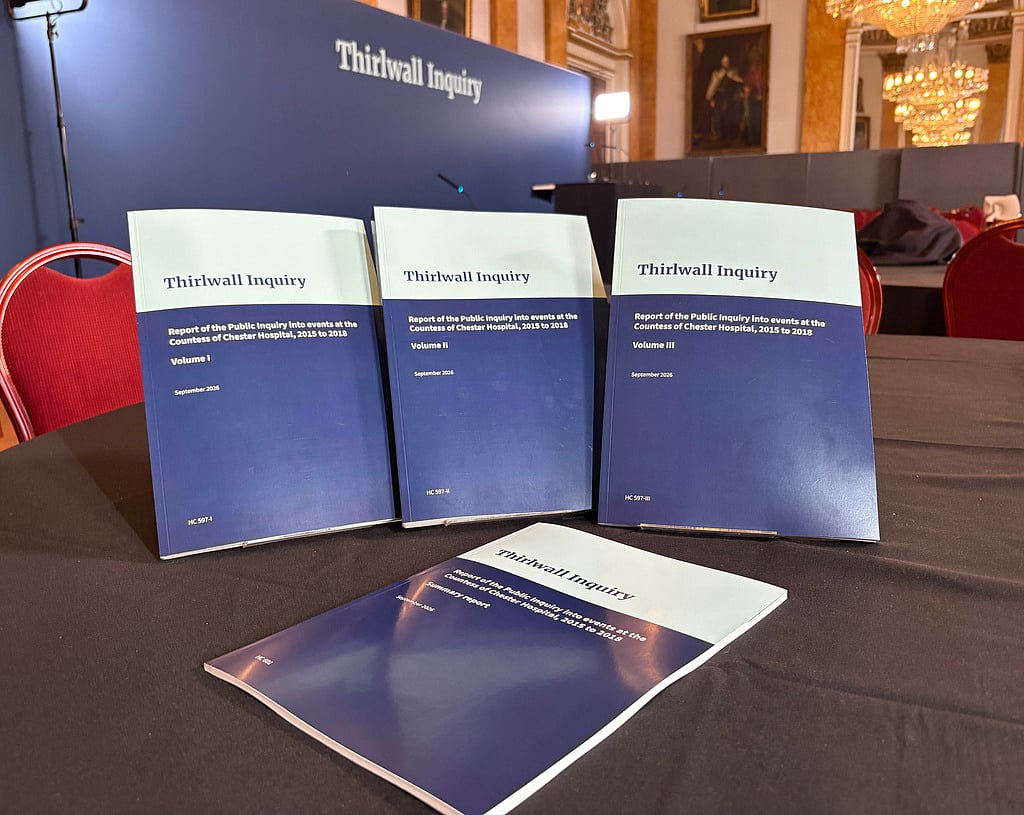
A view of Thirwall Inquiry reports displayed at Liverpool Town Hall ahead of the publication of the findings of a public inquiry into how Lucy Letby was able to repeatedly killed and harmed babies on a hospital neonatal unit in Liverpool, England, Tuesday Sept. 15, 2026. (Eleanor Barlow/PA via AP)
LONDON (AP) — An appeals court judge issued a scathing report Tuesday that found dysfunctional management and a “complete failure” to protect babies at the British hospital where neonatal nurse Lucy Letby was convicted of murdering seven newborns.
The inquiry into baby deaths found the Countess of Chester Hospital, in northwestern England, could have saved some infants if staff had acted sooner when children began collapsing, Justice Kathryn Thirlwall said.
Get it: Fast, verified news for FREE ... download the Gulf News app — simply click here
“Errors were made by nurses, doctors and managers,” Thirlwall said. “There was also complete failure at all levels to invoke safeguarding procedures at any point.”
Letby, 36, is serving a life sentence for the murders of seven babies and attempted killing of seven others. She has maintained her innocence, and a defense team backed by dozens of scientists who have questioned the evidence against her are seeking to clear her name.
Parents kept in the dark for years
Thirlwall’s inquiry didn't review Letby’s convictions, but looked at how institutional failures exposed babies to harm at the hospital, and how staff and management responded and treated parents.
“The anger some parents feel at the way they were treated by the Countess was palpable," she said. “They were kept in the dark for years about what was happening, about the fact that there were concerns that their babies may have been deliberately harmed.”
She focused on the failure of staff to take action when Letby was suspected of deliberately harming babies, saying it did not require certainty of her guilt to intervene.
“How many lives could have been saved had the hospital acted differently?” she said. “It is clear that some babies would have been saved and some attacks would have been prevented if action was taken earlier.”
Letby was convicted in 2023 of the murders of seven infants and attempted murders of six others — including two attempts on one child.
A case in which jurors couldn’t reach a decision was retried and Letby was convicted of another attempted murder.
She was sentenced to 15 life terms with no chance of release — only the fourth woman in the United Kingdom to receive such a term.
Concerns were kept quiet as babies fell ill
Prosecutors said that she harmed babies in ways that left little trace, including injecting air into their bloodstreams, administering air or milk into their stomachs via nasogastric tubes, poisoning them with insulin and interfering with breathing tubes.
She was the only employee on duty in the neonatal unit when the children collapsed or died between June 2015 and June 2016. Prosecutors described her as a “constant malevolent presence.”
Thirlwall’s report describes how numerous children were harmed, but concerns either weren't raised or suspicions weren't elevated to managers.
“The collapses and deaths continued," Thirlwall said.
Even once the hospital began to review a spike in infant mortality and connections to Letby's work shifts — and after the nurse had been placed on administrative duties in July 2016 — they didn't call police until May 2017.
Former CEO Tony Chambers denied stalling or obstructing a police investigation, but Thirlwall said, “that was precisely what he had done" for a year.
Letby remained at the hospital until her arrest in July 2018.
Health Secretary Yvette Cooper told Parliament she was disturbed by the “exercise in spin to steer away” police.
“That is an appalling finding,” Cooper said. "An exercise in spin instead of putting the safety of babies first.”
The government is reviewing the report's recommendations, though Cooper said officials are getting started on a suggestion to put cameras on cots in neonatal units.
Nurse's supporters challenge medical evidence
Lawyers for Letby tried unsuccessfully last year to halt the inquiry.
They claimed that if Letby is later found innocent, the inquiry would fail to fully understand what happened to the babies.
Defence attorney Mark McDonald said that the conclusions of the inquiry were tainted by errors made during the trial and by accepting that Letby intentionally killed the children.
“The alternative narrative identified by nearly 30 internationally-renowned experts has not been properly considered,” McDonald said.
“The inquiry would have been able to hear an alternative account — one that said that insulin results were unreliable, one that said the deaths did not stop when Lucy left the unit.”
Thirlwall said that she didn't consider the debate over Letby's guilt because the Court of Appeal had rejected her legal challenges “with a very clear result.”
Thirlwall said the people challenging the evidence hadn't been at the trial and she said “all of this noise” caused additional distress to parents “who have already suffered far too much.”
New evidence presented
McDonald has presented new evidence to the Criminal Cases Review Commission, or CCRC, which looks into possible injustices and could trigger another court challenge.
A review of the medical evidence used at trial by a panel of experts convened by McDonald found no sign of a crime and concluded that natural causes or bad medical care led to the demise of each of the newborns.
The group of international experts in neonatology and paediatrics found there were inadequate staffing levels, and medical workers lacked proper skills, misdiagnosed ailments and acted slowly in treating acutely ill babies.
Network Links
GN StoreAbout Gulf NewsTerms & ConditionsReach by GNSitemapContact usPrivacy PolicyGN FocusHave your sayWork with usAdvertise with usGulf News epaperPrinting Services
Download our app
© Al Nisr Publishing LLC 2026. All rights reserved.