Ahmed bin Ali Al Sayegh (right) being briefed about the AI-powered firefighting tools displayed at the forum in Dubai on Thursday.
UAE turns to AI to fight fires: Find out how it will save residents, firefighters and protect properties
New federal authority plans AI ambassadors and smarter firefighting tools with agentic AI
Last updated:
5 MIN READ
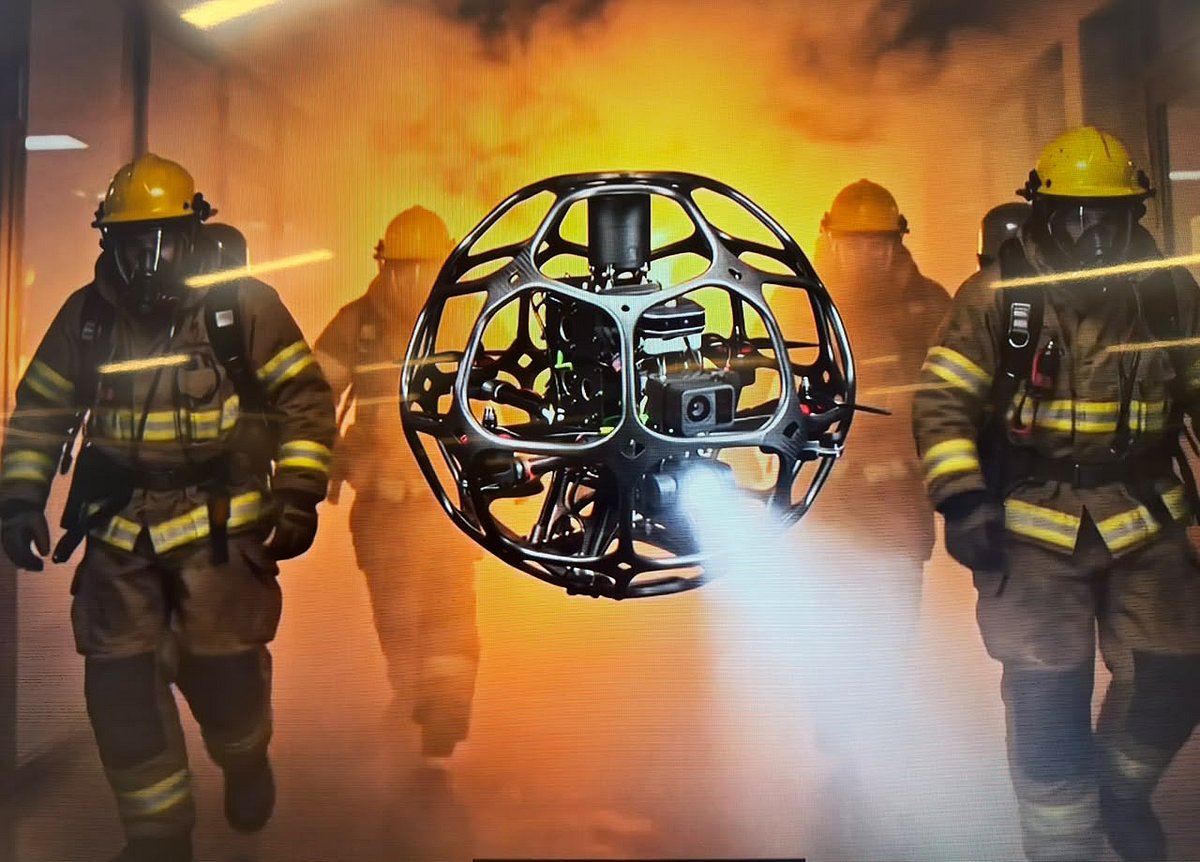
Three projects showcased at the forum offered a glimpse of what is coming: drones inside burning buildings, SOS wearables and rescue rovers
Sajila Saseendran/ Gulf News
Dubai: The UAE is turning to artificial intelligence (AI) to make firefighting and disaster response faster and safter, helping save lives and protect property, according to two top officials.
At the heart of the push is agentic AI, a form of AI that can act with a degree of independence. Major General Dr Jassim Mohammed Al Marzooqi, Director General of the Federal Authority for Ambulance and Civil Defence, said the new federal authority is transforming its operations around the technology.
"We are transforming our operations to use agentic AI, so we can improve protection and response," he told Gulf News.
Get updated faster and for FREE: Download the Gulf News app now - simply click here.
"We can reduce the number of fires and the number of casualties and fatalities,” he pointed out.
The official spoke on the sidelines of a specialised forum organised by the authority, and attended by Ahmed bin Ali Al Sayegh, Minister of Health and Prevention and Chairman of the authority, in Dubai on Thursday.
AI ambassadors
The forum announced the appointment of AI ambassadors to promote the responsible and effective adoption of artificial intelligence applications.
“Every civil defence directorate across the UAE will now have an AI ambassador,” revealed Al Marzooqi, who earlier presented a session on "Building readiness, leading the future."
Their role, he said, is "to go and search, find, test and share the best practices on how to use agentic AI to improve our services."
Mapping hotspots, forecasting fires
Prevention is also a big part of the picture. Once the technology is fed certain data, he said, it can map hotspots, so teams know which areas are high-risk and can be ready before an incident happens.
"Protection means you forecast accidents before they happen," he said.
The aim is not to change the role of firefighters but to back them. "We are trying to support him (firefighter) with more equipment, more technology, more artificial intelligence, so he can do his task more efficiently and with less risk to his own safety," Al Marzooqi said.
Major General Dr Jassim Mohammed Al Marzooqi during his presentation at the forum
He gave the example of a chemical accident with toxic fumes. "You cannot jeopardise the life of a firefighter by sending him to a place where you know he is going to be injured," he said. A robot with sensors can instead detect the fumes first and then help fight the fire. He added that drones and robots are already helping firefighters.
Saving people trapped inside buildings
Three projects showcased at the forum offered a glimpse of what is coming: drones inside burning buildings, SOS wearables and rescue rovers.
Kashif, being developed with Dubai Civil Defence and Dubai AI Campus, is a high-tech drone designed to operate inside a burning building before firefighters enter. It tackles three challenges: navigating without GPS, withstanding extreme temperatures, and locating and assessing trapped people.
Using multiple sensors, the drone builds a real-time 3D map of the building, pinpoints the location and source of the fire, and measures conditions such as oxygen and carbon monoxide levels.
Kashif uses millimetre-wave radar to detect trapped people and monitor their vital signs
Millimetre-wave radar uses high-frequency radio waves to detect trapped people and monitor their vital signs.
A carbon-fibre frame and thermal protection help it work in hazardous environments.
The data is transmitted to Dubai Civil Defence in real time, helping firefighters identify the safest route and reach trapped occupants more quickly.
Saving firefighters’ lives
Najda, a wrist-worn device, is designed to protect firefighters from heat stress and cardiac emergencies.
It monitors vital signs continuously, while AI sets a personalised baseline for each firefighter and flags abnormal readings. If a critical change occurs, it sends an SOS alert to the team leader.
The UAE is exploring wearable devices that send out SOS alert about heat stress and cardiac emergencies faced by firefighters
It can work without an internet connection, with alerts shown on a screen inside the fire truck.
It also sends data to headquarters when connectivity is available.
Search and rescue rovers and drones
Another project, Athar, is a search-and-rescue system for the first 72 hours after a building collapse, earthquake or similar emergency.
Small drones and hand-sized rovers locate trapped people and gather information from hazardous or inaccessible areas.
Its key innovation is an AI-enabled, self-forming communication network, in which each drone or rover acts as a relay when connectivity is weak. It can operate without GPS, Wi-Fi or existing communications infrastructure. Currently designed with three drones and three rovers, the system has the potential to scale up according to requirements.
A search and rescue system using rovers and drones was showcased at the forum
What happens next
Lieutenant Colonel Dr Essa Ahmed Al Mutawa, Director of the General Department of Artificial Intelligence and Assistant Commander-in-Chief for Smart Services at Dubai Civil Defence, told Gulf News that such technologies are being developed by local companies.
"They conducted some research and found gaps and challenges facing civil defence. They came up with proof-of-concept models for us to use to fill those gaps,” he explained.
He said the tools will go through further evaluation, then a pilot project, before being deployed in real-world operations.
Meanwhile, Al Marzooqi said the authority is piloting such technologies and investing in developing them, with teams working alongside universities and private companies.
Al Mutawa said the authority is open to more partners. "We welcome all companies that have ideas on how we can reduce fire incidents and save people," he said.
Network Links
GN StoreAbout Gulf NewsTerms & ConditionsReach by GNSitemapContact usPrivacy PolicyGN FocusHave your sayWork with usAdvertise with usGulf News epaperPrinting Services
Download our app
© Al Nisr Publishing LLC 2026. All rights reserved.