Abu Dhabi's new AI vehicle can spot accidents, fallen trees and faulty traffic lights
Mobile monitoring system helps authorities locate obstacles, respond to traffic incidents
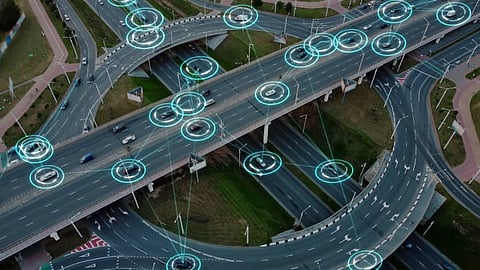
The battle for safer, smoother roads is no longer dependent solely on traffic patrols, surveillance cameras and reports submitted by road users. In Abu Dhabi, road monitoring is entering a new phase in which artificial intelligence is becoming an additional set of eyes operating continuously on the ground, looking for hazards before they turn into traffic congestion, accidents or a direct threat to road users’ safety.
This is the context behind the ‘V City’ project, developed and implemented by the UAE AI Alliance for government entities. The project uses an AI-equipped vehicle that travels across different areas of the Emirate of Abu Dhabi to detect, identify and locate situations that could affect traffic flow and road safety.
Get updated faster and for FREE: Download the Gulf News app now - simply click here.
Mohamed Al Amiri, an AI engineer at the company, said the vehicle can detect a range of challenges and hazards, including fallen trees blocking roads, unreported traffic accidents, malfunctioning traffic signals and obstacles that could disrupt traffic flow. The information is then relayed to the relevant authorities, enabling them to identify the locations of such incidents and respond in a timely manner.
‘V City’ powered by AI
The UAE AI Alliance is developing and implementing a range of projects for government entities, including the ‘V City’ project, which relies on an AI-equipped vehicle travelling through different parts of Abu Dhabi to detect, identify and locate situations that could affect traffic movement and road safety.
This is where the project’s significance lies: its core value is not simply in ‘detecting’ an object or an accident on the road, but in transforming what is observed in the field into data that can be analyzed and used for decision-making and response.
From reporting to detection
Traditionally, dealing with a road problem may begin with a report from a driver, its detection by a patrol, or identification through surveillance cameras. The model represented by ‘V City’ adds another layer: the vehicle itself becomes part of the field-sensing network.
This shift is particularly important in large cities because a problem may not necessarily be a major accident requiring an immediate report. It could be a tree that has fallen across part of a road, a traffic signal that has stopped working, a foreign object in a lane, or a minor accident that no one has yet noticed.
In such cases, the speed at which a problem is detected becomes as critical as the speed at which it is resolved. Every additional minute that an obstruction remains on a busy road can increase the likelihood of slowing traffic, sudden lane changes or secondary accidents.
The use of AI, therefore, is not aimed solely at reducing response times, but also at shortening the interval between the emergence of a hazard, its detection and the decision on how to address it.
Why does Abu Dhabi need such systems?
The figures provide a broader perspective on the project. According to data from the Integrated Transport Centre, the economic cost of road accidents in Abu Dhabi reached approximately Dh5.26 billion in 2025, highlighting that road safety is not merely a security and humanitarian issue, but an economic one as well.
The emirate also recorded an improvement in road fatality indicators during the same year, with the fatality rate falling to 3.11 deaths per 100,000 people, compared with 3.41 in 2024.
Road safety indicators for 2021–2025 also showed a 33 per cent decline in fatalities and an 18 per cent reduction in serious injuries. Abu Dhabi is targeting a 50 per cent reduction in road deaths by 2030, with the ultimate goal of achieving zero road fatalities by 2040.
But these achievements do not mean the mission is over. Rather, declining fatalities raise the bar for the next phase: How can accidents be prevented before they happen?
This is where AI becomes different from traditional monitoring tools. It can move beyond analysing what has already happened to identifying patterns and indicators of potential risk.
A vast smart network: 1,500 cameras, 253 vehicle sensors and 922 traffic signals
The ‘V City’ project does not operate in a technological vacuum. It forms part of an Abu Dhabi traffic-management ecosystem that already uses advanced levels of sensing and data analysis.
During the Abu Dhabi Infrastructure Summit 2026, the Integrated Transport Centre unveiled the emirate’s Central Traffic Management Platform, which uses AI for automated, real-time monitoring of accidents, congestion and events.
The system is integrated with more than 1,500 surveillance cameras, 253 vehicle sensors and 922 traffic signals. Big data from more than 30 sources is analyzed to activate response plans automatically, while information is communicated to road users through 122 electronic message boards distributed across the road network.
These figures point to a clear direction: Abu Dhabi is not building a single AI system for its roads. Rather, it is creating an integrated digital layer connecting sensing, analysis, decision-making and response.
Against this backdrop, the ‘V City’ vehicle can be viewed as a mobile extension of this ecosystem. A fixed camera monitors a specific location, while a vehicle travelling across different areas can expand the field-monitoring footprint and reach places that may not be under direct surveillance at any given moment.
The value of AI: from ‘seeing’ to ‘understanding’
The real value of AI in such applications does not lie simply in filming the road. A camera can capture an image, but an intelligent system can — depending on its design and the data available to it — classify what appears in the image, identify its location, relate it to the traffic context and send an alert to the relevant authority.
This is the transition from vision to understanding... For example, if the vehicle detects a tree that has fallen into a traffic lane, the operational value is not merely the recording of an image. It lies in identifying the object as a potential obstruction, determining its location and transmitting the information to the relevant authority.
The same applies to an unreported accident, a malfunctioning traffic signal or any other obstruction that could disrupt traffic. In this way, the vehicle effectively becomes a mobile sensor for the city.
The most important asset: accumulated data
If the project expands in the future, its greatest value may not lie in individual alerts, but in the accumulated data generated through thousands of journeys.
If the locations, types and timing of recurring obstructions are recorded, as well as the roads where problems repeatedly occur, authorities could move beyond treating individual incidents to analysing their underlying causes.
Data analysis could, for example, reveal that a particular type of hazard occurs repeatedly in a specific area, that certain obstructions appear at particular times, or that certain locations require a permanent engineering intervention rather than repeated temporary fixes.
This is the difference between AI as a monitoring tool and AI as a decision-making tool.
The first says: ‘There is a problem.’
The second could, when sufficient data and appropriate models are available, address the more important question: ‘Why does the problem keep occurring, and where and when is it most likely to happen again?’
AI is redefining response
One of the most important benefits of this model is its potential to reduce the time between detecting a problem and responding to it.
In cities with high traffic volumes, the efficiency of road management is not measured only by the number of accidents dealt with. It is also measured by the number of accidents prevented, the amount of time saved for road users and the ability to prevent a minor problem from developing into a larger traffic crisis.
Abu Dhabi already has experience in using technology to manage road-related risks. Previous initiatives by Abu Dhabi Police demonstrated the ability of smart systems to achieve significant results in dealing with changing weather conditions, including recording zero fatalities and zero major accidents in specific circumstances following the implementation of a driver-alert system between 2018 and 2023.
In January 2026, Abu Dhabi Police also signed a memorandum of understanding with Space42 to develop security systems, autonomous mobility vehicles and road-safety solutions based on AI and autonomous mobility.
Speaking on the sidelines of AI Everything Abu Dhabi 2026, Mohamed Al Amiri, an AI engineer at the UAE AI Alliance, said the company’s projects aim to deliver fast and effective solutions by leveraging advanced technologies.
Al Amiri said the vehicle used in the ‘V City’ project can detect a range of challenges and hazards, including fallen trees on roads, unreported traffic accidents, malfunctioning traffic signals and other obstacles that could disrupt traffic flow.
He noted that the project enables such situations to be detected rapidly and the information transmitted to the relevant authorities, helping them identify their locations, address them and take the appropriate action at the right time.
Risk analysis and forecasting traffic challenges
In parallel, the Integrated Transport Centre is developing AI-based systems to analyze risks and forecast traffic challenges.
Taken together, these initiatives indicate that ‘V City’ is not an isolated project. Rather, it forms part of a broader transformation in the philosophy of transport management in Abu Dhabi.
The economics of AI on the roads
There is also an important economic dimension. Every accident prevented potentially means avoiding part of the costs associated with repairs, insurance, emergency response, congestion and lost working hours, in addition to the human cost that cannot be reduced to a financial figure.
When the economic cost of accidents in the emirate exceeds Dh5 billion a year, investments in technologies capable of reducing risks could generate returns that extend well beyond the transport sector.
The success of a project such as ‘V City’, therefore, should not be measured simply by the number of incidents detected by the vehicles. More meaningful indicators could include:
The average time between detecting an incident and notifying the relevant authority.
The average time between notification and resolution.
The number of incidents detected before a public report is received.
The reduction in the time road obstructions remain in place.
The number of secondary accidents associated with obstructions or undetected incidents.
The accuracy of the AI system in classifying incidents.
The reduction in the need for repeated field interventions.
Improvements in traffic flow following the resolution of detected incidents.
Ultimately, these indicators will determine whether the project is simply another new technology or a tool delivering a measurable impact on quality of life, safety and the economy.
The next challenge: expanding the scope of ‘proactive’ action
Abu Dhabi has set itself a more ambitious goal than simply digitising services.
The Abu Dhabi Digital Government Strategy 2025–2027 announced an investment of Dh13 billion in digital transformation, with a target of implementing more than 200 innovative AI solutions in government services and achieving 100 per cent digitization and automation of government processes.
By 2027, the emirate aims to become the world’s first government to comprehensively embed AI across its government operations.
In September 2025, the Department of Government Enablement announced that Abu Dhabi had deployed more than 100 AI use cases across more than 40 government entities, moving from experimentation to large-scale deployment.
Against this backdrop, ‘V City’ represents a practical example of what a proactive government could mean on the ground.
Instead of waiting for a phone call reporting that a tree has fallen, a traffic signal has malfunctioned or an accident has occurred, the system itself becomes capable of looking for the problem.
From the smart city to the city that ‘senses itself’
Perhaps the most significant development represented by these projects is the changing definition of the smart city itself.
In its first phase, a smart city was one that used cameras, sensors and digital systems to collect information.
An AI-enabled city, by contrast, is moving towards becoming a city that senses what is happening within it, understands the data, identifies priorities and helps authorities act before a problem escalates.
From this perspective, the ‘V City’ vehicle represents an idea that extends beyond the vehicle itself.
It is a model of a ‘mobile eye’ that can help the city see everyday details that people may not notice or cannot monitor continuously.
For an emirate whose geographical scope encompasses Abu Dhabi city, Al Ain and Al Dhafra, and which has an extensive and diverse road network, such technologies could play an important role in expanding field monitoring and connecting data with government response.
Conclusion: AI is not only driving the vehicle — it is driving the decision
The real story behind ‘V City’ is not simply that a vehicle equipped with cameras and AI technologies is travelling through the streets of Abu Dhabi.
The more important development is that the vehicle can become part of a new cycle of city management:
Detection → identification → analysis → alert → response → learning from data.
This cycle has the potential to shift road management from a model that relies heavily on detecting problems after they occur to one that is increasingly proactive.
In a city targeting a 50 per cent reduction in road fatalities by 2030 and zero road deaths by 2040, every technology capable of detecting hazards early should be measured not by the number of images it captures, but by the number of risks it helps prevent.
The real future of AI on Abu Dhabi’s roads may therefore not lie simply in seeing what is happening, but in helping authorities determine what requires intervention first, where, when and why.
That is where data becomes more than information — it becomes government value.
And AI becomes more than a monitoring technology. It becomes a partner in decision-making.
The road, in turn, evolves from a space that is merely monitored into an intelligent system increasingly capable of sensing risks before they reach its users.


